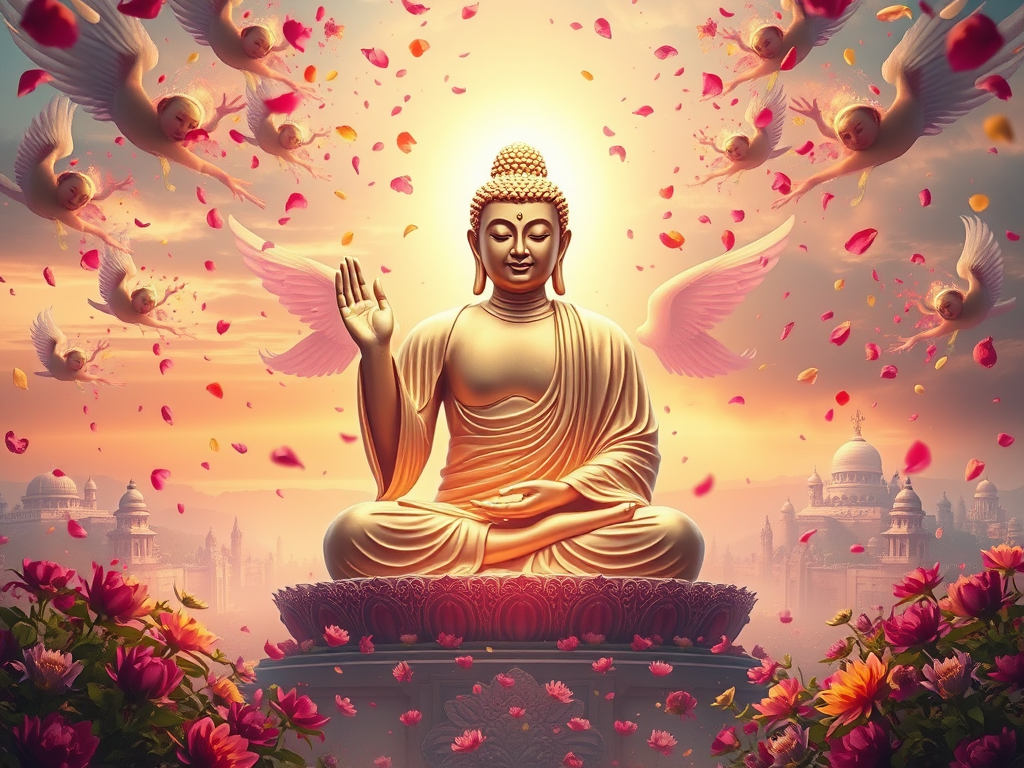
The Lotus Sutra stands as a cornerstone of Mahayana Buddhism, deeply revered across various East Asian Buddhist traditions. Many consider it to encapsulate the ultimate and complete teachings of Shakyamuni Buddha, offering a path to salvation for all. Its narratives and parables present a transformative perspective on the Buddhist path and the very essence of the Buddha. Chapter Seven of this influential scripture, often referred to as the “Parable of the Phantom City,” employs the allegory of travelers and a magically conjured city to elucidate fundamental Buddhist principles. This chapter conveys that the provisional teachings serve as a temporary respite, akin to a phantom city, while the ultimate destination, the true treasure land, represents the attainment of enlightenment. Within this context, the Lotus Sutra recounts the enlightenment of an ancient Buddha named Great-Universal-Wisdom-Excellence. This Buddha achieved awakening after an extended period of meditation spanning ten small kalpas. The passage in question describes the joyous reaction of celestial beings to this momentous event, as they rained down heavenly flowers upon the area [User Query]. This report aims to conduct a thorough examination of the cosmological, symbolic, and narrative significance embedded within this description of Great-Universal-Wisdom-Excellence Buddha’s enlightenment.
The narrative’s placement within the “Parable of the Phantom City” suggests that the detailed descriptions of enlightenment, including the grand cosmic events, might function as skillful means to guide practitioners toward a more profound understanding of ultimate reality. The apparent contrast between these seemingly fantastical occurrences and the core Buddhist message of impermanence and the path to liberation warrants careful consideration. The sheer scale of time and space invoked in the narrative, featuring an ancient Buddha, immeasurable kalpas, and a hundred yojanas, serves to underscore the vastness of the Buddhist cosmos and the protracted journey often required to achieve Buddhahood. This immense scale can inspire a sense of awe and highlight the long-term commitment intrinsic to spiritual practice.
In the context of this auspicious event, the text mentions the “Brahman-heavenly-kings.” Within Mahayana Buddhism, these beings are recognized as high spiritual entities holding a distinguished position within the assembly of Buddhas. In Buddhist cosmology, Brahma is considered a leading God (deva) and a heavenly king. These figures are often regarded as protectors of the Dharma, the teachings of Buddhism. They are typically associated with the Brahmaloka, one of the highest realms within the Buddhist cosmology. The term “Brahma” in Buddhist texts can broadly refer to any of the deities residing in the realms of form (Rūpadhātu) and the formless realms (Ārūpyadhātu). It is important to note that the Buddhist understanding of Brahma differs from the Hindu creator god, often depicted as being of lesser importance than the Buddha.
A significant figure among these is Brahma Sahampati, who is known for appearing before the Buddha after his enlightenment and beseeching him to teach the Dharma to humanity. The Brahman-heavenly-kings attain their elevated status through virtuous actions, sincere offerings, and the transfer of merit to the Dharma realm. They actively participate in the teachings of the Buddha, often serving as guides, protectors, and devoted worshippers within the higher realms of existence. These celestial beings are frequently part of the audience in Mahayana sutras, including the Lotus Sutra. Their act of showering heavenly flowers upon the Buddha Great-Universal-Wisdom-Excellence is a significant gesture. In Buddhist literature and art, the act of showering flowers is associated with miraculous events and the unconditioned power of manifestation. Celestial flowers themselves symbolize beauty, purity, and spiritual joy, serving as divine offerings to honor the Bodhisattva and the Buddha, particularly during pivotal spiritual moments. This act by the Brahman-heavenly-kings signifies their deep reverence and celebration of the Buddha’s awakening. It can also be interpreted as a bestowal of divine blessings and an indication of auspiciousness. Notably, the showering of fragrant water by heavenly kings is also mentioned in accounts of the historical Buddha’s birth. The presence of Brahman-heavenly-kings, who might be perceived as powerful deities in other contexts, paying homage to a Buddha underscores the supreme status of enlightenment within Buddhist cosmology. Even beings in higher realms recognize the profound significance of Buddhahood. The Buddhist perspective often reinterprets existing Vedic deities, placing them within the cycle of samsara and in a position subordinate to the Buddha, who has transcended this cycle. Their reverence highlights the universal benefit derived from a Buddha’s enlightenment. Furthermore, the act of showering flowers by these celestial beings can be viewed as a symbolic representation of the joy and auspiciousness that permeates the cosmos upon the attainment of enlightenment. It signifies the transformative power of this event, extending beyond the individual to encompass all beings. Flowers in Buddhist symbolism frequently represent purity, beauty, and spiritual awakening. The fragrant winds mentioned in the user’s query, though not explicitly detailed in this section, further contribute to the sense of a spiritually charged and auspicious atmosphere.
The passage also refers to a distance of “hundred yojanas” and a time period of “ten small kalpas.” The yojana is an ancient Indian unit of distance, and its exact equivalent in modern measurements is subject to variation. Estimates range from approximately 3.5 to 15 kilometers, or about 7 to 9 miles. Some sources suggest it represents the distance that a royal army or an ox-cart could travel in a single day. Different texts and traditions offer differing lengths for this unit of measurement. For instance, in the Abhidharma teachings, one yojana is equivalent to 16,000 cubits, approximately 7.4 kilometers, while in the Kalachakra tantra, it is 32,000 cubits, around 14.8 kilometers. The Arthashastra provides a conversion of 1 yojana to 12.8 kilometers, or 16 kilometers in ancient Cambodia. Even ancient astronomers like Aryabhata I and Bhaskara I estimated it to be roughly 7.5 miles.
A kalpa, in Buddhist cosmology, denotes an exceptionally long period of time, often described as an aeon related to the lifespan of a universe. There are various perspectives on the precise duration of a kalpa. A small kalpa, also known as an antara-kalpa, is frequently represented as 16,800,000 years, or approximately 16 million years. However, some sources indicate that a small kalpa comprises 1000 regular kalpas, amounting to about 16.8 billion years. In Mahayana Buddhism, a small kalpa is sometimes defined as 139,600 years, with a Mahakalpa consisting of four incalculable periods, each lasting twenty such small kalpas. A Mahakalpa is also described as being composed of eighty small kalpas. Small kalpas are characterized by cyclical patterns of increase and decrease in human lifespan. These vast temporal and spatial scales underscore the extraordinary nature of a Buddha’s achievement, requiring eons of dedicated practice and affecting immense cosmic distances. The extended duration of a kalpa can even lead beings like Brahma to mistakenly believe in the permanence of their existence. The concept of kalpas also illustrates the cyclical nature of the universe within Buddhist cosmology. The lack of a definitive, universally accepted measurement for “yojana” and “small kalpa” suggests that these terms might function more symbolically within the text, emphasizing vastness and immeasurable qualities rather than precise distances and durations. The wide range of estimates for a yojana indicates that its exact value was likely not crucial to the narrative’s message. Similarly, the different lengths attributed to a small kalpa across various Buddhist traditions point towards the concept of an incredibly long time rather than a specific number of years. The description of the cyclical changes within a small kalpa highlights the impermanent nature of even seemingly long periods and the continuous flux within the cosmos, reinforcing the core Buddhist teaching on impermanence (anicca).
The symbolism of heavenly flowers in Buddhist literature and art is rich and multifaceted. Flowers (Pushpa) generally signify “flower” or “blossom”. The act of showering flowers is linked to miraculous occurrences and the unconditioned magical power of manifestation. In Mahayana Buddhism, Bodhisattvas showering flowers often highlights the wondrous and transformative nature of enlightened beings. Within Tibetan Buddhism, flowers are associated with peaceful deities and the journey towards enlightenment. They can represent purity, beauty, spiritual joy, and divine offerings. These floral offerings are used to honor the Bodhisattva and the Buddha, particularly during significant spiritual events. Celestial flowers can also symbolize blessings and auspiciousness. Even the birth of the historical Buddha is associated with celestial maidens and heavenly kings showering fragrant water and flowers. Fragrant winds (Gandha) also carry symbolic significance in Buddhist texts. They are associated with offerings and worship in Mahayana Buddhism. Fragrances are used in the worship of the Bhagavān alongside flowers and other offerings. Gandhā is also the name of a peaceful deity in Tibetan Buddhism, suggesting a connection to fragrance. Smell (Gandha) is recognized as one of the twelve sense spheres in Buddhist philosophy. Fragrant winds can be interpreted as a sign of reverence and a manifestation of a spiritually charged atmosphere surrounding the profound event of enlightenment. The combined imagery of heavenly flowers and fragrant winds creates a sensory experience of purity, joy, and auspiciousness associated with the profound event of enlightenment. This appeals to both visual and olfactory senses, enhancing the impact of the narrative. The use of sensory details like flowers and fragrance helps to convey the extraordinary nature of the event. These elements are traditionally associated with divine realms and auspicious occasions, signaling the immense spiritual significance of the Buddha’s awakening. Furthermore, the contrast between the withered flowers being blown away by fragrant winds and the continuous rain of new flowers suggests a perpetual cycle of renewal and the enduring nature of the Dharma that arises from enlightenment. The impermanence of the withered flowers highlights the transient nature of the mundane world, while the constant raining down of new flowers symbolizes the ever-present potential for spiritual growth and the continuous flow of blessings that emanate from enlightenment.
The number “hundred” also carries symbolic weight in Buddhist thought. It can symbolize a distinct quantity, often understood in relation to larger numbers like “a thousand”. In Tibetan Buddhism, it signifies a process that relies on previously understood quantities. In some contexts, such as the “hundred syllable mantra,” it may not represent a literal count but rather a class or category. The number “hundred” appears in various Buddhist texts, sometimes with specific significance, such as the hundred chief ministers mentioned in the context of Great-Universal-Wisdom-Excellence Buddha , and at other times seemingly as a general expression for a large, indeterminate quantity. Given the varying definitions of a yojana, “hundred yojanas” likely serves to convey the widespread impact of the enlightenment event, suggesting that the blessings and joy extended across a considerable and comprehensive area. While a literal interpretation is difficult due to the varying definitions of a yojana, the symbolic use of “hundred” to denote completeness or a large quantity is common. In this context, it emphasizes that the positive effects of the Buddha’s enlightenment were not localized but radiated outwards significantly. The juxtaposition of precise numbers, such as ten small kalpas, with less defined quantities, like hundred yojanas, might reflect different levels of emphasis within the narrative. The specific duration of meditation is highlighted as a key element leading to enlightenment, while the resulting impact is described in more general terms of vastness.
The passage further describes gods from innumerable other worlds coming to offer homage and give up their pleasures after the Buddha’s enlightenment. Making offerings is a fundamental Buddhist practice that aids in eliminating attachment and accumulating positive karma. These offerings serve as expressions of appreciation and deep devotion to the Buddha and other enlightened beings. While Buddhas themselves do not require these offerings, the act is profoundly beneficial for the practitioner, fostering generosity and detachment from material possessions. Offerings can take various forms, both material, such as flowers, incense, and water, and the offering of one’s own spiritual practice. Importantly, making offerings to the Buddha is also understood as an offering to one’s own inherent Buddha nature. The gods relinquishing their pleasures to make these offerings signifies their profound recognition of the supreme value of enlightenment over the transient enjoyments of the worldly realms. This act demonstrates the universal appeal and transformative power of the Buddha’s awakening, attracting beings from across the vast expanse of the cosmos. The act of offering by deities is also mentioned in other Buddhist narratives. The arrival of gods from countless other worlds underscores the idea that a Buddha’s enlightenment is not an isolated event but has far-reaching repercussions throughout the entire Buddhist cosmology, drawing beings who recognize its immense significance. This highlights the interconnectedness of the cosmos in Buddhist thought. The enlightenment of one being has a ripple effect, influencing beings in other realms and demonstrating the universality of the potential for awakening. Furthermore, the gods giving up their pleasures to make offerings suggests a hierarchical valuation within Buddhist cosmology, where spiritual attainment and the opportunity to be in the presence of an enlightened being are considered far more valuable than the sensory pleasures of even the highest heavenly realms. This reinforces the Buddhist emphasis on transcending worldly attachments and diligently seeking liberation from the cycle of suffering. Even beings in seemingly blissful states recognize the ultimate goal of enlightenment.
The broader Buddhist understanding is that a Buddha’s enlightenment extends far beyond the individual who achieves it, profoundly influencing the entire universe and all sentient beings within it. A Buddha’s enlightenment is regarded as the pinnacle of spiritual attainment. It entails the complete purification of the mind and the realization of perfect wisdom. As stated in the user’s query, the enlightenment of any being transcends personal contact, bringing about a change in the entire universe. When the Buddha Great-Universal-Wisdom-Excellence attained enlightenment, a remarkable event occurred: five hundred ten thousand million Buddha worlds in each of the ten directions trembled and shook in six different ways. Moreover, dark and secluded places within those worlds, where the light of the sun and moon never penetrated, were suddenly illuminated, allowing beings to see one another. This cosmic shaking and illumination symbolize the radical and transformative impact of enlightenment on the very fabric of reality. The Lotus Sutra itself emphasizes that the ultimate aim of Buddhist practice is the attainment of Buddhahood for all beings. The descriptions of cosmic events accompanying a Buddha’s enlightenment, such as the shaking of worlds and the illumination of dark realms, symbolize the radical and transformative nature of this awakening. These events suggest a fundamental shift in the universe’s spiritual energy and potential. These dramatic occurrences are not necessarily literal but serve as powerful metaphors for the profound impact of enlightenment. It signifies the overcoming of ignorance and suffering, bringing light and understanding to all corners of existence. The idea that enlightenment changes the entire universe implies a deep interconnectedness between the enlightened mind and the cosmos. This suggests that the potential for enlightenment resides within all beings and that its realization has far-reaching consequences. This aligns with the Mahayana concept of Buddha-nature, which posits that all sentient beings possess the inherent capacity for Buddhahood. The enlightenment of one Buddha serves as a beacon and a catalyst for the potential awakening of countless others throughout the universe.
Chapter Seven, known as “The Parable of the Phantom City,” holds a significant place within the Lotus Sutra, particularly for its role in revealing the concept of skillful means (upaya) and the ultimate aspiration of Buddhahood for all beings. The central parable illustrates how the Buddha employs various teachings, tailored to different capacities, to guide beings toward the ultimate truth of the One Vehicle (Ekayana) – the singular path leading to Buddhahood. In this allegory, the phantom city represents the provisional teachings, while the treasure land symbolizes true and complete enlightenment. The distance of five hundred yojanas mentioned in the parable symbolizes the illusions of thought and desire that obscure the path. The profound realization that these very earthly desires are intrinsically linked to the Mystic Law (Nam-myoho-renge-kyo) signifies the understanding that the illusory phantom city and the ultimate treasure land are, in essence, one and the same. Within this context, the story of the Buddha Great-Universal-Wisdom-Excellence holds specific significance. It highlights the concept of Buddhas existing in the distant past, spanning immeasurable eons. The narrative underscores the incredibly long duration of a Buddha’s practice and lifespan. Notably, this ancient Buddha also preached the Lotus Sutra, emphasizing its timeless importance across different cosmic ages and among various Buddhas. The sixteen sons of Great-Universal-Wisdom-Excellence Buddha, who renounced their secular lives and earnestly urged him to teach, further illustrate the crucial role of discipleship and the transmission of the Dharma. Ultimately, the story reinforces the Lotus Sutra’s central message that Buddhahood is the inherent potential and ultimate goal attainable by all sentient beings. The inclusion of the story of an ancient Buddha within a chapter focused on skillful means suggests that the very concept of a Buddha’s enlightenment, as described with such grandeur, might be a skillful way to lead beings towards understanding the deeper truths of the Lotus Sutra, such as the eternality of Buddhahood and the potential for all to achieve it. The Lotus Sutra frequently utilizes narratives and parables to convey complex philosophical ideas. The grand narrative of Great-Universal-Wisdom-Excellence’s enlightenment serves as a compelling illustration of the transformative power of Buddhist practice and the ultimate destiny of all beings. Furthermore, the fact that Great-Universal-Wisdom-Excellence also taught the Lotus Sutra within his era emphasizes the sutra’s central role in the Mahayana understanding of the Dharma and its timeless relevance across different cosmic cycles and appearances of Buddhas. This reinforces the Lotus Sutra’s claim to be the ultimate teaching of the Buddha. By depicting past Buddhas also teaching this sutra, it establishes a lineage and highlights its enduring significance for attaining enlightenment.
Comparing the description of Buddha Great-Universal-Wisdom-Excellence’s enlightenment with accounts of the historical Buddha’s enlightenment found in other Buddhist texts, such as the Pali Canon, reveals both similarities and significant differences. The Pali Canon describes Siddhartha Gautama’s journey to awakening under the Bodhi tree, detailing his profound meditative experiences. Through deep concentration, he recalled his past lives, gained insight into the law of karma, and realized the Four Noble Truths and the cessation of mental defilements (asavas). Similar to the Lotus Sutra account, Brahma Sahampati plays a role in the Pali Canon by requesting the Buddha to teach the Dharma after his enlightenment. The Pali Canon generally emphasizes the historical Buddha as a human being who attained enlightenment through his own dedicated effort and wisdom. In contrast, the Lotus Sutra often presents a more transcendent view of the Buddha, depicting him with an immeasurable lifespan and cosmic influence. The enlightenment of Great-Universal-Wisdom-Excellence is marked by grand cosmic events, such as the shaking of countless worlds, which are less prominent in the Pali Canon’s account of the historical Buddha’s awakening. The duration of practice leading to enlightenment also differs between the narratives, with Great-Universal-Wisdom-Excellence meditating for ten small kalpas , while the historical Buddha attained awakening more immediately after years of striving. The immediate aftermath of enlightenment involves a request to teach in both accounts, but the scale and nature of the assembly differ (sixteen sons and Brahma kings versus initial hesitation and Brahma’s intervention). The differences in these enlightenment narratives reflect the distinct perspectives and aims of Mahayana and early Buddhism. The Lotus Sutra emphasizes the universal potential for Buddhahood and the eternal nature of the Buddha, while the Pali Canon focuses on the historical Buddha’s human journey and the core teachings for individual liberation. The Pali Canon, considered by many to represent the earliest Buddhist teachings , presents a more grounded account of the Buddha’s life and enlightenment. The Lotus Sutra, emerging later within the Mahayana tradition , further develops these themes, emphasizing the bodhisattva ideal and the cosmic dimensions of Buddhahood. While the cosmic events described in the Lotus Sutra might seem fantastical compared to the Pali Canon, they serve to highlight the profound and transformative nature of enlightenment within the Mahayana framework, emphasizing its impact on a much grander scale. The Lotus Sutra utilizes vivid imagery and grand narratives to inspire faith and convey the immense spiritual power of Buddhahood. The cosmic shaking and illumination symbolize the breaking through of limitations and the dawning of ultimate wisdom, affecting not just the individual but the entire universe.
In conclusion, the description of Buddha Great-Universal-Wisdom-Excellence’s enlightenment in Chapter Seven of the Lotus Sutra offers a rich tapestry of cosmological, symbolic, and narrative elements. The presence of the Brahman-heavenly-kings, their reverent act of showering heavenly flowers, the vast scales of time and space represented by yojanas and kalpas, the symbolism of fragrant winds, the significance of the number hundred, the homage of gods from countless worlds, and the cosmic impact of enlightenment all contribute to a profound understanding of Buddhahood within the Mahayana tradition. When viewed within the context of the “Parable of the Phantom City” and compared with accounts of the historical Buddha’s enlightenment, the narrative reveals the Lotus Sutra’s emphasis on skillful means, the universal potential for Buddhahood, and the eternal nature of the Buddha. The auspicious dawn of wisdom, as depicted in the enlightenment of Great-Universal-Wisdom-Excellence, serves as a powerful reminder of the transformative power of Buddhist practice and the ultimate liberation available to all beings.
| Source (Text/Tradition/Scholar) | Estimated Length (km) | Estimated Length (miles) | Brief Note |
|---|---|---|---|
| Vāyu Purāṇa | ~14.5 | ~9 | Based on 4 Krośas |
| Bṛhatsaṃhitā | ~8 | 5 | |
| Āryabhaṭa I & Bhāskara I | ~12 | 7.5 | |
| Vaishnavism | ~12.8 | 8 | |
| Digital Pali Dictionary | ~11.2 | ~7 | Distance travelled with one yoke of oxen in a day |
| Nichiren Buddhism Library | ~7 | ~4.3 | Distance royal army could march in a day |
| Rigpa Wiki (Abhidharma) | ~7.4 | ~4.6 | 16,000 cubits |
| Rigpa Wiki (Kalachakra Tantra) | ~14.8 | ~9.2 | 32,000 cubits |
| Encyclopedia of Buddhism | 4.8 – 28 | 3 – 17.5 | Range of estimates |
| Wikipedia (Arthashastra) | 12.8 – 16 | 8 – 10 | |
| Wikipedia (Hindu scriptures) | ~15 | ~9.3 | Based on 4 gavyuti |
| Weekly Wisdom Blog | ~14 | ~8.7 | Distance one bullock can pull a cart in a day |
| Wisdom Library (Purana) | ~12 | ~7.5 | Roughly equivalent |
| Source (Text/Tradition/Scholar) | Estimated Duration (years) | Brief Note |
|---|---|---|
| Digital Dictionary of Buddhism | 16,800,000 | Small kalpa |
| Wikipedia | 16,000,000,000 | Small kalpa as 1000 regular kalpas |
| Wisdom Library (Mahayana) | 139,600 | Small kalpa in Mahayana |
| Tibetan Buddhist Encyclopedia | 15,998,000 | Small kalpa based on lifespan cycles |
| Reddit (Theravada view) | 16,000,000 | Regular kalpa; small kalpa is 1000 regular kalpas |
| Dhamma Wiki | 16,800,000 | Small kalpa |
| Reddit (Theravada view) | 639,919,990,000 | Duration of one antara-kalpa based on lifespan increase and decrease cycle |
Works cited
- Lotus Sutra – Wikipedia, accessed May 2, 2025, https://en.wikipedia.org/wiki/Lotus_Sutra
- “The Parable of the Phantom City” chapter: seven important points | OTT | Nichiren Buddhism Library, accessed May 2, 2025, https://www.nichirenlibrary.org/en/ott/PART-1/7
- Myohorengekyo Kejoyuhon Dai Shiti (7) THE PARABLE OF MAGIC CITY – 島根県龍泉寺 龍珠会, accessed May 2, 2025, https://www.ryujukai.com/learning-the-lotus-sutra/chapter7/
- Lotus Sutra Book Club: Chapter 7: The Parable of the Fantastic Castle-City – Reddit, accessed May 2, 2025, https://www.reddit.com/r/Buddhism/comments/zesl6r/lotus_sutra_book_club_chapter_7_the_parable_of/
- Key Passages From The Record of the Orally Transmitted Teachings (Part 6), accessed May 2, 2025, https://www.worldtribune.org/2024/key-passages-from-the-record-of-the-orally-transmitted-teachings-part-6/
- The Lotus Sutra[7] – The Parable of the Phantom City – nichiren.info, accessed May 2, 2025, https://nichiren.info/buddhism/lotussutra/text/chap07.html
- Great Universal Wisdom Excellence | Dictionary of Buddhism, accessed May 2, 2025, https://www.nichirenlibrary.org/en/dic/Content/G/92
- Lotus Sutra – Chapter 7, accessed May 2, 2025, https://www.buddhistdoor.com/OldWeb/resources/sutras/lotus/sources/lotus7.htm
- Chapter 7: The Parable of a Magic City – 500 Yojanas, accessed May 2, 2025, https://www.500yojanas.org/lotus-sutra/chapter7/
- Brahma Heaven king: Significance and symbolism, accessed May 2, 2025, https://www.wisdomlib.org/concept/brahma-heaven-king
- Brahmā (Buddhism) – Wikipedia, accessed May 2, 2025, https://en.wikipedia.org/wiki/Brahm%C4%81_(Buddhism)
- Brahma in Buddhism – Thai Buddha statues, accessed May 2, 2025, https://www.thai-buddhas.com/blog/brahma-in-buddhism/
- Buddhist cosmology – Wikipedia, accessed May 2, 2025, https://en.wikipedia.org/wiki/Buddhist_cosmology
- Brahma – Dhamma Wiki, accessed May 2, 2025, https://www.dhammawiki.com/index.php/Brahma
- Wait, Didn’t Brahmā Create the Universe or Something? | Buddhism.net, accessed May 2, 2025, https://buddhism.net/posts/buddhism-for-all/b1305-wait-didnt-brahma-create-the-universe-or-something/
- Brahma: Significance and symbolism, accessed May 2, 2025, https://www.wisdomlib.org/concept/brahma
- Buddhist deities – Conceptual and metaphoric refuge – Mandalas Life, accessed May 2, 2025, https://mandalas.life/list/buddhist-deities-conceptual-and-metaphoric-refuge/
- Pushpa, Puṣpa, Puṣpā: 46 definitions – Wisdom Library, accessed May 2, 2025, https://www.wisdomlib.org/definition/pushpa
- Celestial flower: Significance and symbolism, accessed May 2, 2025, https://www.wisdomlib.org/concept/celestial-flower
- Future exhibition – National Palace Museum, accessed May 2, 2025, https://south.npm.gov.tw/English/ExhibitionsDetailE003110.aspx?Cond=be0bda12-a244-4702-9c92-059f13f33c3b&appname=Exhibition3111EN&State=1
- Yojana, Yojanā: 28 definitions – Wisdom Library, accessed May 2, 2025, https://www.wisdomlib.org/definition/yojana
- [article04]Shoji MORI, Tsunao MOTOZAWA : A Study of Yojana — Re-examination of the Ancient Indian Measure of Distance, accessed May 2, 2025, https://www.sakya-muni.jp/english/0001/0094monograph-series-no6/1-04article04/
- Yojana – Encyclopedia of Buddhism, accessed May 2, 2025, https://encyclopediaofbuddhism.org/wiki/Yojana
- Yojana – Wikipedia, accessed May 2, 2025, https://en.wikipedia.org/wiki/Yojana
- Definitions for: yojana – SuttaCentral, accessed May 2, 2025, https://suttacentral.net/define/yojana
- yojana | Dictionary of Buddhism, accessed May 2, 2025, https://www.nichirenlibrary.org/en/dic/Content/Y/16
- Yojana – Rigpa Wiki, accessed May 2, 2025, https://www.rigpawiki.org/index.php?title=Yojana
- Kappa (Kalpa) Analogies & Yojana – Dhamma Wheel Buddhist Forum, accessed May 2, 2025, https://www.dhammawheel.com/viewtopic.php?t=3021
- Yojana: Significance and symbolism, accessed May 2, 2025, https://www.wisdomlib.org/concept/yojana
- Once upon a time there was a dangerous, bad road five hundred yojanas long. It was so fearful that no men lived in the neighborhood. Now many people wished to pass through this road in order to reach a place of treasures. – 500 Yojanas, accessed May 2, 2025, https://www.500yojanas.org/500-yojanas/
- The Next 10 Years | 500 Yojanas, accessed May 2, 2025, https://www.500yojanas.org/the-next-10-years/
- DDB: 劫 | – Buddhism-dict.net, accessed May 2, 2025, http://www.buddhism-dict.net/ddb/pcache/52id(b52ab).html
- Kalpa (time) – Wikipedia, accessed May 2, 2025, https://en.wikipedia.org/wiki/Kalpa_(time)
- Glossary – Kalpa – Dharmaling, accessed May 2, 2025, http://www.dharmaling.org/en/glossary/75-kalpa
- What is meant by Kalpa? Why does the end of Kalpa destroy everything including heavens? : r/theravada – Reddit, accessed May 2, 2025, https://www.reddit.com/r/theravada/comments/1cyow44/what_is_meant_by_kalpa_why_does_the_end_of_kalpa/
- Kalpa (劫) – Tibetan Buddhist Encyclopedia, accessed May 2, 2025, https://tibetanbuddhistencyclopedia.com/en/index.php?title=Kalpa_(%E5%8A%AB)
- The “World Cycle” – Dhamma Wheel Buddhist Forum, accessed May 2, 2025, https://www.dhammawheel.com/viewtopic.php?t=298
- Small kalpa: Significance and symbolism, accessed May 2, 2025, https://www.wisdomlib.org/concept/small-kalpa
- Brahma Worlds (brahma loka) in Theravada Buddhism – drarisworld – WordPress.com, accessed May 2, 2025, https://drarisworld.wordpress.com/2020/10/12/brahma-worlds-brahma-loka-in-theravada-buddhism/
- Gandha, Gamdha, Gandhā: 61 definitions – Wisdom Library, accessed May 2, 2025, https://www.wisdomlib.org/definition/gandha
- The Buddha’s Birthday Celebration Ceremony – Dharma Jewel Monastery, accessed May 2, 2025, https://dharmajewel.us/the-buddhas-birthday-celebration-ceremony/
- A hundred: Significance and symbolism, accessed May 2, 2025, https://www.wisdomlib.org/concept/a-hundred
- The categories and meaning of the hundred syllable Heruka Vajrasattva mantra: according to Tāranātha and Bamda Gelek Gyatso, accessed May 2, 2025, https://dakinitranslations.com/kalacakra-2/the-categories-and-meaning-of-the-one-hundred-syllable-vajrasattva-mantra-according-to-taranatha-and-bamda-gelek-gyatso/
- Numbers in Sutras: How are they to interpreted? – Dharma Wheel, accessed May 2, 2025, https://www.dharmawheel.net/viewtopic.php?t=24011
- Where did the significance of the number 10,000 come from? : r/Buddhism – Reddit, accessed May 2, 2025, https://www.reddit.com/r/Buddhism/comments/8bv1yn/where_did_the_significance_of_the_number_10000/
- Significance of Offering and Dana in Buddhism – Enlightenment Thangka, accessed May 2, 2025, https://enlightenmentthangka.com/blogs/thangka/what-is-dana-in-buddhism
- The Contents of Dharma Services – Dharma Drum Mountain Global Website–Special Topics, accessed May 2, 2025, https://www.dharmadrum.org/portal_d8_cnt_page.php?folder_id=28&cnt_id=69&up_page=1
- The Importance of Offerings – Jampa Ling, accessed May 2, 2025, https://www.jampaling.org/teaching-items/the-importance-of-offerings/
- Buddhist Water Bowl Offerings as an Antidote to Attachment – Buddha Weekly: Buddhist Practices, Mindfulness, Meditation, accessed May 2, 2025, https://buddhaweekly.com/buddhist-water-bowl-offerings-as-an-antidote-to-attachment/
- The Dhammapada: The Buddha’s Path of Wisdom – Access to Insight, accessed May 2, 2025, https://www.accesstoinsight.org/tipitaka/kn/dhp/dhp.intro.budd.html
- 9 – Shakyamuni Buddha’s Enlightenment: What Did He Realize? – The Zen Studies Podcast, accessed May 2, 2025, https://zenstudiespodcast.com/buddhas-enlightenment/
- A Sketch of the Buddha’s Life: Readings from the Pali Canon – Access to Insight, accessed May 2, 2025, https://www.accesstoinsight.org/ptf/buddha.html
- Lotus Sutra – Buddha Rebirth? – Dharma Wheel, accessed May 2, 2025, https://www.dharmawheel.net/viewtopic.php?t=39839
- The Wonderful Dharma Lotus Flower Sutra 1 – City of Ten Thousand Buddhas, accessed May 2, 2025, http://cttbusa.org/lotus/lotus1.asp
- Pali Canon, Tipitaka, Dharma – Buddhism – Britannica, accessed May 2, 2025, https://www.britannica.com/topic/Buddhism/The-Pali-canon-Tipitaka
- The Life of the Buddha: According to the Pali Canon: Bhikkhu Nanomoli – Amazon.com, accessed May 2, 2025, https://www.amazon.com/Life-Buddha-According-Pali-Canon/dp/9552400635
- Buddha’s true teachings or hearsay? Was the Buddhist Pali Canon recorded at the time of Buddha’s death or generations afterwards? : r/Buddhism – Reddit, accessed May 2, 2025, https://www.reddit.com/r/Buddhism/comments/16420k/buddhas_true_teachings_or_hearsay_was_the/
- Is the Pali Canon the authentic word of the Buddha himself? Do you even have to read the Pali Canon or can you practice without ever reading it? : r/theravada – Reddit, accessed May 2, 2025, https://www.reddit.com/r/theravada/comments/1erc1fw/is_the_pali_canon_the_authentic_word_of_the/
- Does the Pali Canon convey the authentic teachings of the Buddha? – SuttaCentral, accessed May 2, 2025, https://discourse.suttacentral.net/t/does-the-pali-canon-convey-the-authentic-teachings-of-the-buddha/10311
- World of brahma: Significance and symbolism, accessed May 2, 2025, https://www.wisdomlib.org/concept/world-of-brahma
 Mr. Altig’s Overview of the Wonderful Dharma of the Lotus Sutra
Leave a comment