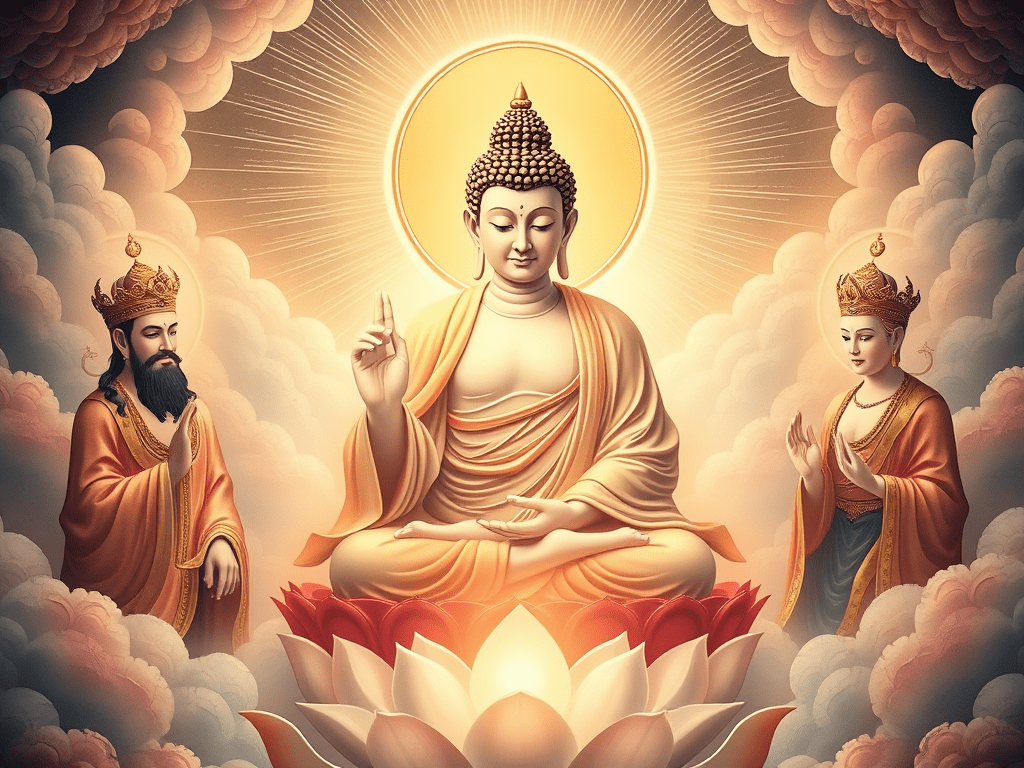
I. Introduction: The Universal Aspiration for Enlightenment
The human spirit often harbors a profound yearning for its endeavors to resonate beyond the personal sphere, contributing to a larger, universal good. The verses presented—
May the merits we have accumulated by this offering
Be distributed among all living beings,
And may we and all other living beings
Attain the enlightenment of the Buddha!
—eloquently capture this altruistic aspiration, a sentiment that lies at the very heart of Mahayana Buddhist philosophy. The desire to cultivate such a wish reflects a deep engagement with the path of spiritual development, seeking to align one’s life with principles of boundless compassion and wisdom.
This noble wish finds its scriptural and philosophical grounding within the Saddharma Puṇḍarīka Sūtra, or the Lotus Sutra, a paramount scripture in Mahayana Buddhism. Revered across East Asia and beyond, the Lotus Sutra is celebrated for its profound and encompassing teachings, particularly its emphasis on the universal potential for all sentient beings to attain Buddhahood.1 It proclaims the “One Vehicle” (Ekayāna), a single, all-inclusive path that ultimately leads every being, irrespective of their current capacities or past actions, to the supreme awakening of a Buddha.1 This message of radical inclusivity and inherent potential for enlightenment forms the bedrock of its enduring influence.2 The Lotus Sutra does not present these lofty ideals as attainable only by a select few; rather, it validates and encourages such universal aspirations, presenting them as accessible goals for all who earnestly seek them.1 Its teachings are designed to empower individuals, revealing the “great hidden treasure of the heart, as vast as the universe itself,” and fostering a dynamic way of living rooted in the interconnectedness of all existence.5
This report aims to meticulously examine the scriptural context of the aforementioned verses, tracing their origin to a specific narrative within the Lotus Sutra. It will explore the key figures involved—the ancient Buddha Great-Universal-Wisdom-Excellence and the celestial Brahma Kings—and delve into the profound Buddhist doctrine of accumulating merit (puṇya). Crucially, it will elucidate the Mahayana practice of dedicating such merits for the universal enlightenment of all sentient beings, connecting these elements to the broader compassionate vision that defines the Lotus Sutra and the Bodhisattva path. Through this exploration, the report seeks to provide a comprehensive understanding of how such a universal wish is not only validated but actively cultivated within the Mahayana tradition.
II. The Enlightenment of Great-Universal-Wisdom-Excellence Buddha and the Vow of the Brahma Kings (Lotus Sutra, Chapter Seven: “Parable of the Conjured City”)
Chapter Seven of the Lotus Sutra, often titled “The Parable of the Conjured City” (Kejōyu-hon), unfolds a magnificent narrative from the distant past, recounting the enlightenment of a Buddha named Great-Universal-Wisdom-Excellence and the extraordinary events that followed, including the pivotal vow uttered by the Brahma Kings.
A. Narrative of the Buddha’s Attainment of Enlightenment
The chapter commences with Shakyamuni Buddha recounting a story from an almost unimaginably remote past, “long ago, past limitless, boundless, unconceivable, Asankheya aeons”.6 This vast expanse of time serves to underscore the rarity and immense preciousness of the appearance of a Buddha in the world. In that ancient era, there lived a Buddha named Great-Universal-Wisdom-Excellence (Sanskrit: Mahābhijñājñānābhibhū Tathāgata).6
His path to supreme, perfect enlightenment (Anuttara-samyak-saṃbodhi) was one of profound meditative absorption and perseverance. Even after being seated on the Bodhimaṇḍa (the seat of enlightenment) and having “destroyed the troops of Mara” (symbolizing the overcoming of all inner and outer defilements and temptations), the ultimate Buddhadharmas, the truths of enlightenment, did not immediately manifest in his mind.6 For a period extending from one minor aeon up to ten minor aeons, this Buddha remained seated in the lotus posture, his body and mind unmoving, yet the Dharma of the Buddhas had not yet fully arisen within him.6 This depiction highlights the profound depth and immense difficulty associated with attaining the perfect awakening of a Buddha, an achievement that transcends ordinary understanding and effort. The sheer duration of this final meditative push, even after conquering Māra, suggests that the realization of a Buddha is not merely an intellectual understanding but a complete transformation of being, requiring inconceivable spiritual stamina.
Finally, “at the end of the period of ten small kalpas, the Dharma of the Buddhas came into the mind of Great-Universal-Wisdom-Excellence Buddha. Now he attained Anuttara-samyak-saṃbodhi“.7 This moment of supreme awakening was not a quiet, personal event but one that resonated throughout the cosmos.
B. The Celestial Celebration: The Brahma Kings’ Arrival and Offerings
The enlightenment of Great-Universal-Wisdom-Excellence Buddha was accompanied by extraordinary cosmic signs. It is described that “five hundred billion Buddha-worlds in each of the ten quarters quaked in the six ways”.7 Furthermore, the celestial palaces of the Brahman-heavenly-kings in these myriad worlds were suddenly illumined with an unprecedented brilliance, causing them to wonder at the cause of this phenomenon.7 This universal resonance signifies the profound impact of a Buddha’s awakening, an event that touches and illuminates all corners of existence. The magnitude of the Buddha’s spiritual achievement—the culmination of those ten small kalpas of intense, post-Māra meditation—directly correlates with the extraordinary and universal scale of these responsive cosmic events, emphasizing that such profound realization has far-reaching, transformative consequences for the entire universe.
Drawn by this supernal light and the auspicious signs, the Brahma Kings from the ten directions—east, southeast, south, southwest, west, northwest, north, northeast, nadir, and zenith—each governing five hundred billion worlds, began to converge.7 Among them, the great Brahman-heavenly-king from the zenith, named Sikhin, led his retinue.7 Carrying flower-plates filled with heavenly flowers, and with their celestial palaces miraculously moving along with them, they journeyed to the Sahā-world, specifically to the Well-Composed World, and approached the Bodhi-tree where Great-Universal-Wisdom-Excellence Buddha was seated in serene majesty, surrounded by gods, dragon-kings, and other beings.7
Their devotion was expressed through elaborate acts of reverence. They worshipped the Buddha by bowing their heads at his feet, circumambulated him hundreds of thousands of times, and showered him with heavenly flowers. These flowers, it is said, piled up to the height of Mount Sumeru, the mythical axis mundi of the Buddhist cosmos, and were also offered to the magnificent Bodhi-tree itself, which was ten yojanas tall.7 Beyond these floral tributes, the Brahma Kings performed an act of profound offering: they presented their own celestial palaces to the Buddha, requesting him to accept them out of compassion and for their ultimate benefit.7 The offering of their palaces, which are described as the most cherished abodes of the gods, representing supreme comfort and heavenly attainment 8, is deeply symbolic. It signifies a remarkable transcendence of attachment to even the most refined states of conditioned existence and the highest celestial rewards. This act points towards a recognition of the unconditioned nature of Buddhahood as being infinitely more valuable than any heavenly pleasure, however sublime.
C. The Brahma Kings’ Praise and the Pivotal Vow
In the presence of the newly enlightened Buddha, the assembled Brahma Kings, with one mind and voice, uttered gāthās (verses) of profound praise. They extolled the appearance of a Buddha as a rare and joyous event, a light dispelling the darkness that engulfs the worlds when no Buddha is present.7 They praised him as the “Honorable Saint who saves the world,” capable of liberating beings from the “prison of the triple world” (the realms of desire, form, and formlessness).7 Their verses lamented the long ages passed without a Buddha, during which beings in the evil paths increased and those in heavenly realms diminished, falling into suffering due to their ignorance of the Dharma.7
It is within this context of fervent praise and profound understanding of the Buddha’s significance that the pivotal verses cited in the initial query are spoken. The translation provided in one source confirms their presence, uttered by the Brahman-heavenly-kings of the five hundred billion worlds in the zenith:
Our palaces are beautifully adorned
With your light.
We offer them to you.
Receive them out of your compassion towards us!
May the merits we have accumulated by this offering
Be distributed among all living beings,
And may we and all other living beings
Attain the enlightenment of the Buddha! 7
Another translation renders this specific dedication as: “We vow that this merit and virtue. May extend to all living beings, So that we and all beings. May together realize the Buddha Way”.8 This vow is a powerful and explicit expression of Mahayana altruism. Here, the highest celestial beings, having performed meritorious actions through their offerings and praise, dedicate these merits not for their own continued heavenly enjoyment or individual advancement, but for the supreme enlightenment of all sentient beings, explicitly including themselves within that universal aspiration.
Following this profound dedication, the Brahma Kings collectively entreated Great-Universal-Wisdom-Excellence Buddha to “turn the wheel of the Dharma.” They implored him to “beat the drum of the Dharma as sweet as nectar, Save the suffering beings, And show them the way to Nirvāṇa!”.7 This sequence of actions—witnessing the enlightenment, making offerings, praising the Buddha, vowing to share merit for universal enlightenment, and then requesting the Buddha to teach—establishes a significant paradigm. It suggests that the sincere and profound aspiration for universal benefit is not merely a consequence of hearing the Dharma, but can also be a compelling condition that invites its very promulgation. The Dharma wheel is most powerfully turned when the motivation for seeking and receiving it is rooted in the compassionate wish for the liberation of all.
D. The Buddha’s Response and Initial Teachings
Great-Universal-Wisdom-Excellence Tathāgata responded to the earnest appeals of the Brahma Kings from all ten quarters, as well as those of his own sixteen sons (who had also arrived at the Bodhimaṇḍa), with tacit consent.7 He then proceeded to turn the wheel of the Dharma, initially expounding the teaching of the Four Noble Truths and Dependent Origination.1 It was only later, after a vast period of one hundred thousand eons, and at the specific behest of his sixteen sons (who were themselves Brahma Kings), that he taught the more profound and ultimate doctrine of the Lotus Sutra.1
This progression from foundational teachings to the ultimate truth of the Lotus Sutra by Great-Universal-Wisdom-Excellence Buddha mirrors the pedagogical approach often attributed to Shakyamuni Buddha himself. It perfectly illustrates the crucial Mahayana concept of upāya-kauśalya, or skillful means, whereby a Buddha adapts the presentation of the Dharma to suit the varying capacities and predispositions of disciples.2 The initial, more elementary doctrines serve as a “conjured city,” an expedient resting place, to guide beings gradually towards the “treasure land” of the One Vehicle, the ultimate and all-encompassing truth revealed in the Lotus Sutra.1 This narrative strategy within Chapter Seven thus reinforces the very theme of the chapter’s title, demonstrating the timeless validity of employing provisional teachings as stepping stones to the final, unifying Dharma.
III. The Significance of Great-Universal-Wisdom-Excellence Buddha (Mahābhijñājñānābhibhū / Daitsū Chishō Butsu)
The figure of Great-Universal-Wisdom-Excellence Buddha is not merely a character in an ancient tale; he embodies profound doctrinal principles central to the Lotus Sutra and Mahayana Buddhism, particularly as interpreted through various commentarial traditions.
A. Deciphering the Name and Attributes
The Sanskrit name Mahābhijñājñānābhibhū is rich in meaning. Mahā means “great”; abhijñā refers to “supernormal knowledges” or “higher penetrations”; jñāna signifies “wisdom” or “knowledge”; and abhibhū means “overcomer,” “victor,” or “surpasser.” Thus, the name can be understood as “The Thus Come One of Great Higher Penetrating Wisdom Victory” 6 or “He Who Has Overcome Through Great Superknowledge and Wisdom.” This nomenclature itself points to a Buddha who has attained profound insight and complete mastery over all aspects of reality.
The Japanese interpretation, particularly as found in The Record of the Orally Transmitted Teachings (OTT), a significant work in Nichiren Buddhism which offers commentary on the Lotus Sutra, provides further layers of meaning to Daitsū Chishō Butsu (the Japanese rendition of the Buddha’s name) 10:
- Daitsū (Great Universal): This component is said to represent the “mind king” or the fundamental core of the mind. It also corresponds to the theoretical aspect of the teachings. In a more immanent sense, Daitsū is equated with the physical body, or even the entirety of our lives as they undergo the cycle of birth and death. Nichiren and his followers, who chant Nam-myoho-renge-kyo (the ultimate Law of the Lotus Sutra), are identified as embodying this “Great Universal” aspect.10
- Chishō (Wisdom Excellence): This component represents the distinctive functions or activities of the mind. It corresponds to the essential aspect of the teachings. It is also related to the thoughts that arise within our bodies and minds as they experience birth and death. Crucially, the act of chanting daimoku (Nam-myoho-renge-kyo) is identified as “Wisdom Excellence.” The wisdom of those who uphold the Lotus Sutra is deemed “a hundred, a thousand, ten thousand times more excellent than the greatest wisdom of the schools of the provisional teachings,” hence the appellation “Wisdom Excellence”.10
Therefore, in this interpretive lens, Great-Universal-Wisdom-Excellence Buddha comes to signify the totality of one’s being—body and mind, the fundamental core and its active functions. He represents the ultimate integration of theoretical understanding (Daitsū) and essential practice (Chishō), which culminates in enlightenment. This interpretation radically democratizes the concept of Buddhahood. Rather than viewing this ancient Buddha as a remote historical figure, he becomes a profound metaphor for the inherent Buddha-nature and the potential for enlightenment existing within each practitioner. “Great Universal Wisdom Excellence is this body that each of us possesses,” and “the votaries, who chant Nam-myoho-renge-kyo, are the Buddha Great Universal Wisdom Excellence”.10 This perspective shifts the locus of Buddhahood from an external, distant entity to an immediate, realizable potential within one’s own life through dedicated practice of the “Wonderful Law.”
The following table summarizes these symbolic attributes:
| Attribute/Name Component | Sanskrit/Japanese | Symbolic Meaning (General) | Symbolic Meaning (OTT/Nichiren tradition) | Relevance to Practitioner |
| Mahābhijñā | Great Superknowledge | Profound, extraordinary cognitive abilities and insights. | The inherent capacity for supreme wisdom. | Points to the practitioner’s innate potential to develop profound insight through practice. |
| Jñāna | Wisdom | Deep understanding of the true nature of reality. | The essential wisdom of the Lotus Sutra. | The wisdom gained through understanding and practicing the ultimate truth of the Lotus Sutra. |
| Abhibhū | Overcomer/Victor | Victory over all obstacles, defilements, and illusions. | Overcoming fundamental darkness or ignorance through faith and practice. | The ability to overcome personal illusions and sufferings by embracing the Mystic Law. |
| Daitsū | Great Universal (大通) | The vast, all-encompassing nature of the Buddha’s being. | The mind king (core of mind); theoretical teaching; the body; our lives in birth/death; Nichiren & followers chanting Nam-myoho-renge-kyo. | Represents the practitioner’s entire being, their life itself, as the field for realizing Buddhahood. The inherent universality of the Buddha-nature within. |
| Chishō | Wisdom Excellence (智勝) | The supreme quality and power of the Buddha’s wisdom. | Distinctive functions of mind; essential teaching; thoughts in body/mind; the act of chanting daimoku; wisdom of Lotus Sutra votaries. | Represents the active practice (e.g., chanting) that manifests the inherent wisdom. The superior quality of wisdom derived from the Lotus Sutra, enabling transformation of earthly desires into enlightenment. |
B. Role in the Lotus Sutra’s Macro-Narrative
Great-Universal-Wisdom-Excellence Buddha plays a crucial role in the overarching narrative and thematic development of the Lotus Sutra. His story serves several key functions:
- Illustrating the Immeasurable Span of Buddhahood: His existence in the incredibly distant past powerfully demonstrates the Lotus Sutra’s teaching that Buddhas have appeared and taught throughout immeasurable eons, not just in the historical period of Shakyamuni Buddha.6 This establishes the timeless and universal nature of the Dharma and the continuous presence of enlightened beings working for the welfare of all.
- Establishing a Lineage and the Antiquity of the Lotus Sutra: The narrative reveals that Great-Universal-Wisdom-Excellence Buddha had sixteen sons, who, after hearing him preach the Lotus Sutra, themselves became Bodhisattvas, continued to propagate its teachings, and eventually attained Buddhahood in various Buddha-lands.1 Significantly, Shakyamuni Buddha reveals that he himself was one of these sixteen sons in a past incarnation.1 This establishes a profound spiritual lineage for the Lotus Sutra, tracing its origins back to this ancient Buddha and underscoring the idea of a “continuous journey of shared struggle from the infinite past” between mentor and disciple in propagating the Law.11 The sixteen sons, interpreted in the OTT as “the functions of our minds” 10, symbolize the widespread dissemination and diverse manifestations of the enlightened mind. Their active role in propagating the Dharma reinforces the Lotus Sutra’s message of dynamic engagement in the world for the purpose of teaching and liberating others, a core tenet of the Bodhisattva path and resonant with the ideal of kosen-rufu, the broad propagation of the Mystic Law.11
- Embodying the “Parable of the Conjured City”: As previously mentioned, this Buddha’s teaching methodology—initially expounding the Four Noble Truths and Dependent Origination before, much later, revealing the Lotus Sutra at his sons’ request 1—is a prime illustration of the central theme of Chapter Seven: the “Parable of the Conjured City” (Kejōyu-hon). The parable describes a wise guide leading a group of travelers towards a great treasure land. When the travelers become weary and wish to turn back, the guide conjures up an illusory city for them to rest in. Once refreshed, the guide reveals the city’s illusory nature and urges them onward to the true destination.1 Similarly, the provisional teachings (the “conjured city”) are skillful means (upāya) designed to lead beings of varying capacities towards the ultimate “treasure land” of the One Buddha Vehicle taught in the Lotus Sutra.9 The “distance of five hundred yojanas” to this treasure land is symbolic of the manifold illusions, earthly desires, and karmic hindrances that impede spiritual practice.10 This distance is effectively traversed, and the journey completed, when one realizes, through the wisdom of the “Wonderful Law” (often equated with Nam-myoho-renge-kyo in the Nichiren tradition), that “the phantom city is identical with the treasure land”.10 The narrative of Great-Universal-Wisdom-Excellence Buddha’s teaching career causally demonstrates how the ultimate teaching of the Lotus Sutra reframes and gives true, ultimate meaning to all provisional teachings, revealing them as integral parts of the single path to Buddhahood.
IV. The Brahma Kings: Divine Protectors and Supplicants of the Dharma
The Brahma Kings play a conspicuous and significant role in the narrative of Great-Universal-Wisdom-Excellence Buddha’s enlightenment, acting as celestial witnesses, devotees, and crucial instigators for the dissemination of the Dharma.
A. Brahma in Buddhist Cosmology
In Buddhist cosmology, Brahma (or a Brahmā) is a leading deva (god or celestial being) and a heavenly king, often regarded as a dharmapāla, a protector of the Buddha’s teachings.13 While Buddhism adopted the figure of Brahma from the pre-existing Indian religious landscape, it significantly recontextualized his role. Early Buddhist texts never depict Brahma as a creator god in the ultimate sense; rather, Buddhist teachings deny a supreme creator and often portray Brahma and other deities like Indra as beings who, while powerful and long-lived, are still subject to the laws of karma and rebirth, and thus subordinate to a fully enlightened Buddha.13
Brahma figures are said to reside in the Brahmaloka, the “Brahma worlds,” which are high heavenly realms within the realm of form (rūpadhātu) or even the formless realm (arūpyadhātu), attained through considerable spiritual merit and advanced meditative achievements.13 Despite their exalted status, they are still within the cycle of samsara.
A particularly important Brahma figure in Buddhist tradition is Brahmā Sahampati. According to numerous suttas, it was Brahmā Sahampati who appeared before the newly enlightened Shakyamuni Buddha when the latter was hesitating to teach the profound Dharma he had discovered, deeming it too subtle for worldly beings to comprehend.13 Fearing that “the world is lost” if the Dharma were not taught, Brahmā Sahampati earnestly entreated the Buddha to share his wisdom for the benefit of those beings “with little dust in their eyes” who would be capable of understanding.17 This act is considered pivotal, as it was in response to this plea that Shakyamuni Buddha resolved to teach. Some interpretations suggest that the Buddha’s hesitation and Brahma’s subsequent request were intended to highlight the preciousness of the Dharma and to ensure that beings, particularly those who revered Brahma, would value and respectfully listen to the teachings.17
B. Symbolic Significance of the Brahma Kings in Lotus Sutra, Chapter Seven
The actions of the multitude of Brahma Kings in Chapter Seven of the Lotus Sutra echo and amplify the traditional role of Brahmā Sahampati, imbued with distinct Mahayana characteristics:
- Cosmic Recognition and Celebration: Their spontaneous appearance from the ten quarters, accompanied by their retinues and illuminated palaces, and their elaborate offerings of heavenly flowers, music, and even their own celestial abodes, serve as a powerful cosmic affirmation of the Buddha’s enlightenment.7 It signifies that the attainment of Buddhahood is an event of universal significance, recognized and celebrated by the highest beings in the cosmos.
- Amplified Plea for the Dharma: The unified praise and earnest request from these numerous Brahma Kings for Great-Universal-Wisdom-Excellence Buddha to “turn the wheel of the Dharma” 7 is a magnified version of Brahmā Sahampati’s singular plea. The fact that these are not just one, but countless Brahma Kings from “five hundred billion Buddha-worlds in each of the ten quarters” 7 making this request underscores the universal need and urgent longing for the Buddha’s teachings across all realms of existence. Their intervention highlights the profound value and indispensable nature of the Dharma. If even these exalted beings, dwelling in blissful heavens, perceive the pervasive darkness and suffering of the world in the absence of a Buddha’s guidance and implore for the teachings 7, it powerfully demonstrates the critical role of a Buddha’s wisdom for the welfare of all.
- Exemplars of Mahayana Altruism: Most significantly, their vow to dedicate the merits of their offerings “among all living beings” so that “we and all other living beings / Attain the enlightenment of the Buddha!” 7 elevates their role far beyond that of mere supplicants or protectors. They become shining exemplars of the Mahayana Bodhisattva aspiration. This collective vow for universal enlightenment, including their own, reflects the expansive vision of the Lotus Sutra, which emphasizes universal salvation. It is a distinct Mahayana development of the Brahma figure, showcasing that even the highest gods recognize the supreme value of Buddhahood over their own heavenly states and actively wish for this ultimate attainment for everyone. This act demonstrates the Mahayana teaching that no worldly attainment, however lofty (including rebirth in a Brahma heaven), is the final goal. Only Buddhahood offers true, complete liberation from suffering, and this is the ultimate aspiration for all beings, even gods, who are still within the bounds of samsara. Their aspiration for Buddhahood for themselves and all others shows that heavenly existence is not the ultimate refuge, thereby reinforcing the Buddhist critique of attachment to any conditioned state and highlighting the supreme, unconditioned nature of enlightenment.
The presence and actions of the Brahma Kings in Chapter Seven, therefore, are not incidental. They serve to validate the Buddha’s enlightenment, emphasize the universal necessity of the Dharma, and, most importantly in the context of the Lotus Sutra, to model the profound Mahayana ideal of dedicating all virtuous actions towards the supreme enlightenment of every sentient being.
V. The Doctrine of Merit (Puṇya): Accumulation, Purpose, and Universal Dedication
The vow of the Brahma Kings to distribute the merits of their offering for the enlightenment of all beings is deeply rooted in the Buddhist doctrine of puṇya (Pāli: puñña), or merit, and its distinctively Mahayana application through the practice of pariṇāmanā, the dedication or transference of merit.
A. Defining “Merit” (Puṇya) in Buddhism
In Buddhist teachings, puṇya refers to a kind of spiritual credit, positive energy, or wholesome karmic force that is accumulated through virtuous and skillful actions of body, speech, and mind.19 Such actions include, but are not limited to, acts of generosity (dāna), ethical conduct (sīla), mental cultivation through meditation (bhāvanā), reverence, service, listening to the Dharma, expounding the Dharma, and straightening one’s views. Merit is generally understood to be a cause for positive outcomes, such as happiness, favorable circumstances in this life and future lives, well-being, and spiritual growth.19 It is the natural fruition of wholesome intentions and deeds.
B. Accumulation and Purpose of Merit
The understanding of merit accumulation and its primary purpose varies somewhat between the major branches of Buddhism:
- Theravada Perspective: In Theravada Buddhism, the accumulation of merit is considered highly important for lay practitioners and monastics alike. Good deeds and positive karma are believed to bring blessings, lead to favorable rebirths in pleasant realms (such as human or heavenly worlds), and create conducive conditions for spiritual practice.19 The purpose is often seen as ensuring well-being within the cycle of rebirths and gradually progressing towards Nibbāna (Nirvana).
- Mahayana Perspective: Mahayana Buddhism, while also acknowledging the general karmic benefits of merit, places a distinctive emphasis on its role in the Bodhisattva path. For a Bodhisattva—an individual who aspires to attain full Buddhahood for the sake of liberating all sentient beings—the accumulation of merit is crucial for developing the requisite qualities of wisdom (prajñā) and compassion (karuṇā), and for perfecting the pāramitās (the six or ten perfections, such as generosity, ethics, patience, effort, concentration, and wisdom).19 Merit is seen as fuel for the arduous journey to Buddhahood. A key Mahayana understanding is that merit can be gathered continuously, even during periods of rest or inattentiveness, once bodhicitta—the profound aspiration to attain enlightenment for the benefit of all sentient beings—has taken firm root in one’s mindstream.19 This highlights that the motivation behind actions is paramount. Without the altruistic motivation of bodhicitta, merit accumulation might remain primarily self-serving, leading to personal gain within samsara rather than contributing to the universal project of enlightenment. The Brahma Kings’ vow, made in the context of their offerings, is a clear and powerful expression of such bodhicitta.
C. The Profound Practice of Dedicating Merit (Pariṇāmanā)
The Mahayana tradition takes the concept of merit a significant step further with the practice of pariṇāmanā, which means “to change, to transform, to dedicate, or to transfer.” This is the conscious and intentional act of directing one’s accumulated merit, the positive energy from virtuous deeds, towards a specific lofty goal, most commonly the well-being and ultimate enlightenment of all sentient beings.22
The rationale behind this practice is deeply embedded in core Mahayana philosophical principles:
- Bodhicitta: As mentioned, the aspiration for the enlightenment of all is the driving force. Dedicating merit is a direct expression and cultivation of this altruistic intention.
- Interconnectedness (Pratītyasamutpāda): The understanding that all phenomena arise in dependence upon causes and conditions, and that all beings are inextricably interconnected. One’s own liberation is not seen as separate from the liberation of all.21
- Emptiness (Śūnyatā): The wisdom realizing that all phenomena, including the self, the act of dedicating, and the merit itself, lack inherent, independent existence. This understanding helps to overcome selfish attachment to one’s own merit.
The practice of dedicating merit is typically performed at the conclusion of any spiritual activity—such as meditation, chanting, listening to or giving Dharma teachings, performing acts of kindness, or even mundane positive actions—with either specific traditional verses or a heartfelt, spontaneous intention.22 Many Buddhist traditions have beautiful verses for this purpose, often expressing wishes such as: “By this merit may all attain omniscience. May it defeat the enemy, wrong-doing. From the stormy waves of birth, old age, sickness, and death, from the ocean of samsara, may I free all beings” 22, or more simply, “May the merits of our practice benefit all beings”.23
The benefits of this practice are manifold. It expands one’s spiritual practice beyond narrow self-interest, actively cultivating universal love, compassion, joy, and equanimity. It aligns the practitioner’s mind with the ultimate truth of non-duality and interconnectedness. Paradoxically, though an act of selfless giving, the dedication of merit is said to accrue further benefit for the practitioner themselves.22 This is not a contradiction but reflects a profound spiritual dynamic: by diminishing self-cherishing, purifying the mind of possessiveness, and strengthening the Bodhisattva resolve, one naturally makes greater strides on the path to enlightenment. The “self” that might perceive a “loss” of merit is the very ego-illusion that the path seeks to dismantle.
D. The Brahma Kings’ Vow as an Exemplar
The vow of the Brahma Kings in Chapter Seven of the Lotus Sutra stands as a perfect and powerful scriptural exemplar of this quintessential Mahayana practice of merit dedication:
“May the merits we have accumulated by this offering
Be distributed among all living beings,
And may we and all other living beings
Attain the enlightenment of the Buddha!” 7
Commentary on these verses explicitly confirms this intention: “We vow that this merit and virtue gained by making this offering to the Buddha may extend to all living beings…so that we and all beings, may together realize the Buddha Way, the Way of Buddhahood”.8 This act by such highly advanced celestial beings, dedicating their profound merit not for continued heavenly existence or personal glory but for the highest conceivable goal—universal Buddhahood—serves as a potent endorsement and model for all Mahayana practitioners. It powerfully illustrates the Mahayana innovation of directing merit towards ultimate awakening for all, rather than primarily towards better rebirths within samsara.21 This fundamentally transforms the purpose of every virtuous action, linking it directly to the grand Bodhisattva project and imbuing daily practice with immense significance. Furthermore, their universal dedication challenges any hierarchical notions of spiritual attainment. If even the highest gods are aspiring and dedicating merit for all beings to achieve Buddhahood, it powerfully reinforces the Lotus Sutra’s core message that Buddhahood is an inclusive possibility and that the path inherently involves a collective, not merely individual, journey towards liberation.
VI. Echoes of Universal Salvation: Connecting Chapter Seven to Core Lotus Sutra Themes
The narrative of Great-Universal-Wisdom-Excellence Buddha’s enlightenment, the celestial celebration by the Brahma Kings, and their profound vow of merit dedication in Chapter Seven are not isolated events. Instead, they resonate deeply with, and serve as narrative embodiments of, the most central and transformative themes of the Lotus Sutra.
A. The One Vehicle (Ekayāna)
A cornerstone of the Lotus Sutra’s teachings is the doctrine of the One Vehicle (Ekayāna).1 This doctrine proclaims that the various spiritual paths and practices taught by the Buddha throughout his long teaching career—such as the path of the Śrāvaka (voice-hearer or disciple striving for Arhatship), the Pratyekabuddha (solitary realizer), and the Bodhisattva (one striving for full Buddhahood to benefit all beings), often referred to as the “three vehicles”—are ultimately not separate, disparate goals. Rather, they are all skillful means (upāya-kauśalya) employed by the Buddha to guide beings of differing capacities and inclinations towards the single, supreme, and all-encompassing goal: the attainment of full Buddhahood.2
The Brahma Kings’ vow, “may we and all other living beings / Attain the enlightenment of the Buddha!” 7, is a direct and powerful reflection of this Ekayāna principle. Their wish transcends any particular vehicle or level of attainment short of supreme Buddhahood; it is a prayer for the ultimate and universal realization for everyone without exception. Similarly, the narrative structure itself, where Great-Universal-Wisdom-Excellence Buddha first teaches foundational doctrines (akin to the provisional vehicles) before later expounding the Lotus Sutra (the ultimate One Vehicle) at the request of his sixteen sons 1, serves as a dramatic illustration of how all teachings ultimately converge upon and are fulfilled in the One Buddha Vehicle.
B. Inherent Buddha-Nature (Tathāgatagarbha)
Closely allied with the concept of the One Vehicle is the Mahayana teaching of Tathāgatagarbha, or inherent Buddha-nature, which is strongly implied and foundational to the message of the Lotus Sutra.1 This doctrine asserts that all sentient beings, without exception, possess the innate potential, the seed or embryo (garbha), of a Thus Come One (Tathāgata), i.e., a Buddha. Buddhahood is not something to be acquired externally but is an intrinsic quality of mind that needs to be uncovered and actualized by removing the temporary obscurations of ignorance and defilements.4 The Lotus Sutra declares that “all equally possess the potential for Buddhahood and that all have the ability to savor state of absolute happiness”.5
The Brahma Kings’ confident vow that “we and all other living beings” can indeed attain the enlightenment of the Buddha 7 implicitly presupposes this universal, inherent potential. Their aspiration is not a mere fanciful hope against impossible odds but an affirmation of an underlying spiritual reality: that the capacity for supreme awakening resides within every being. Their dedication of merit is thus aimed at nurturing this seed of Buddhahood in all.
C. The Bodhisattva Ideal and Bodhicitta
The Lotus Sutra is a quintessential Mahayana text that champions the Bodhisattva ideal—the compassionate hero who, motivated by bodhicitta (the mind of enlightenment), postpones their own entry into final Nirvana to tirelessly work for the complete liberation of all sentient beings.2 The Bodhisattva path is characterized by the cultivation of boundless compassion (karuṇā) and profound wisdom (prajñā), and the practice of the six (or ten) perfections (pāramitās).
The Brahma Kings’ vow in Chapter Seven is a luminous expression of bodhicitta. Their primary concern, articulated in their moment of highest spiritual elation and offering, is not their own advancement but the enlightenment of all beings. They perfectly embody the Bodhisattva spirit, demonstrating that even beings of great power and lofty status embrace this altruistic motivation as the highest spiritual calling. The Lotus Sutra itself is considered a vital scripture for Bodhisattvas, outlining their profound mission and the path to its fulfillment.12
The entire sequence of events in Chapter Seven—the arduous path to enlightenment of Great-Universal-Wisdom-Excellence Buddha, the cosmic celebration, the Brahma Kings’ offerings and their universal vow, followed by the Buddha’s agreement to teach and the subsequent propagation of the Lotus Sutra by his sixteen sons (including a past incarnation of Shakyamuni Buddha)—serves as a grand narrative enactment of these core philosophical tenets. The story is not merely an ancient legend; it is a living demonstration of the One Vehicle, the reality of inherent Buddha-nature, and the compassionate imperative of the Bodhisattva path. Furthermore, the Mahayana understanding that one’s own liberation is inextricably intertwined with the liberation of all others 21 finds strong support in the Brahma Kings’ inclusive vow. The formulation “may we and all other living beings attain the enlightenment” suggests a simultaneous and interconnected journey, where the aspiration for self-enlightenment and the aspiration for the enlightenment of all are two indispensable facets of the same profound process.
Finally, the setting of this narrative in “limitless, boundless, unconceivable, Asankheya aeons” past 6 establishes the timelessness and cosmic scale of the Lotus Sutra’s message. It suggests that the aspiration for universal enlightenment, as exemplified by these ancient Brahma Kings and the Buddha they revered, is not a novel ideal but a fundamental, ancient principle that has echoed throughout cosmic history, continuously re-enacted by countless Buddhas and Bodhisattvas in their compassionate efforts to guide all beings to liberation.
VII. Conclusion: Cultivating the Boundless Wish for the Benefit of All
This exploration into Chapter Seven of the Lotus Sutra has verified the scriptural authenticity of the verses expressing a universal dedication of merit, locating them within the profound praise offered by the Brahma Kings upon the enlightenment of Great-Universal-Wisdom-Excellence Buddha.7 The narrative surrounding this event is rich with symbolic meaning, highlighting the immense spiritual achievement of this ancient Buddha, the responsive reverence of the celestial realms, and, most significantly, the articulation of a quintessential Mahayana aspiration by the Brahma Kings themselves.
Their vow—”May the merits we have accumulated by this offering / Be distributed among all living beings, / And may we and all other living beings / Attain the enlightenment of the Buddha!”—serves as a timeless inspiration. It calls upon all who encounter it to look beyond the confines of personal gain and to embrace a path illuminated by boundless compassion and wisdom. This aspiration is not merely a lofty sentiment but is deeply rooted in the Buddhist doctrines of merit (puṇya), its purposeful accumulation, and its profound dedication (pariṇāmanā) for the highest welfare of all. The actions of the Brahma Kings provide a powerful scriptural model for this practice, demonstrating that even beings of great heavenly attainment recognize the supreme value of universal Buddhahood.
The initial query expressed a personal desire to “cultivate this wish.” This report affirms that such an aspiration lies at the very core of the Bodhisattva path and is highly extolled throughout Mahayana Buddhist teachings. The practice of consciously dedicating the merit accrued from all virtuous actions—whether formal spiritual practices like meditation and chanting, or simple acts of kindness in daily life—is a direct and effective method for nurturing and expressing this boundless wish.22 By understanding the doctrinal foundations and scriptural precedents, such as the inspiring example of the Brahma Kings, the cultivation of this universal altruism can be undertaken with greater confidence, clarity, and connection to a rich and profound spiritual tradition. The knowledge itself, by elucidating the “why” and “how,” becomes a supportive condition for deepening this very practice.
The cultivation of such a universal wish has a transformative potential that extends far beyond the individual. It fosters a shift in perception, moving one from being a passive observer of the world’s sufferings to an active agent of compassion and positive change. It encourages a “dynamic way of living” 5, where one’s life becomes a vehicle for contributing to the happiness and liberation of others. As one dedicates one’s efforts to this great vow for universal enlightenment, the inherent Buddha-nature within oneself and all beings is gradually awakened, paving the way to transform this “suffering-filled saha world into the Land of Eternally Tranquil Light”.12 Through such practice, the noble wish of the Brahma Kings becomes a living reality in the heart and actions of the practitioner, contributing, moment by moment, to the ultimate welfare of all sentient beings.
Works cited
- The Lotus Sutra: The Sutra of the Wonderful Dharma – Deus Today, accessed May 16, 2025, https://www.deustoday.com/lotus-sutra/
- Lotus Sutra – Wikipedia, accessed May 16, 2025, https://en.wikipedia.org/wiki/Lotus_Sutra
- Lotus Sutra – Most Influential Sutra of Mahayana Buddhism – Original Buddhas, accessed May 16, 2025, https://www.originalbuddhas.com/blog/lotus-sutra
- Lotus Sutra | Soka Gakkai (global), accessed May 16, 2025, https://www.sokaglobal.org/about-the-soka-gakkai/buddhist-lineage/lotus-sutra.html
- Buddhism: The Wisdom of the Lotus Sutra | Daisaku Ikeda Official Website, accessed May 16, 2025, https://www.daisakuikeda.org/main/philos/essays-on-buddhism/buddh-lotus.html
- Lotus Sutra – Chapter 7, accessed May 16, 2025, https://www.buddhistdoor.com/OldWeb/resources/sutras/lotus/sources/lotus7.htm
- Chapter 7: The Parable of a Magic City – 500 Yojanas, accessed May 16, 2025, https://www.500yojanas.org/lotus-sutra/chapter7/
- The Wonderful Dharma Lotus Flower Sutra … – City of 10,000 Buddhas, accessed May 16, 2025, https://www.cttbusa.org/dfs7/dfs7_6.asp.html
- Akshobhya’s Magic City: Lotus Chapter 7, Metaphor of Expedient Means and Shunyata, accessed May 16, 2025, https://buddhaweekly.com/lotus-sutra-chapter-7-the-transformed-city-analogy/
- “The Parable of the Phantom City” chapter: seven important points …, accessed May 16, 2025, https://www.nichirenlibrary.org/en/ott/PART-1/7
- Key Passages From The Record of the Orally Transmitted Teachings (Part 6), accessed May 16, 2025, https://www.worldtribune.org/2024/key-passages-from-the-record-of-the-orally-transmitted-teachings-part-6/
- Chapter 7: The Mission and Practice of the Bodhisattvas of the Earth | Soka Gakkai (global), accessed May 16, 2025, https://www.sokaglobal.org/resources/study-materials/buddhist-study/the-basics-of-nichiren-buddhism-for-the-new-era-of-worldwide-kosen-rufu/chapter-7.html
- Brahmā (Buddhism) – Wikipedia, accessed May 16, 2025, https://en.wikipedia.org/wiki/Brahm%C4%81_(Buddhism)
- Brahma: Significance and symbolism, accessed May 16, 2025, https://www.wisdomlib.org/concept/brahma
- Devas and Brahma: Significance and symbolism, accessed May 16, 2025, https://www.wisdomlib.org/concept/devas-and-brahma
- Brahmas and devas: Significance and symbolism, accessed May 16, 2025, https://www.wisdomlib.org/concept/brahmas-and-devas
- Why the Buddha “Hesitated” To Teach – The Minding Centre, accessed May 16, 2025, https://www.themindingcentre.org/dharmafarer/wp-content/uploads/2009/12/12.1-Why-the-Buddha-hesitated.pdf
- The supportive god, Brahma – Dhamma Wheel Buddhist Forum, accessed May 16, 2025, https://www.dhammawheel.com/viewtopic.php?t=36517
- Merit accumulation: Significance and symbolism, accessed May 16, 2025, https://www.wisdomlib.org/concept/merit-accumulation
- Merit punya: Significance and symbolism, accessed May 16, 2025, https://www.wisdomlib.org/concept/merit-punya
- Mahayana | Origins, Beliefs, Practices & Schools | Britannica, accessed May 16, 2025, https://www.britannica.com/topic/Mahayana
- How to Practice Dedicating Merit | Lion’s Roar, accessed May 16, 2025, https://www.lionsroar.com/how-to-practice-dedicating-merit/
- Merit — The Prairie Sangha of Urbana-Champaign, accessed May 16, 2025, https://www.prairiesangha.org/merit
- Lotus Sutra: Significance and symbolism, accessed May 16, 2025, https://www.wisdomlib.org/concept/lotus-sutra
 Mr. Altig’s Overview of the Wonderful Dharma of the Lotus Sutra
Leave a comment