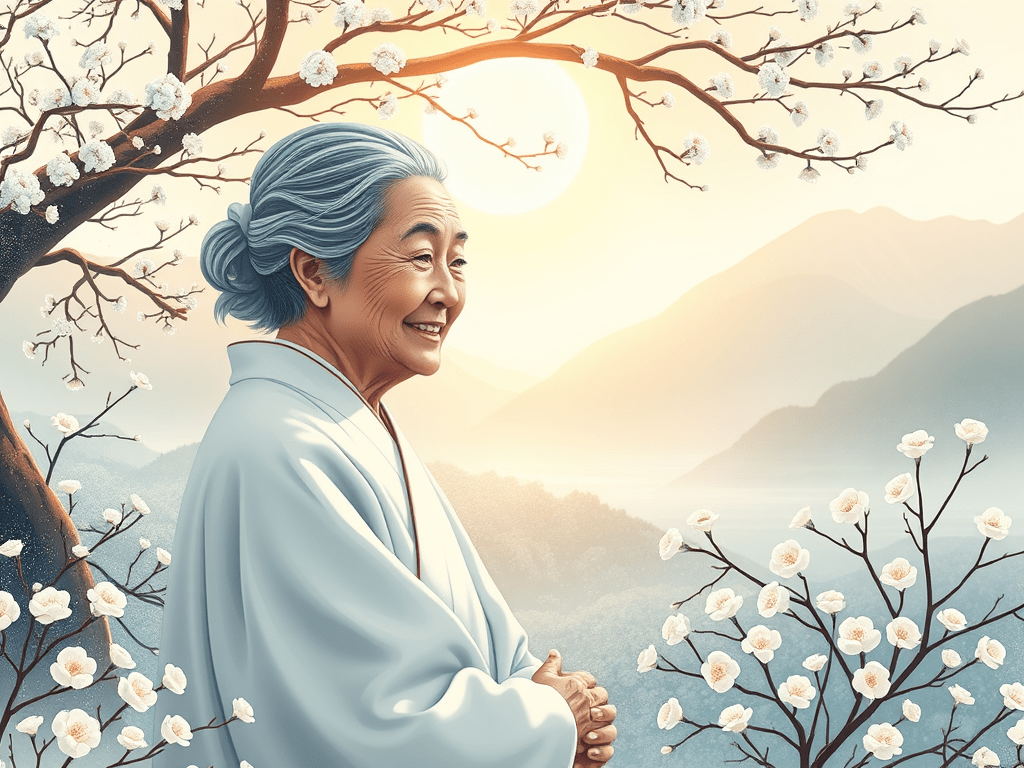
This briefing reviews the core tenets of Nichiren Buddhism, with a particular focus on its accessible, everyday approach to faith and practice, as exemplified in Nichiren’s “Letter to the Nun Myoichi.” It draws primarily from an essay titled “Unveiling Everyday Faith: Nichiren’s Practical Path to Joy and Wisdom in the ‘Letter to the Nun Myoichi’,” which has been fact-checked and affirmed as “factually accurate, well-organized, and spiritually faithful” to Nichiren Buddhism as interpreted by the Soka Gakkai International (SGI).
Main Themes and Key Ideas
1. Historical Context and Nichiren’s Accessible Teachings
Nichiren (1222–1282), a Japanese Buddhist monk during the turbulent Kamakura period, established a unique form of Mahayana Buddhism. His life was marked by “relentless persecutions, including the Tatsunokuchi Persecution in 1271, which culminated in his subsequent exile to Sado Island.” Despite these severe adversities, Nichiren “triumphed over every adversity,” demonstrating the power of Buddhahood and serving as a “living validation of the principle that ‘winter always turns to spring.’”
Central to his teachings was the assertion that the Lotus Sutra contained the ultimate truth, uniquely suited for the “turbulent Age of Dharma Decline.” He advocated for the simple, faithful recitation of its title, “Namu Myoho Renge Kyo,” as the sole effective path to Buddhahood in one’s present lifetime. This approach deliberately emphasizes “the simple, everyday dimensions of faith and practice,” directly contrasting with the perception of Buddhism as an intricate discipline requiring extensive study or mastery of complex concepts. His teachings were designed to be “accessible to all individuals regardless of their social standing, educational background, or inherent abilities.”
2. The Human Context of Faith: Nun Myoichi’s Story
The “Letter to the Nun Myoichi” is deeply rooted in personal hardship. Nun Myoichi, an elderly and frail widow, faced “unimaginable hardships” after her husband’s estate was confiscated due to his steadfast faith in Nichiren’s teachings. Her husband passed away while Nichiren was in exile, leaving Myoichi to care for an ill son and young daughter, all while suffering from a “poor constitution.”
Despite these overwhelming difficulties, Myoichi exhibited a “powerful seeking spirit” and continued to support Nichiren. Nichiren was “acutely aware of Myoichi’s dire situation” and offered profound empathy and encouragement. He used the “powerful and enduring metaphor, ‘winter always turns to spring,’” assuring her that her husband had died in “winter,” but “spring” had now arrived with Nichiren’s safe return. This metaphor conveys that “those who remain true to their convictions are destined to attain Buddhahood and achieve happiness.” This personal context highlights that Nichiren’s message was “specifically tailored to offer solace and a practical path forward amidst profound, everyday adversity.”
3. “Faith is Nothing Special”: Demystifying Buddhist Practice
Nichiren radically redefined faith, grounding it in universally understood human experiences. He explicitly stated, “Faith is nothing special. A wife loves her husband, the husband devotes his life to her, parents do not give away their children, and children do not desert their mother. Likewise, believe in the Lotus Sutra, the Buddha Śākyamuni, the Buddha Tahō, all Buddhas, Bodhisattvas and deities. Then chant ‘Namu Myoho Renge Kyo.’ This is faith.”
This analogy makes faith “relatable and comprehensible for ‘ordinary people’” by drawing parallels to “universally understood human emotions and commitments.” It conveys that faith is not an abstract concept or an extraordinary resolve, but a “strong aspiration” akin to deeply ingrained parts of one’s being, such as “a drowning person’s intense wish for help, or a woman cherishing her mirror, or a man wearing his sword.” This approach “democratizes spiritual practice,” suggesting that “profound spiritual capacity is inherently present within everyday human connections,” countering the elitism often associated with other Buddhist schools.
Nichiren “sharply critiqued other Buddhist schools prevalent in his era,” such as Pure Land, Zen, and Shingon, for their perceived “elitism, complexity, and focus on other-worldly aspirations or secret transmissions.” He considered their practices “ineffective or even ‘useless magic’” (though a more faithful phrasing might be “useless incantations” or “false doctrines”), asserting that his “simplification” was a “radical re-centering of Buddhist practice” to make the “highest truth” universally accessible.
4. The Mystic Law in Action: Chanting “Namu Myoho Renge Kyo” (Daimoku)
The core practice in Nichiren Buddhism is chanting “Namu Myoho Renge Kyo,” known as Daimoku. This is not merely a ritualistic utterance but “a profound engagement with the ultimate reality of life.” Its etymology reveals deep philosophical meaning:
- “Nam”: From Sanskrit namas, meaning “to dedicate one’s life” to “the principle of eternal and unchanging truth.”
- “Myoho”: “Wonderful Law” or “Mystic Law.” “Myo” (enlightenment) and “Ho” (ignorance) together encapsulate the idea that “ignorance and the Dharma nature are a single entity,” meaning “the enlightened nature of a Buddha and the deluded nature of an ordinary person are fundamentally one.” (Note: The interpretive phrasing “Myo represents death, and Ho, life” is metaphorical and not a direct quote from original sources.)
- “Renge”: “Lotus flower,” symbolizing the “simultaneity of cause and effect” because its flower and seeds appear concurrently. This means “the instantaneous manifestation of Buddhahood within practice.”
- “Kyo”: “Sutra” or “teaching,” representing “the words and voices of all living beings,” implying that chanting “resonates with and stimulates the inherent Buddha nature within oneself and others.”
Chanting “Namu Myoho Renge Kyo” is believed to “profoundly impact an individual’s life,” reducing suffering, eradicating negative karma, and advancing the practitioner toward “perfect and complete awakening.” It “polishes’ the deluded mind, transforming it into a ‘bright mirror that is the true suchness of the Dharma nature.’” The practice is “direct and immediate,” with Buddhahood not something to be attained externally, but “awakened from within the very moment of sincere practice.” The Daimoku’s universality, combining Sanskrit and Chinese, is seen as representing the “voices of all humanity,” reinforcing Nichiren’s vision of kosen-rufu (widespread propagation of the teaching for global peace and happiness).
5. Cultivating Compassion, Wisdom, and Joy in Daily Life
Nichiren Buddhism provides a framework for cultivating inner states that positively impact daily life:
- Harmonious Relationships and Human Revolution: Happiness and enlightenment originate from within, emphasizing the “oneness of life and its environment.” An individual’s inner transformation, or “human revolution,” “can profoundly and positively influence their external relationships and the broader society.” Chanting is the “driving force for that change,” leading to a “self that is solid and resolute.” “Goodness” fosters “harmonious coexistence, empathy and solidarity,” and compassion involves “praying for others, embracing their suffering as one’s own.”
- Developing a Sustainable State of Happiness: Happiness is an “inner life condition” actively created, not dependent on external circumstances. Nichiren Buddhism aims for “absolute happiness,” a state where “living itself is joy.” Suffering is transformed into “fuel to advance with great courage and hope,” and “joy is found in both life and death” as death is viewed as “an integral aspect of the eternity of life.”
- The Balance of Faith, Practice, and Study: Nichiren championed a “dynamic balance of faith, practice and study,” stating, “Without practice and study, there can be no Buddhism. You must not only persevere yourself; you must also teach others. Both practice and study arise from faith.”Faith: Unwavering belief in one’s own limitless potential and the inherent Buddhahood of all people.
- Practice: “Practice for oneself” (daily chanting and recitation) and “practice for others” (teaching and supporting others in their Buddhist practice). These are “likened to the two wheels of a cart.”
- Study: Engaging with Nichiren’s writings to comprehend teachings, strengthening conviction and enabling effective application.
This interdependent cycle ensures continuous growth, where “reason gives rise to faith; faith, in turn, seeks reason; reason thus gained elevates faith; and faith thus elevated further deepens reason.” Sharing Buddhism (“planting the seeds of Buddhahood”) is also vital for transforming one’s own karma and contributing to societal peace.
Conclusion
Nichiren’s “Letter to the Nun Myoichi” powerfully illustrates his revolutionary emphasis on accessible and practical faith. By demystifying faith and providing the simple, universal practice of chanting “Namu Myoho Renge Kyo,” he offered a direct path to awakening inherent Buddha nature, contrasting sharply with the complexities of other Buddhist schools. The enduring message—epitomized by the metaphor “winter always turns to spring”—provides guidance for cultivating resilience, inner happiness, and compassion in daily life. This individual “human revolution” extends outward, fostering harmonious relationships and contributing to the global aim of kosen-rufu, establishing peace and happiness for all humanity.
 Mr. Altig’s Overview of the Wonderful Dharma of the Lotus Sutra
Leave a comment