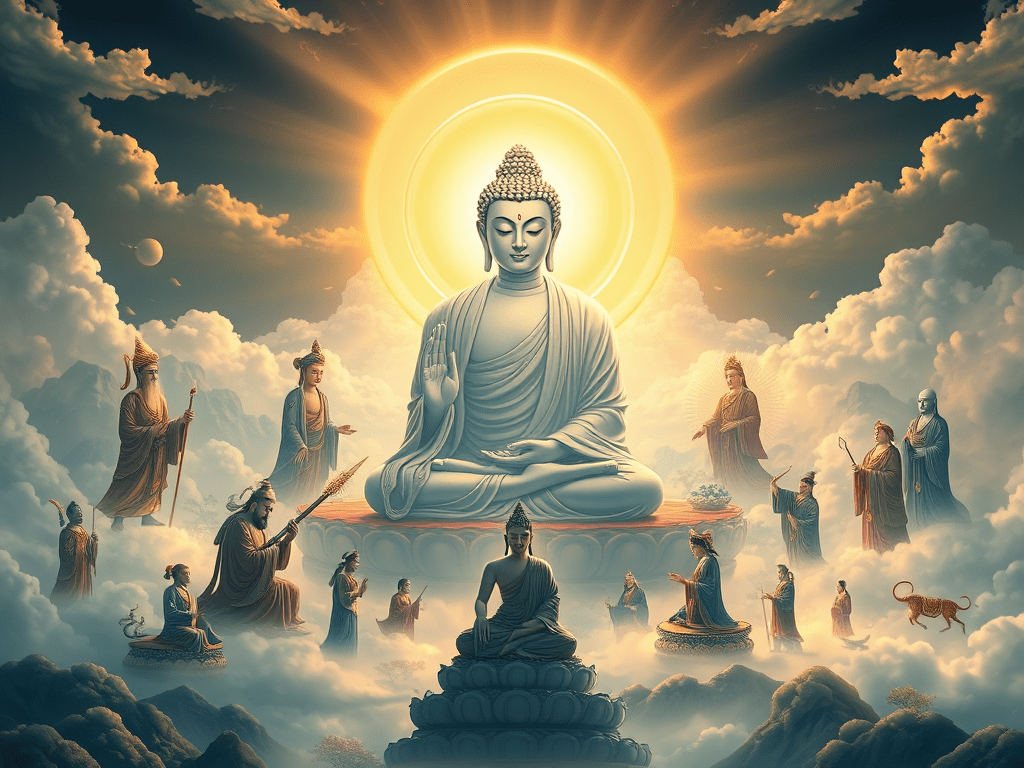
This briefing document summarizes the core themes and most important concepts presented in the provided sources, focusing on the Lotus Sutra’s significance, particularly through Nichiren’s interpretation, and its role in personal and societal transformation.
1. The Lotus Sutra: A Foundation for Universal Enlightenment
The Lotus Sutra, or Saddharma Puṇḍarīka Sūtra, is a foundational text in Mahayana Buddhism, particularly influencing Tiantai, Tendai, Nichiren, and Zen traditions. Its teachings are considered “complete and sufficient for salvation,” offering a “radical re-vision of both the Buddhist path and the very person of the Buddha.”
Key Teachings:
- One Vehicle (Ekayāna): This doctrine unifies all seemingly disparate Buddhist paths into a single, overarching path to Buddhahood, asserting “no other vehicle” apart from the Buddha’s skillful means.
- Universal Buddhahood: A revolutionary assertion that “all beings may eventually become Buddha,” positing that “every individual possesses the inherent potential to achieve Nirvana and awaken their true nature, often referred to as Dharmakaya or Buddha-nature.” The Lotus Sutra is unique in asserting this universal potential “without exception.”
- Skillful Means (Upāya): Buddhas adapt their teachings and strategies to suit diverse needs, using “a rich tapestry of parables” (e.g., Burning House, Prodigal Son) to guide beings toward ultimate truth.
- Eternal Buddha: The Sutra re-envisions Shakyamuni Buddha not as a singular historical figure, but as a manifestation of a “transcendent, eternal Buddhahood,” perpetually guiding beings. This concept, especially emphasized in Chapter 16 (“Life Span of the Thus Come One”), implies that the Dharma is not lost or degenerating but “perpetually available through the Sutra.”
- Importance of Faith: Sincere belief and devotion are paramount for comprehending and embodying the Buddha’s teachings, serving as “the key to unlocking the path to enlightenment.”
2. Samantabhadra’s Vow of Protection and Practice
Universal-Sage Bodhisattva (Samantabhadra or Fugen) is a significant figure in the Lotus Sutra, “deeply associated with practice and meditation.” He is revered as the “patron of the Lotus Sutra” and represents action, complementing Mañjuśrī’s wisdom.
Samantabhadra’s Declaration (Chapter 28):
In Chapter Twenty-Eight, Samantabhadra makes a “solemn and far-reaching declaration” to protect those who uphold the Lotus Sutra in the “defiled world in the later five hundred years.” He vows: “In the Evil and corrupt age of the last five-hundred-year period, if there is someone who accepts and upholds this Sutra, I will guard and protect him, free him from decline and harm, see that he attains peace and tranquillity, and make certain that no one can spy out and take advantage of his shortcomings.”
This declaration includes a promise of his appearance to diligent practitioners: if individuals “concentrate their minds [on study and practice] strenuously for three weeks,” he will appear “mounted on his white elephant with six tusks, accompanied by innumerable Bodhisattvas.” This imagery symbolizes “purity, immense power, and the ability to overcome all obstacles.” Samantabhadra also vows to ensure the Sutra’s “wide propagation” and that it “never comes to an end” after the Buddha’s extinction.
This protective role “legitimizes and empowers the practices of the Lotus Sutra in Mappō,” implying that the Sutra’s efficacy in this age is “significantly bolstered by the direct intervention of enlightened beings.”
3. The Age of Mappō: Nichiren’s Direct Path
Mappō, or the Latter Day of the Law, is a core concept in East Asian Buddhist eschatology, positing a “progressive decline in the Buddha’s law over time,” making enlightenment increasingly difficult through conventional means. This period, believed to have commenced in 1052 CE, is characterized by “a deterioration not only in the quality and quantity of transmitted Buddhist teachings but also in the spiritual and karmic capacities of practitioners themselves.”
Nichiren’s Interpretation and Rationale:
Nichiren, active in 13th-century Japan during a time of “severe social and political turmoil,” firmly believed his era was Mappō. He contended that in this “degenerate age, other Buddhist teachings…had lost their ability to lead people to enlightenment.” For Nichiren, “only the Lotus Sutra possessed the profound power and ultimate truth necessary to guide all individuals to liberation in Mappō.” He viewed societal instability as a direct result of “abandonment of the correct teaching.”
Nichiren asserted that Buddhism in Mappō demanded to be “practiced with the body,” meaning through “concrete actions that would lead to tangible results in transforming both individual lives and society.” His major work, Rissho Ankoku Ron (Establishing The Correct Teaching for the Peace of The Land), argued that national peace depended on embracing the Lotus Sutra.
He focused on the “Primordial Eight Chapters” (Honmon Happon) of the Lotus Sutra (specifically Chapters 15-22, with particular emphasis on 16 and 21) as most suitable for ordinary practitioners in Mappō.
Comparison with Other Mappō Responses:
- Pure Land Buddhism: Emphasized reliance on “Other-Power” (tariki) of Amida Buddha through chanting the nenbutsu (Namu Amida Butsu) for rebirth in a Pure Land, arguing the Lotus Sutra was “too complex for the ‘benighted persons of the Final Dharma age’.”
- Dōgen Zenji (Sōtō Zen): Explicitly “rejected the concept of shōzōmatsu, which includes Mappō,” maintaining that the Dharma “neither waxes nor wanes.” Dōgen emphasized zazen (sitting meditation) as enlightenment itself, advocating “unrelenting efforts to live in the spirit of the Buddha precisely because of the perceived difficulties of the age.”
- Nichiren’s Unique Stance: Accepted Mappō as a real, prophetic condition, but used it to assert the exclusive and direct efficacy of the Lotus Sutra’s title (Daimoku) as the “only valid practice for this specific age.” Unlike Dōgen, Nichiren embraced Mappō as an indicator that the time for the ultimate teaching had arrived, demanding “a unique, direct, and universally accessible practice—chanting the Daimoku—that also required active, even confrontational, propagation to transform society.”
4. Nichiren’s Practical Engagement: The Three Great Secret Laws and Bodily Reading
Nichiren established the “Three Great Secret Laws” as the concrete manifestation of the Lotus Sutra’s essence for Mappō:
- Gohonzon (Object of Devotion): A calligraphic mandala embodying Nam-myoho-renge-kyo.
- Daimoku (Chanting): The chanting of “Namu Myōhō Renge Kyō” to the Gohonzon, considered the “direct path to enlightenment” for Mappō. It embodies the “title and essence of the Lotus Sutra,” activating “three thousand realms in a single thought-moment” within one’s life.
- Sanctuary (Kaidan): The place where the Gohonzon is enshrined and practice is carried out.
The Five Practices Through Nichiren’s Lens:
Samantabhadra’s five practices from Chapter 28 are interpreted by Nichiren as active engagements:
- Seeking the Sutra: Cultivating a “seeking spirit”—”an open and receptive heart” and a “continuous striving to understand Nichiren Daishonin’s teachings and actively integrate them into one’s daily life,” linked to the aspiration to “single-mindedly desire to see the Buddha” (revealing inherent Buddhahood).
- Keeping the Sutra: “Relying steadfastly on its teachings and maintaining unwavering confidence in its power,” ensuring practice “does not become an ’empty routine or habit’” but manifests “the good qualities of the six perfections.”
- Reading and Reciting the Sutra: Primarily actualized through chanting Namu Myōhō Renge Kyō (Daimoku), which contains “all of the qualities of Buddhahood” and represents the “mystic law.” Auxiliary recitation of Chapter 2 and Chapter 16 is also practiced.
- Copying the Sutra (Shakyo): Understood as “a means of making its profound teachings available to others,” a meditative act performed with “meticulous care and deep appreciation,” generating “limitless merit.”
“Bodily Reading” the Lotus Sutra:
Nichiren’s concept of “bodily reading the Lotus Sutra” signifies an “immediate, experiential, and face-to-face encounter with the living presence of the Primordial Buddha,” transcending passive engagement. This involves:
- Awareness of Śākyamuni Buddha’s living presence: Recognizing the Eternal Buddha as “eternally active and engaged in human events.”
- One contains all: The Tiantai doctrine of “three thousand realms in a single thought-moment,” meaning every thought, word, or deed “contains within itself the entirety of existence.”
- The here and now: The “bodily reading” must be “directly applicable to the specific time, place, and contemporary events,” demanding “actualization in endeavors toward the transformation of the land, toward the realization of an ideal society.”
- Utmost seriousness: Practitioners must “actively ‘speak up against and oppose prevailing thoughts and philosophies that denigrate the message of the Lotus Sutra’,” demonstrating a willingness to dedicate one’s life to propagation.
This approach transforms practices into a “dynamic, activist path” where internal awakening “must necessarily translate into concrete actions aimed at transforming society.”
5. Merits of Practice: Transforming Self and World
The practices, especially through Nichiren’s interpretation, lead to a “dual transformation: ‘seeing the world for what it is’ and actively ‘making it better for everyone’.”
Seeing the World for What It Is:
This signifies an “experiential awakening” and the realization of one’s “inherent Buddha-nature,” meaning all beings “possess an internal Buddha-nature and the capacity to attain Buddhahood in their current lifetime.” Chanting Daimoku is seen as “polishing a tarnished mirror, so as to reflect the true nature of reality — Buddhahood!” This involves perceiving the “fundamental law that underlies the workings of all life and the universe,” recognizing the “Eternal Shakyamuni Buddha” as a constant presence, and grasping the “eternity of life.” This realization imbues life with “purpose, hope, vitality, courage, compassion, and wisdom.”
Making the World Better for Everyone:
This is the essence of the bodhisattva path, dedicated to attaining enlightenment for the benefit of all. “True happiness for yourself is impossible while others suffer.” When individuals help others discover their inner strength, “their own capacity for life simultaneously expands.” This reciprocal dynamic is “the marvel of the bodhisattva path; actions to benefit others cannot be separated from actions to benefit oneself.”
Practitioners manifest “the perfect wisdom and great compassion of the Buddha” and actualize the “six perfections.” Nichiren viewed his disciples as “Bodhisattvas of the Earth,” tasked with spreading the correct teaching to “establish a peaceful and just society.”
The Vision of a “Pure Land” in This World:
A significant merit is the “tangible transformation of the ‘defiled world’ into a ‘pure land of peace and tranquility’.” The Lotus Sutra teaches: “This world of Mine is at peace” and “there is no Pure Land other than the very place where the practicer of the Lotus Sūtra resides.” This emphasizes that the Buddha land is “inseparable from the present world,” and “the land is thus held to reflect the life state of living beings,” meaning individual inner transformation leads to external environmental transformation, creating “a tangible paradise on Earth.”
6. Conclusion: A Catalyst for Human Revolution
Universal-Sage Bodhisattva’s vow, coupled with Nichiren’s interpretation of Mappō, transformed a prophecy into an “urgent mandate for action,” establishing a “direct and accessible path to enlightenment” through the Lotus Sutra. The practices of seeking, keeping, reading, reciting, and copying, when understood through “bodily reading,” lead to “seeing the world for what it is” and “making it better for everyone.”
The Lotus Sutra offers “profound hope and empowerment,” asserting that every individual has “innate potential for Buddhahood” and the capacity to transform their life and environment. It advocates an “active, engaged approach to life’s myriad challenges,” viewing them as opportunities for growth. The ultimate aim is “the creation of genuine and lasting happiness for oneself and for others, leading to the establishment of a society founded on peace and the dignity of all life.” This “humanism of the Lotus Sutra” catalyzes a “continuous human revolution.”
 Mr. Altig’s Overview of the Wonderful Dharma of the Lotus Sutra
Leave a comment