Date: August 9, 2025
Subject: An analysis of Maitreya’s questions in Chapter 15 of the Lotus Sūtra, Shakyamuni Buddha’s response, and subsequent interpretations across various Buddhist traditions (Tiantai, Nichiren, Zen).
1. Executive Summary
Maitreya’s profound questions in Chapter 15 (“Emerging from the Earth”) of the Lotus Sūtra serve as a pivotal narrative device, prompting Shakyamuni Buddha to unveil his true, eternal nature and the immeasurable lifespan of his enlightenment. This revelation, addressed in Chapter 16 (“The Life Span of the Tathāgata”), fundamentally reshapes the understanding of Buddhahood within Mahāyāna Buddhism. Far from demonstrating a lack of faith, Maitreya’s earnest inquiry exemplifies a healthy skepticism welcomed by the Buddha, modeling how faith is deepened through understanding. Subsequent interpretations across traditions, notably Tiantai, Nichiren, and Zen, highlight different facets of this episode, from the concept of the “Original Buddha” and the “Middle Way” to the active role of “Bodhisattvas of the Earth” in the present age and the symbolic meaning of inherent Buddha-nature. This episode is central to understanding the timeless and pervasive nature of the Dharma and the Buddha’s compassionate guidance.
2. Context of Maitreya’s Question (Chapter 15)
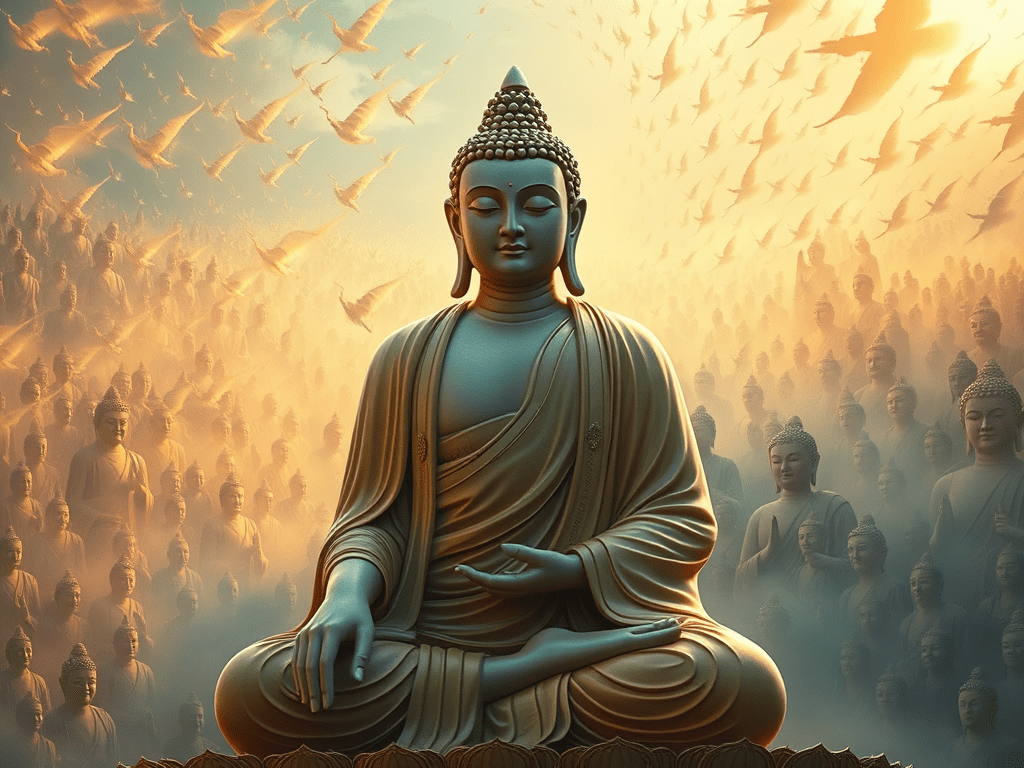
- Astonishing Scene: The chapter opens with an unprecedented sight: “innumerable bodhisattvas suddenly spring forth from beneath the earth and fill the sky before the Buddha.” These bodhisattvas are “as numerous as the sands of countless Ganges Rivers,” led by four great leaders, and are unknown to the assembly [1][2].
- Maitreya’s Dilemma: Bodhisattva Maitreya, representing the assembly, is astonished. He asks Shakyamuni Buddha who these mysterious bodhisattvas are and “how they could have trained to such advanced stages under Shakyamuni’s guidance in such a short time” [3][4].
- The Analogy of Implausibility: Maitreya articulates the perceived contradiction: Shakyamuni attained enlightenment historically only about forty years prior, yet these bodhisattvas appear to have practiced for eons. He uses a vivid analogy: “as absurd as a 25-year-old man claiming to be father to a 100-year-old” to convey the apparent impossibility of Shakyamuni having “taught and converted an immeasurable…number of great bodhisattvas” in such a brief period [5][6].
- Core Question: Maitreya’s pressing inquiry, chanted in verse, summarizes: “How in such a short time did you teach these innumerable bodhisattvas, cause them to aspire to enlightenment, and establish them in non-retrogression?” [7]. This question is rooted in genuine confusion, not disbelief, setting the stage for a profound revelation.
3. Buddha’s Response and the Revelation of Eternal Buddhahood (Chapter 16)
- Confirmation and Deeper Doubt: Shakyamuni confirms that these countless bodhisattvas are indeed his disciples, whom he “has been teaching and converting since the distant past” [8]. This initial statement deepens the assembly’s perplexity.
- Disclosure of Immeasurable Lifespan: To resolve the doubt, Shakyamuni reveals that his enlightenment was not attained 40 years prior under the Bodhi tree, but “countless eons (kalpas) in the past” [9]. This is the central revelation of the Buddha’s immeasurable lifespan.
- Rejection of Mere Miracle: The text explicitly “rejects the idea that the Buddha simply used a sudden feat of supernatural power to train them overnight” [11]. Instead, it asserts a “grander truth – that Shakyamuni’s Buddhahood transcends the conventional timeline” [11].
- “Original Buddha”: This teaching elevates Shakyamuni to the status of the “Original Buddha” whose enlightened work is timeless [11]. He has “ever since the long distant past” been guiding these bodhisattvas [10][5].
- Maitreya’s Role: Maitreya’s “earnest questioning is the device that prompts the Buddha to unveil this deepest level of truth” [8]. This repositioning subtly places Maitreya, the future Buddha, as a learner awed by Shakyamuni’s true greatness.
4. Faith and the Importance of Questioning
- Faith and Skepticism: The episode models a balanced Buddhist approach to faith, combining “faith and healthy skepticism” [12]. Maitreya prefaces his query by affirming the assembly’s trust in the Buddha’s wisdom as “never false” [12].
- Compassionate Pedagogy: Maitreya candidly admits the scenario is hard to grasp and requests clarification “for the sake of future followers who might harbor doubts” [12][7]. The bodhisattvas state, “We ourselves have faith in the Buddha… Nevertheless, in the age after the Buddha has passed, if newcomers hear this they may not believe it… so we beg you to explain and dispel our doubts” [12].
- Welcoming Inquiry: Shakyamuni warmly praises Maitreya’s question, calling it “excellent” [13]. The Buddha “does not demand blind obedience”; instead, he welcomes sincere questions as a path to deeper understanding [13].
- Active Engagement: This dynamic demonstrates that Buddhist faith is not passive acceptance but “an active engagement of one’s whole being – including a critical mind – in pursuit of truth” [8][12]. It ensures faith is bolstered by understanding, leading to insight and “unshakable peace.”
5. Tiantai (T’ien-t’ai) Interpretation: The “Original” Buddha and the Middle Way
- “Essential Teaching”: Tiantai scholars like Zhiyi (6th century) identified Chapter 15 as the “beginning of the ‘essential teaching’” of the Lotus Sūtra, where Shakyamuni reveals his original enlightenment [14][15]. Chapters 1-14 are considered the “trace teaching” of the historical Buddha, transitioning to the “essential teaching” of the “original, eternal” Buddha from Chapter 15 onward [17].
- Primordial Buddha and Original Disciples: The earth-emerging bodhisattvas are understood as the Buddha’s “original disciples from time without beginning“, underscoring Shakyamuni’s status as the “primordial Buddha” [15].
- Symbolism of “Under the Earth”: Zhiyi interpreted the bodhisattvas dwelling “under the earth” figuratively. In his Fahua Wenju, “‘underneath’… is none other than the middle way,” symbolizing the “fundamental ground of truth (Dharma-nature)” or “the Land of Eternally Tranquil Light” [16]. This means the bodhisattvas abide in the profound emptiness or thusness underlying all phenomena.
- Emergence from Dharma: Their sudden appearance “from the earth” is not literal dirt, but signifies their arising from the deep “ground of Dharma” – the ultimate truth, hidden from mundane view, that manifests when the Buddha’s true teaching is revealed [16].
- Reconciling Contradictions: Maitreya’s bafflement sets the stage for Shakyamuni to disclose the “Middle Way reality of his Buddha-hood,” reconciling the apparent contradiction of a short-lived Buddha instructing ageless bodhisattvas [16]. Tiantai views this as guiding readers from a superficial view to an enlightened understanding that “the Buddha’s compassion and teaching activity are timeless” [16].
6. Nichiren’s Interpretation: Bodhisattvas of the Earth and Their Mission
- Eternal Buddha and Literal Truth: Nichiren Daishonin (13th century) saw Shakyamuni’s statement “I have been teaching these bodhisattvas since the remotest past” as literal proof of Shakyamuni as the “Eternal Buddha” [18][19]. He aligned with Tiantai in identifying Shakyamuni in Chapters 15-16 as “the Buddha in his true identity” [19].
- Identity of the Bodhisattvas: Nichiren’s distinctive view is that “the Bodhisattvas of the Earth are the very practitioners who embrace and propagate the Lotus Sūtra in the present era” (the Latter Day of the Law) [19][20].
- Divine Mandate: Nichiren boldly declared, “Nichiren and his followers… are all followers of these bodhisattvas who emerged from the earth,” identifying his movement as the “reincarnation or continuations of those very Bodhisattvas” entrusted to spread the correct teaching [20].
- Practice and Mission: The core practice for these bodhisattvas is the chanting of the Lotus Sūtra’s title (Nam-myoho-renge-kyo) [21][22]. By chanting and teaching this Law, Nichiren’s followers fulfill the vow to “lead and guide all living beings” to enlightenment [23][24].
- Inspirational Message: For Nichiren Buddhists, Maitreya’s astonishment highlights the extraordinary nature of the “essential teaching.” It implies that even after the historical Buddha’s passing, awakened Bodhisattvas (manifest as ordinary people) trained by the Eternal Buddha will continue the mission of universal salvation [19][20]. They believe upholding this teaching connects them directly with the Eternal Buddha’s disciples and work.
7. Symbolic Readings: Inherent Enlightenment and the Inner Buddha Nature
- Enlightenment is Inherent: Many symbolic interpretations, especially in Zen, see the emergence of bodhisattvas from the earth as highlighting that “enlightenment and the Dharma are inherent in this world and within ourselves,” not from an external realm [25].
- Earth as the Ordinary World: The “earth” from which the bodhisattvas spring symbolizes “the ordinary, everyday world – this saha world with all its suffering – which nevertheless contains limitless potential for wisdom and compassion” [25].
- “Treasures of the House”: The aphorism “The treasures of the house do not come in through the front gate” illustrates that enlightenment “is not something that enters our life from outside, but arises from within the ‘house’ of our own life” [26]. The “saviors” are nurtured in the depths of our own world.
- Spiritual Ecology/Buddha-Nature: Some modern interpreters see this as implying a “spiritual ecology,” where “the earth itself, and all reality, is already suffused with the Buddha’s wisdom, poised to assist all beings” [27]. “Buddha-nature is the ground of our being,” and bodhisattva qualities inherent in life can burst forth when conditions are right [27].
- Innate Enlightenment (Hongaku): This aligns with hongaku, the Mahāyāna teaching that we are originally enlightened, and practice simply brings out what is already present [25]. Maitreya’s bewilderment can represent the unenlightened mind encountering its own inherent Buddha-nature for the first time.
- Call to Personal Responsibility: Devotional traditions draw inspiration for “devotion and personal responsibility,” encouraging believers to emulate the bodhisattvas and “bring forth” the bodhisattva from their own hearts by studying and chanting the Lotus Sūtra [28][29].
8. Conclusion
Maitreya’s questions in the Lotus Sūtra are indispensable for revealing one of Mahāyāna Buddhism’s profound truths: the Buddha’s infinite enlightenment and the boundless nature of his true disciples. The episode exemplifies a fusion of “faith and understanding,” where sincere inquiry deepens faith through wisdom, rather than undermining it [12].
- Tiantai emphasizes the doctrinal transition from the temporary to the “Original Buddha” and the symbolic meaning of the bodhisattvas arising from the “Middle Way” or Dharma-nature [16][18].
- Nichiren concretizes this by identifying the Bodhisattvas of the Earth as present-day practitioners committed to propagating the Lotus Sūtra, thereby continuing the Eternal Buddha’s mission [19][20].
- Symbolic readings across various traditions, including Zen, highlight the inherent nature of enlightenment and Buddha-nature within all beings and the world itself [25].
Ultimately, Maitreya’s role serves as a reminder that true understanding often begins with a question, guiding practitioners to perceive the Buddha’s enduring and far-reaching guidance that transcends conventional time and space. The innumerable bodhisattvas emerging from the earth represent both a literal miracle and a powerful metaphor for the awakening of countless Bodhisattva-hearted beings in every age, all nurtured by the Buddha who “has been teaching and converting this multitude” from the very start [10].
 Mr. Altig’s Overview of the Wonderful Dharma of the Lotus Sutra
Leave a comment