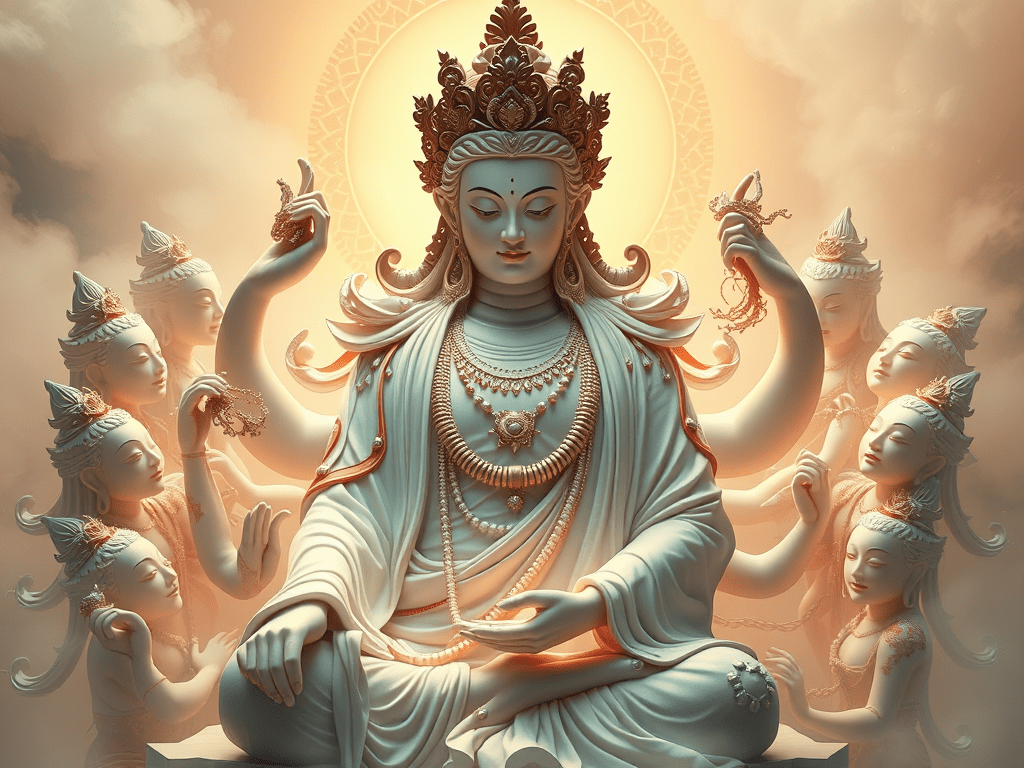
Executive Summary
This document synthesizes a detailed analysis of Avalokiteśvara, the Bodhisattva of Compassion, as presented in Chapter Twenty-Five of the Lotus Sūtra, titled “The Universal Gateway.” The analysis reveals a complex figure whose significance extends far beyond that of a simple devotional deity. The central thesis is that the text presents a dual-layered understanding of salvation, offering both literal, worldly deliverance from suffering and a profound path of inner, psychological transformation.
The Bodhisattva’s defining characteristic is the application of upāya (skillful means), epitomized by their ability to manifest in thirty-three different forms to meet the specific needs of sentient beings. This capacity is not merely a display of power but a personification of the core Mahāyāna doctrine that all paths ultimately lead to the One Vehicle of Buddhahood.
A critical aspect of Avalokiteśvara’s legacy is a remarkable cultural evolution, most notably the transformation from a male Indian bodhisattva into the feminized figure of Guanyin in China. This shift was a bottom-up process driven by sociological needs and theological interpretations, demonstrating Buddhism’s profound adaptability.
Finally, the analysis concludes that the “Universal Gateway” remains relevant in the modern era as a blueprint for compassionate action. Contemporary interpretations, particularly within Engaged Buddhism, reframe the bodhisattva’s powers as a potential to be actualized within each practitioner, transforming devotional practice into a call for deep listening and active engagement to alleviate suffering in the world.
1. The Doctrinal Foundation: Chapter 25 of the Lotus Sūtra
1.1. Context of the Lotus Sūtra
The Saddharma-puṇḍarīka Sūtra (Lotus Sūtra) is a foundational text in Mahāyāna Buddhism. Its central metaphor is the lotus flower, which grows in muddy water yet rises above it to produce a pure blossom. This symbolizes the potential for all beings to achieve a pure life and enlightenment amidst the defilements and troubles of the world. The sūtra is known for its “radical re-vision” of the Buddhist path, asserting that the various paths to enlightenment are skillful means (upāya) that are part of a single, all-encompassing “One Vehicle” to Buddhahood.
1.2. The “Universal Gateway” Chapter
Chapter Twenty-Five, “The Universal Gateway of the Bodhisattva Avalokiteśvara,” functions as a standalone sermon on the bodhisattva’s compassion and powers. It is one of the most popular chapters, often circulated independently as the Avalokiteśvara Sūtra. Its primary purpose is to introduce the “Universal Gate” (pumen), symbolizing that salvation is accessible to all beings through Avalokiteśvara. The chapter outlines a democratic path to liberation, requiring only a sincere heart to call upon the bodhisattva’s name, making it accessible regardless of social status, gender, or level of scholarly or meditative attainment.
2. The Dual Nature of Salvation: Literal and Allegorical Deliverance
Chapter 25 promises deliverance from a series of external dangers and internal afflictions for those who call Avalokiteśvara’s name. This promise is understood through a dual interpretation that provides both devotional comfort and a guide for inner transformation.
2.1. The Seven Difficulties and Three Poisons
The text details seven external threats and three internal “poisons” from which the bodhisattva offers salvation:
• The Seven Difficulties: Falling into fire, being swept away by floods, encountering demons, facing attack by knives and staves, being haunted by malignant ghosts, suffering imprisonment, and being accosted by thieves.
• The Three Poisons: Lust, anger, and folly (ignorance).
2.2. Literal vs. Allegorical Readings
The power of the text lies in its capacity for both literal and allegorical interpretation.
• Literal Reading: This interpretation presents Avalokiteśvara as a powerful savior who can physically intervene in worldly affairs, such as preventing a fire from burning or a river from drowning a person. This aspect is a primary driver of popular devotion, as it offers tangible benefits and reinforces belief in divine intercession.
• Allegorical Reading: Scholarly commentary reveals a deeper, psychological meaning. The “Seven Kinds of Difficulty” are symbolic of inner experiences. For example, fire represents the emotional pain of being “burned” by an event, a flood signifies being “drowned” by inner turmoil, and imprisonment is the feeling of being held captive by one’s own suffering. The three poisons are already explicitly psychological states.
This dual reading resolves the theological paradox of why a divine being does not prevent all disasters. Bodhisattvas are not omnipotent and cannot overturn karma. The act of calling the bodhisattva’s name is an act of mental cultivation that prepares the individual to receive the ever-present compassion, with physical miracles being a secondary effect of the primary miracle of inner transformation.
| Physical Danger/Poison | Literal Meaning | Allegorical Meaning |
| Fire | Falling into a great fire; the fire will not burn you. | Being consumed by anger, emotional pain, or internal “fires.” |
| Water | Being carried away by a flood; you will reach shallows. | Overwhelming emotional turmoil; feeling “drowned” by suffering. |
| Demons/Ghosts | Tormented by evil spirits; they will not be able to harm you. | Haunted by inner fears, anxieties, and unwholesome states of mind. |
| Knives & Staves | Physical assault; weapons will shatter. | Being “cut” or “stabbed in the back” by people or events. |
| Imprisonment | Being captured and put in chains; bonds will be broken. | Feeling held prisoner by one’s own habits, suffering, or circumstances. |
| Thieves/Robbers | Being attacked by bandits; you will be saved. | Being “robbed” of one’s inner peace, presence, and well-being. |
| Lust | Afflicted by great lust; you will be freed from desire. | The mental poison of greed, attachment, and craving. |
| Anger | Afflicted by great anger; you will be freed from rage. | The mental poison of hatred and ill-will. |
| Folly | Afflicted by great folly; you will be freed from stupidity. | The mental poison of delusion and ignorance. |
3. The Principle of Upāya: The Thirty-Three Manifestations
The Lotus Sūtra’s teachings on upāya-kauśalya (skillful means) are central to its doctrine. Upāya refers to the adaptable strategies used by Buddhas and Bodhisattvas to guide beings according to their unique capacities. Avalokiteśvara’s thirty-three forms of manifestation are the ultimate expression of this principle. The bodhisattva appears in whatever form is necessary to teach and save a particular being, embodying the “One Vehicle” doctrine that all paths lead to the same ultimate truth.
| Manifestation | Type of Being Saved |
| Buddha | Those to be saved by a Buddha |
| Pratyekabuddha | Those to be saved by a Pratyekabuddha |
| Śrāvaka | Those to be saved by a Śrāvaka |
| Brahma King | Those to be saved by the Brahma King |
| Śakra (Indra) | Those to be saved by Śakra |
| Maheśvara | Those to be saved by Maheśvara |
| Great Heavenly General | Those to be saved by a Great Heavenly General |
| Vaishravana | Those to be saved by Vaishravana |
| Lesser King | Those to be saved by a Lesser King |
| Elder | Those to be saved by an Elder |
| Ordinary Citizen | Those to be saved by an Ordinary Citizen |
| High Official | Those to be saved by a High Official |
| Brahman | Those to be saved by a Brahman |
| Monk | Those to be saved by a Monk |
| Nun | Those to be saved by a Nun |
| Layman | Those to be saved by a Layman |
| Laywoman | Those to be saved by a Laywoman |
| Wife of an Elder, etc. | Those to be saved by the wife of a layperson |
| Boy or Girl | Those to be saved by a boy or girl |
4. Theological Profile and Etymology
4.1. The Union of Karuṇā and Prajñā
Avalokiteśvara is the ideal embodiment of karuṇā (compassion) and prajñā (wisdom), the two pillars of the bodhisattva path.
• Karuṇā: An active, unselfish willingness to alleviate the suffering of others. This is exemplified by the vow to delay one’s own Buddhahood until all beings are liberated.
• Prajñā: A profound wisdom and understanding of the true nature of reality. The union of these two ensures that compassionate action is a skillful response tailored to each situation, not a blind impulse.
4.2. Etymological and Theological Shifts
The bodhisattva’s name reflects a significant evolution.
• The original Sanskrit name, Avalokitasvara, means “Sound Perceiver,” aligning perfectly with the Chinese translation Guanshiyin (“Perceiver of the World’s Sounds”) and the core function of hearing the cries of sentient beings.
• The later form, Avalokiteśvara, means “Lord who looks down.” The inclusion of īśvara (“Lord”), a term associated with supreme Hindu deities like Śiva, shows an adaptation to theistic cultural contexts, bridging Buddhist doctrine with familiar concepts of a supreme being without adopting the notion of a creator god.
4.3. Naming Across Cultures
The name transformed as Buddhism spread:
• China: Guanshiyin or the shortened Guanyin. The character shì was dropped during the Tang dynasty to avoid a naming taboo involving Emperor Tàizōng.
• Japan: Kannon or Kanzeon.
• Korea: Kwanse’um.
• Vietnam: Quanam.
5. Cultural Adaptation and the Feminization of Guanyin
Avalokiteśvara is a prime example of Buddhism’s cultural malleability. While remaining the embodiment of compassion, the figure’s persona adapted to local contexts across Asia.
• Tibet: Known as Chenrezig, with the Dalai Lama regarded as his incarnation.
• Sri Lanka: Became Natha Deviyo and a royal symbol.
• China: Underwent the most profound transformation, evolving from a male bodhisattva into the beloved female figure of Guanyin, often called the “Goddess of Mercy.”
The feminization of Guanyin was a complex, bottom-up cultural process that became prominent from the 12th century onward.
• Sociological Factors: The bodhisattva’s compassionate nature resonated with maternal qualities in Chinese culture. This transformation also filled a “religious vacuum” for a powerful female spiritual figure, offering a counterbalance to patriarchal ideologies.
• Theological Basis: The Lotus Sūtra itself provides a basis by stating the bodhisattva can appear as a woman and can grant children.
• Indigenization: Local legends, most famously that of Princess Miao-shan who sacrificed her own body to heal her father, provided a human narrative that made the celestial figure relatable. This led to the creation of pilgrimage sites like Putuo Shan.
| Tradition | Name | Gender | Primary Associated Text/Cult | Key Iconographic Attributes | Associated Cultural Concepts |
| Indian Buddhism | Avalokiteśvara, Padmapāni | Male | Lotus Sūtra, Kāraṇḍavyūha Sūtra, Pure Land | Lotus, Amitābha in crown, elaborate jewelry, varada mudra | Embodiment of karuṇā, chief attendant to Amitābha Buddha |
| Tibetan Buddhism | Chenrezig, Jainraisig | Male | Mantra: Auṃ Maṇi Padme Hūṃ | Multiple arms and heads (e.g., Eleven-Headed, Thousand-Armed) | Incarnated as the Dalai Lama; compassionate savior for all realms |
| Chinese Buddhism | Guanshiyin, Guanyin | Female | Lotus Sūtra, Pure Land, local folk legends (Miao-shan) | White robes, willow branch, pure water vase, infant (as Sòngzǐ Guānyīn) | “Goddess of Mercy”; patroness of sailors; fertility goddess |
| Japanese Buddhism | Kannon, Kanzeon | Male & female | Lotus Sūtra | Multi-armed or simple, often holds lotus or water vase | Compassionate savior; patron of fishermen; patron of children |
6. The Visual Language of Compassion: Iconography
The visual representations of Avalokiteśvara/Guanyin are rich with symbolism.
• Lotus Flower: Represents purity and enlightenment, rising unstained from the “muddy waters of samsara.”
• Pure Water Vase: Contains the “divine nectar of life,” used to relieve suffering.
• Willow Branch: Used to sprinkle the pure water, it is believed to ward off evil. Its flexibility symbolizes resilience and adaptability.
• Thousand-Armed, Thousand-Eyed Form: This powerful image is a visual metaphor for the bodhisattva’s limitless capacity. The thousand eyes symbolize the wisdom (prajñā) to perceive suffering everywhere, while the thousand arms symbolize the boundless compassion (karuṇā) to help all beings. The eyes in the palms of the hands signify that every act of compassion is guided by wisdom.
7. Intertextual Roles: Emptiness and the Pure Land
Avalokiteśvara’s character is further illuminated by his roles in other key Mahāyāna texts.
• The Heart Sūtra: Here, Avalokiteśvara is a philosophical teacher who explains the core doctrine of śūnyatā (emptiness) to the monk Śāriputra. He declares that “form is emptiness, and emptiness is form.” This complements the Lotus Sūtra by providing the philosophical foundation for the thirty-three manifestations. The forms are not substantial but are skillful, compassionate expressions arising from the unconditioned potential of emptiness.
• Pure Land Buddhism: In this tradition, Avalokiteśvara is the chief attendant to Amitābha Buddha in the Western Pure Land of Sukhāvatī. He assists in teaching the Dharma and guiding beings to rebirth in this realm, connecting him to one of East Asia’s most popular Buddhist traditions.
8. Conclusion: The Living Legacy and Call to Action
The enduring legacy of Avalokiteśvara lies in the ability to bridge abstract doctrine with the tangible realities of human suffering. The “Universal Gateway” provides both devotional comfort and a profound guide for inner transformation.
In the modern era, this legacy has been interpreted as a call to action. The philosophy of Engaged Buddhism reframes Avalokiteśvara’s role not as an external savior to be petitioned, but as an internal potential to be actualized. Practitioners are encouraged to:
• Practice Deep Listening: Embody the “Perceiver of the World’s Sounds” by listening to others with selfless compassion.
• Build a Pure Land on Earth: Engage in social justice and environmental activism as a form of Dharma practice.
• Become an Emanation: Recognize the inherent Buddha-nature in all beings and see oneself as a manifestation of the bodhisattva’s thousand arms and eyes, acting skillfully and compassionately to alleviate suffering in the world.
 Mr. Altig’s Overview of the Wonderful Dharma of the Lotus Sutra
Leave a comment