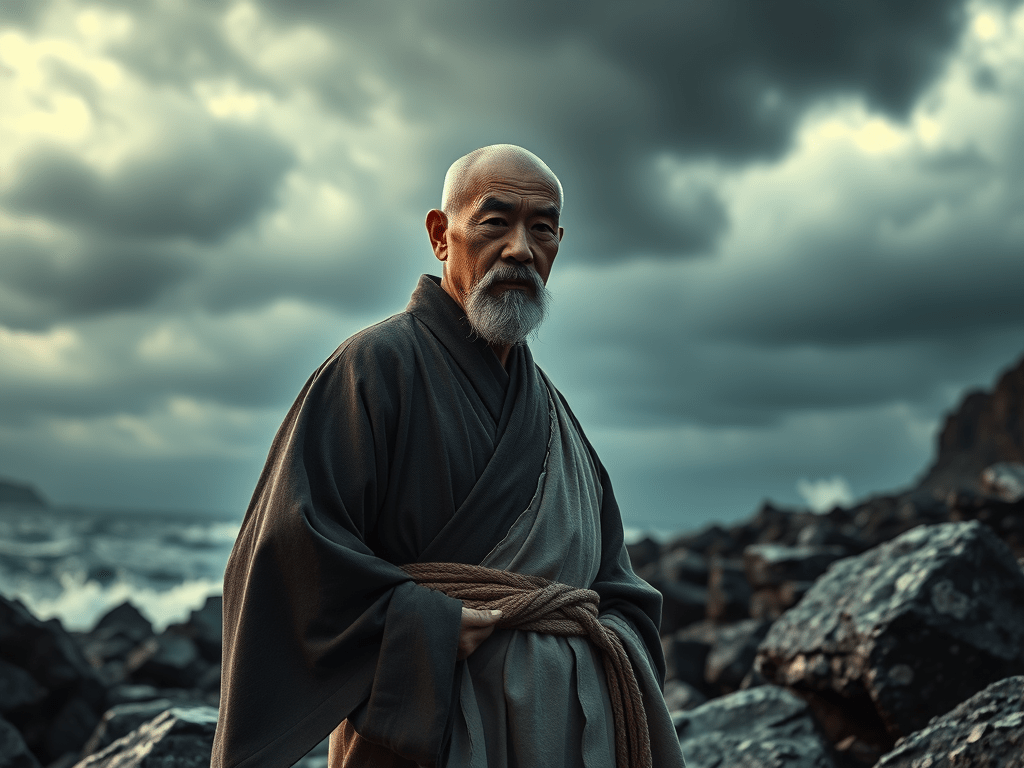
We all know the feeling. Life is moving along, and then, without warning, a challenge appears that knocks us off our feet. It could be a professional setback, a personal crisis, or a wave of obstacles that leaves us feeling powerless and wondering what we did wrong. We strive, we hope, we pray, but sometimes it feels like the universe isn’t listening.
What if our entire framework for understanding these struggles is backward? What if hardship isn’t a sign of failure, but of progress? This is one of several profound perspectives offered by Nichiren Daishonin, a 13th-century Japanese Buddhist reformer. From a place of extreme adversity—exiled on the desolate Sado Island, facing starvation and the constant threat of execution—he developed a philosophy of radical empowerment that flips the script on conventional wisdom.
This article explores four of his most impactful takeaways. These are not abstract spiritual ideas but practical principles that can reframe our modern understanding of faith, protection, and the true source of our personal power.
1. The Surprising Sign of Progress? More Obstacles.
In most belief systems, facing severe hardship after committing to a path can feel like a devastating rebuke. It’s natural to think, “I must be doing something wrong,” or “This isn’t working.” Nichiren Buddhism offers a startlingly different interpretation: encountering intense opposition isn’t a sign that your faith has failed; it can be proof that you are on the correct path.
Nichiren taught his followers to view hardships as “actual proof” of their progress. He explained that the Lotus Sūtra, the scripture he held as the highest teaching, prophesied that its true practitioners would inevitably face severe opposition. Therefore, when these obstacles appeared, they were not a mark of failure but a validation that one’s practice was powerful enough to challenge negativity. This reframes suffering from a faith-destroying experience into an affirmation of one’s efforts.
But this principle goes even deeper. Nichiren also taught the concept of “lessening one’s karmic retribution” (tenju kyōju). This means that through dedicated practice, the heavy negative karma we have created in the past can be experienced in a much lighter form in this lifetime. From this perspective, a challenge isn’t just a test; it’s a profound act of purification. The obstacle becomes a fire that doesn’t just forge our resolve but also burns away the karmic fuel of past causes, liberating us for the future. As Nichiren encouraged, adversity should be met not with fear, but with a sense of courageous joy.
“The greater the hardships befalling him, the greater the delight he feels, because of his strong faith.”
2. True Faith Isn’t About Worshipping a God—It’s About Seeing Yourself.
At the center of Nichiren Buddhist practice is an object of devotion called the Gohonzon. It is not a statue of a deity but a calligraphic mandala that functions as a “clear mirror.” The purpose is not to worship an external being but to reflect the practitioner’s own inner, enlightened nature.
Crucially, the Gohonzon doesn’t just represent the highest state of Buddhahood. It graphically depicts all of the Ten Worlds—the full spectrum of life conditions inherent within every person—from the sublime state of Buddhahood down to the lowest state of Hell. This sends a profound message: enlightenment is not achieved by eradicating our negative aspects like anger, greed, or doubt. Instead, it is the process of illuminating our entire being. To make this explicit, the Gohonzon includes the Sanskrit characters for the wisdom kings Aizen Myō-ō, who represents the principle of “earthly desires are enlightenment,” and Fudō Myō-ō, who represents “the sufferings of birth and death are nirvana.”
Our struggles and imperfections are not things to be eliminated; they are the very raw material for our growth. Devotion, in this context, becomes an act of perceiving and summoning forth the Buddhahood that exists within the totality of who we are, transforming our lowest states into sources of wisdom and strength.
“Illuminated by the light of the five characters of the Mystic Law, they display the dignified attributes that they inherently possess. This is the object of devotion.”
3. Real Protection Isn’t a Shield You’re Given, It’s Power You Unleash.
The concept of “protection” in many traditions implies a passive receiving of grace from an external power—a shield that deflects harm. While Nichiren Buddhism includes the idea of receiving blessings from protective powers, or “protection from without” (gego), it presents a more surprising and empowering interpretation.
The primary function of faith is to unlock the practitioner’s own inherent power to protect themselves and others. This is the “manifestation from within” (naikun), where one summons forth the state of Buddhahood that already exists in their life. The philosophical engine behind this is the principle of the “oneness of life and its environment” (eshō funi). This doctrine teaches that our inner self and our outer world are non-dual—they are not two separate things. Therefore, a fundamental inner transformation (naikun) must manifest as a corresponding change in one’s environment, eliciting external protection (gego).
This process of deep inner change is a “human revolution”—a fundamental inner transformation that changes one’s core disposition from one of helplessness and complaint to one of empowerment and responsibility. Instead of pleading for an external force, faith becomes a direct catalyst for practical action. It turns a practitioner from a passive recipient of fortune into an active creator of their own destiny.
4. The Ultimate Life Hack? Focus on Someone Else’s Happiness.
This non-dual reality finds its ultimate practical application in the “two ways of practice”: practice for oneself (jigyō) and practice for others (keta). Nichiren compared them to the two wheels of a cart, insisting that both are absolutely essential to move forward. You cannot achieve your own happiness without working for the happiness of others.
This creates a powerful virtuous cycle. When you sincerely strive to help another person, you are inevitably forced to confront your own inner weaknesses—your doubt, your fear, your ego. Overcoming these internal obstacles to support someone else deepens your own faith and elevates your own state of life. This elevated state, in turn, makes you far more effective at helping others, which continues the cycle of mutual growth.
Nichiren’s instruction to “spread even a word or phrase” was revolutionary because it democratized this power. He took the ability to teach and empower out of the exclusive hands of a clerical elite and placed it in the hands of every single person. He taught that the most direct path to one’s own enlightenment is to help another unlock theirs.
“Strive to carry out the two ways of practice and learning. Without practice and learning Buddhism will cease to exist. Endeavor yourself and cause others to take up these two ways of practice and learning, which stem from faith.”
Taken together, these principles from a 13th-century monk in exile form a cohesive philosophy of radical empowerment. They are not four separate ideas, but facets of a single, non-dual reality. Obstacles and progress become one. The self and the object of worship are one. Inner power and outer protection are one. And ultimately, helping oneself and helping others become one indivisible act.
This transforms faith from a passive plea for external help into an active engine for resilience and profound personal transformation.
What could we achieve if we began to see our challenges not as roadblocks, but as the very fuel for our own transformation and the source of our power to help others?
 Mr. Altig’s Overview of the Wonderful Dharma of the Lotus Sutra
Leave a comment