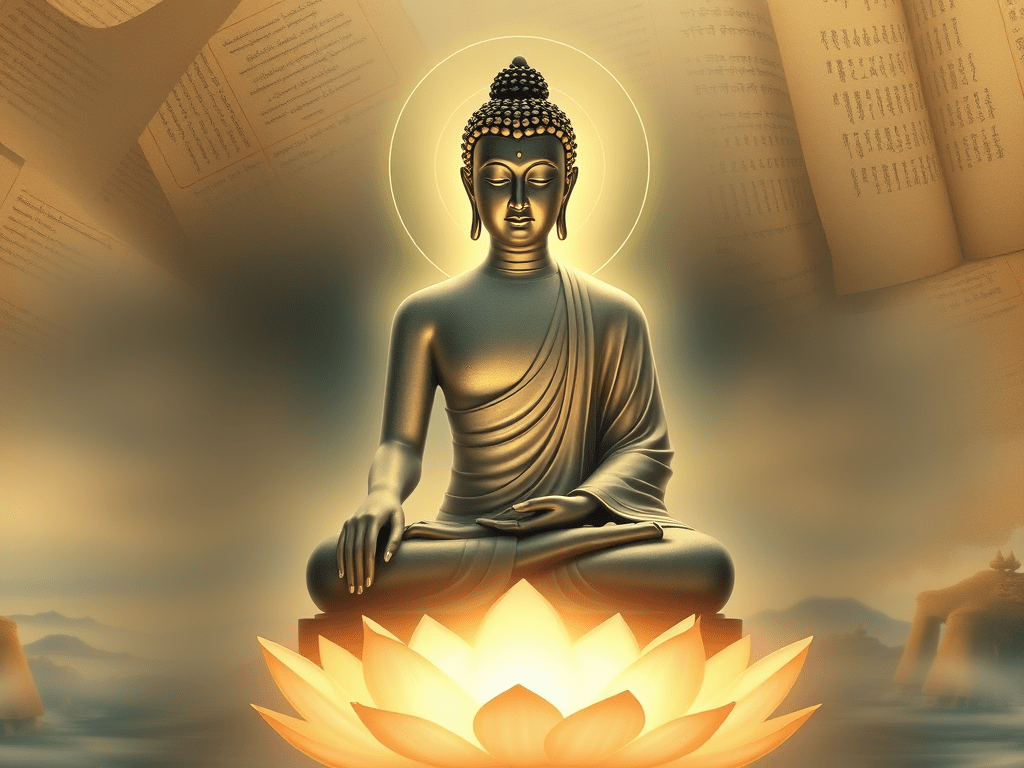
Imagine discovering a medicine that could cure every ailment, a universal remedy for all suffering. You would expect it to be met with universal joy and gratitude. Yet, what if the creator of this medicine prophesied that it would attract immense “hatred and jealousy”? This is the profound paradox at the heart of the Lotus Sūtra, one of the most revered texts in Mahāyāna Buddhism.
In an unsettling declaration to Medicine-King Bodhisattva, Śākyamuni Buddha reveals that this sūtra is his supreme teaching, the very “good medicine” for the world. But in the same breath, he delivers a stark warning about its reception.
“Do not give it to others carelessly!… Many people hate it with jealousy even in my lifetime. Needless to say, more people will do so after my extinction”.
Why would the ultimate expression of the Buddha’s compassion become an object of such visceral hostility? The reasons are not a contradiction but instead reveal deep, counter-intuitive truths about the nature of reality, the human mind, and the very path to enlightenment.
1. The Book That Is a Living Buddha
The first surprising truth is a claim so radical it redefines what a sacred text can be. The Lotus Sūtra declares itself to be the “store of the hidden core of all the Buddhas.” This isn’t just a collection of profound words; it is presented as the living, complete body of the Buddha himself—his Dharmakāya, or eternal Dharma body.
The sūtra provides concrete evidence for this astonishing assertion. The Buddha instructs that wherever this text is kept, a stupa—a sacred monument—should be erected in its honor. Then comes the most revolutionary part of the teaching:
“It is not necessary to place Śarīra [physical relics] in it. Why is this? Within it already is the complete body of the Thus Come One”.
This teaching is breathtakingly impactful. It shifts the primary object of veneration from the historical, physical relics of the Buddha to the living text itself. It means the eternal Buddha is not a distant figure from the past, but a present reality. A direct encounter with the enlightened one becomes possible for anyone, anywhere, through the act of engaging with the sūtra. The book isn’t about the Buddha; the book is the Buddha.
2. Why the Best News Can Feel Like a Vicious Attack
This claim—that a mere book contains the complete, living body of the Buddha—is not just a philosophical curiosity. It is the very fuse that ignites the psychological resistance the Buddha prophesied. The root of this hostility is a fundamental poison of the mind called moha (delusion or ignorance). In Buddhism, moha isn’t a simple lack of information; it is an active, willful resistance to any truth that threatens a person’s core identity.
The Lotus Sūtra‘s central message is the “One Vehicle”—the teaching that Buddhood is inherent in all beings. While this sounds like the most liberating news imaginable, it can be perceived as a profound threat. For those who have dedicated their lives to other spiritual paths—such as the path to become an arhat, an ideal focused on personal liberation—this universal truth doesn’t feel like a gift. In a powerful parable, the sūtra explains that the nirvāṇa these practitioners seek is like a “conjured city,” an beautiful, illusory resting place created by a wise guide to encourage weary travelers. To be told that the destination you’ve strived for your whole life is not the final treasure but a temporary illusion feels like a complete invalidation of your entire journey.
Paradoxically, the sūtra’s radical inclusivity is the very source of the exclusionary hatred it provokes. To a mind clouded by delusion, this ultimate act of compassion is mistaken for a hostile attack.
3. Proof of Faith: When Persecution Becomes the Path
Given that this attack from a deluded mind is inevitable, the sūtra then performs a breathtaking act of spiritual alchemy: it reframes the resulting persecution not as a setback, but as the very proof of the teaching’s power. Instead of being a sign of failure, encountering hostility is framed as a necessary—and even validating—part of the path.
The Nichiren school of Buddhism developed this insight into the powerful concept of “reading the sūtra with one’s body” (shikidoku). This means to live out the sūtra’s prophecies of persecution in one’s own life. By facing and enduring the predicted hardships, a practitioner proves the absolute truth of the Buddha’s words through their own lived experience.
This teaching completely reframes adversity. Suffering is no longer a random misfortune but a profound spiritual opportunity. Enemies become unwitting teachers who provide the perfect conditions to forge essential virtues like patience (kṣānti-pāramitā). Opposition, in this light, is an invaluable, if painful, gift that deepens faith and accelerates the journey to enlightenment.
4. Your Fiercest Protectors Are Compassionate Monsters
The sūtra does not leave its followers to walk this perilous path alone. For the practitioner courageously “reading the sūtra with their body,” it promises constant, unwavering protection from the Buddhas of all directions and from a special class of powerful beings called Dharmapālas, or “Dharma Protectors.”
What’s surprising is what these guardians look like. They are often depicted with terrifying appearances—dark skin, bared fangs, multiple arms wielding fearsome weapons, and feet trampling on the symbols of ignorance. This ferocity, however, is not malevolence. It is a manifestation of “wrathful compassion,” the energetic and uncompromising activity of enlightenment directed against all obstacles. These obstacles are both outer, like persecution, and inner—the practitioner’s own greed, anger, and delusion.
Crucially, the most powerful of these guardians are understood to be wrathful emanations of the Buddhas’ and Bodhisattvas’ own compassionate activity. This isn’t hired protection; it is the Buddha’s love taking on a form fierce enough to destroy anything that hinders the path to truth. They are the monstrous embodiment of a fierce, protective love.
Conclusion: The Ultimate Response to a Hostile World
The resistance the Lotus Sūtra provokes is not a flaw in its message, but a testament to its profound and world-altering power. It challenges us to the core, and that challenge can be frightening.
The sūtra teaches that the Bodhisattva’s ultimate response to this hostility is not retaliation, anger, or despair. It is the steady cultivation of great compassion (karunā), a compassion that understands that those who attack the Dharma are themselves suffering, trapped by their own delusion.
In situations where we cannot directly reach an opponent, the practice becomes an inner one, a quiet but powerful act of will. As the source material reminds us, “The least we can do is hope in our hearts for the happiness of all beings, even if they are not accessible to us.” This is the practice that protects our own hearts from the poison of hatred and aligns us with the Buddha’s ultimate intent: the liberation of all.
This leads to a final question to carry with us: What might change if we saw the greatest challenges not as obstacles, but as the very path itself?
 Mr. Altig’s Overview of the Wonderful Dharma of the Lotus Sutra
Leave a comment