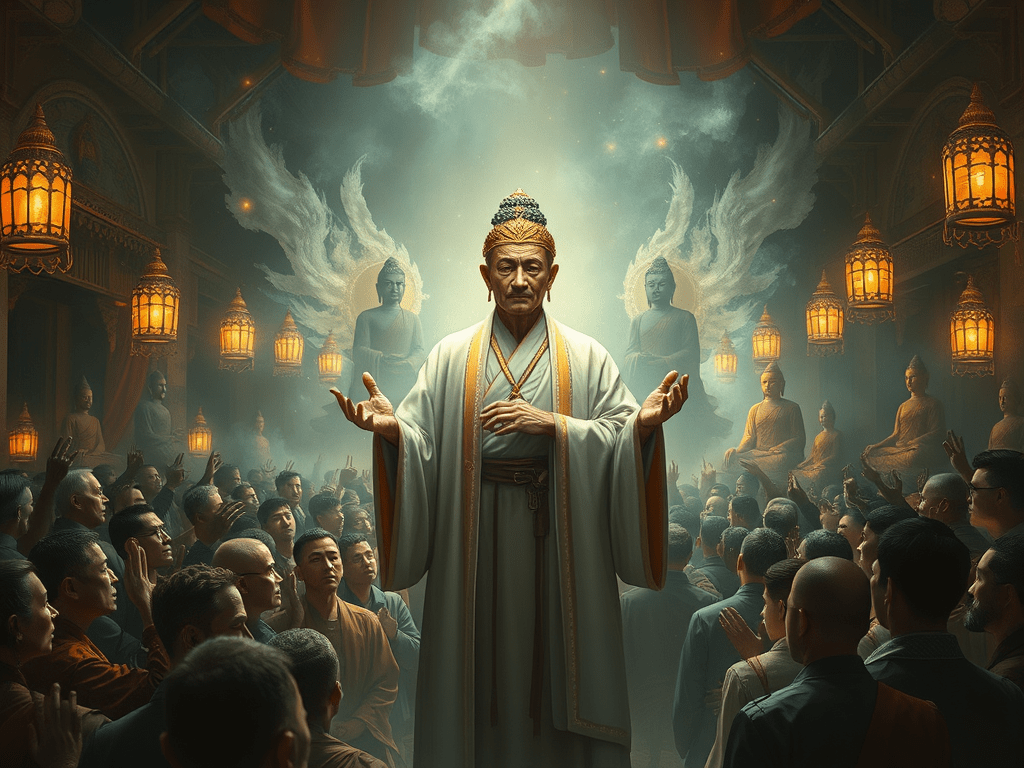
In a city plagued by chronic illness, there lived a wise Physician whose knowledge contained “the store of the hidden core of all the Buddhas”. This Physician possessed a single, ultimate Prescription that promised a cure for all suffering and revealed that the inherent nature of every resident was perfect health—a supreme state of “boundless compassion, wisdom, and courage”. This truth, that every person possessed an innate “buddha-nature”, was the Physician’s true and final intention.
However, the Physician had previously given out many “skillful means” (upāya)—lesser treatments adapted to the limited understanding of the sufferers. Some patients, dedicated entirely to these provisional paths, formed small, exclusive groups.
One group, the Aspirants of the Lesser Cure, had spent years perfecting a treatment that led only to temporary individual peace. They invested their entire sense of self and purpose in this limited goal.
When the Physician’s Emissary—a “Teacher of the Dharma” who had “renounced their pure lands” out of pity for the suffering beings—came forth to reveal the final, universal Prescription (the One Vehicle, or Ekayāna), chaos erupted.
The Emissary announced, “The limited cures you cling to are merely stepping stones; the true and ultimate health you seek is already within you, and this Prescription is the direct path to awakening it.”
But the Aspirants of the Lesser Cure were so deeply mired in delusion (moha) and attachment to their provisional identity that they could not perceive this announcement as liberation. Instead, they perceived it as a hostile invalidation of their life’s work. They reacted with intense “hatred and jealousy”. They insisted the Physician’s ultimate Prescription was not good medicine, but “poison”. They began to “slander the Dharma” (hōbō), spreading rumors to keep others from accepting the cure.
The Emissary faced increasing hostility, just as the Physician had prophesied: “Many people hate it with jealousy even in my lifetime. Needless to say, more people will do so after my extinction”.
Yet, the Emissary did not despair or retaliate. They remembered that their mission required them to enter the “room of the Tathāgata,” which means to have great compassion. Even when suffering persecution, the Emissary was filled with “unshakeable courage” and the knowledge that they were “an emissary of the Thus Come One”.
They understood that they were not alone. Above them, unseen by the deluded crowds, the Buddhas of all directions “protected and held them in mind”. Furthermore, the fierce, uncompromising energy of enlightenment manifested as the Dharma Protectors (Dharmapālas), who worked to subdue the negativity arising from ignorance and destroy the hindrances. The Emissary knew they were “covered with the Thus Come One’s robes”.
The Emissary’s ultimate response to those who hated the Prescription was universal compassion (karunā). Knowing they might not be able to reach everyone immediately, they maintained the fundamental practice: “The least we can do is hope in our hearts for the happiness of all beings, even if they are not accessible to us”.
By enduring the hostility and continuing to teach, the Emissary was fulfilling the highest form of practice, transforming the conflict into an opportunity to “read the sūtra with one’s body” (shikidoku). Every act of persecution only reaffirmed the truth of the Physician’s prophecy and, paradoxically, ensured that the “seed of Buddhahood” was planted in the lives of their opponents.
Thus, the Emissary’s life demonstrated that the ultimate teaching requires not the avoidance of conflict, but the courageous embodiment of compassion, transforming the “poison of hatred into the medicine of patience”.
 Mr. Altig’s Overview of the Wonderful Dharma of the Lotus Sutra
Leave a comment