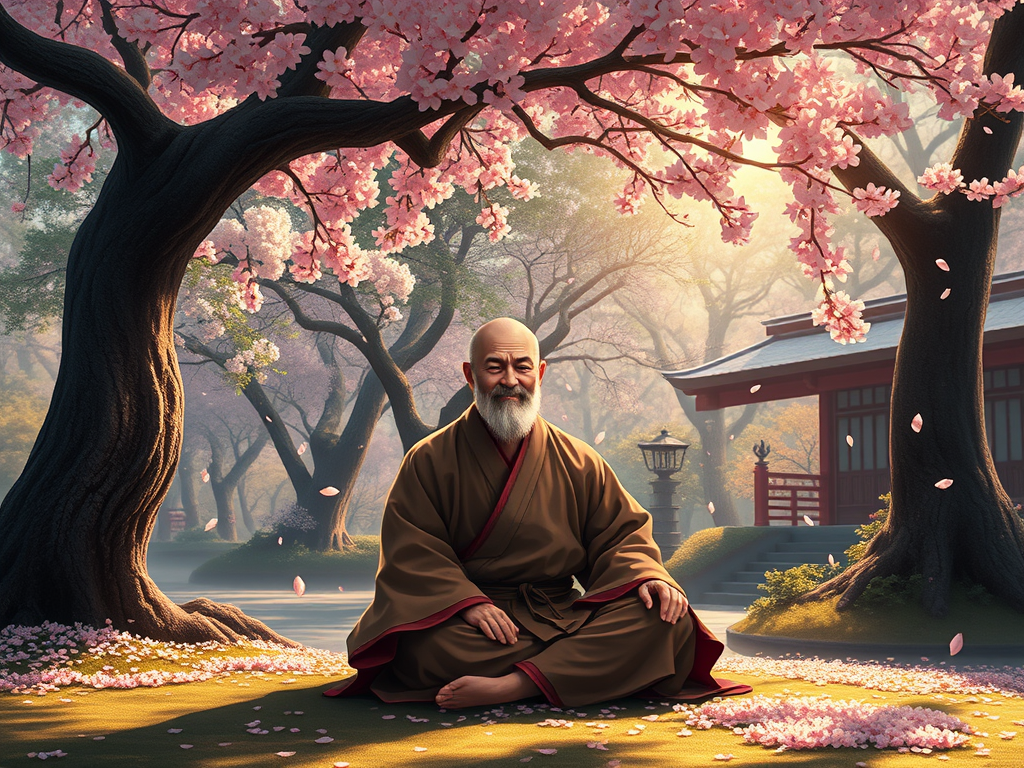
We often picture spiritual wisdom as a distant peak, accessible only to the most dedicated climbers. The common cultural image suggests that the deepest truths are complex, abstract, and reserved for an elite few—monks, scholars, or gurus who have spent decades in seclusion and study. We assume that the path to enlightenment is an arduous ascent, demanding immense personal strength and intellectual prowess.
But what if this entire assumption is backward? A counter-intuitive principle from 13th-century Japanese Buddhism, inherited from the great 6th-century Chinese systematizer T’ien-t’ai Zhiyi, completely flips this spiritual hierarchy on its head. This article delves into a 13th-century paradox that serves as a key to unlock a more compassionate and radically inclusive vision of enlightenment—one that finds ultimate power not in human perfection, but in human reality.
The Harder the Path, the Less Powerful the Teaching
At the core of this revolutionary idea is a profound paradox. In his treatise On The Four Depths of Faith and Five Stages of Practice, the Japanese reformer Nichiren quotes this diagnostic tool from the earlier T’ien-t’ai school for evaluating the true power of any spiritual teaching.
“the truer the teaching the lower the stage (of those enlightened by it); whereas the more provisional the teaching the higher the state must be (of those enlightened by it)”
To understand this, let’s first unravel the second half. It claims that “provisional” or preparatory teachings require a practitioner of a “higher state.” This is because these paths rely on what is known as “self-power” (jiriki). The burden of progress rests entirely on the individual’s shoulders, demanding immense spiritual stamina, intellectual rigor, and unwavering resolve over long periods. An example is the bodhisattva path of practicing the Six Perfections—such as giving, forbearance, and diligence—for countless eons. Only someone with extraordinary, pre-existing capacity could hope to complete such a demanding journey.
The first, more radical half argues the opposite: the “truer” or ultimate teaching is most effective for people of a “lower stage.” How can this be? Here we find the logic of compassion, which introduces a different source of power. While some paths rely on jiriki, and others rely on tariki (“other-power,” or faith in an external savior), this ultimate teaching draws on “Law-Power.” The power resides not in the practitioner’s effort, nor in a distant Buddha, but within the universal Law (the Dharma) itself—a Law that is both transcendent and inherent within one’s own life. Encountering this teaching is like plugging a lamp into a power source. The lamp’s ability to shine comes from the vast electrical grid, not from its own intrinsic brilliance. Similarly, a person lacking profound wisdom or meditative skill can connect to the immense power of the Dharma through simple faith and be illuminated by the teaching itself. This idea subverts all spiritual hierarchies, suggesting the most potent truth is also the most universally accessible.
The Buddha’s “Compassionate Lies” Weren’t Lies at All
If some teachings are “provisional,” does that make them false? Not at all. This philosophy is grounded in the concept of “skillful means” (upāya), which posits that the Buddha was like a master physician who prescribed different remedies for different spiritual ailments. He tailored his message to the capacity of his audience, knowing that a direct dose of the ultimate truth could be overwhelming or counterproductive for those not ready to receive it.
This principle is captured perfectly in the parable of the burning house from the Lotus Sūtra. A wealthy father sees that his dilapidated house is on fire, but his children are inside, so absorbed in their games that they ignore his warnings to escape. Knowing their desires, he calls out to them, promising them wonderful toys he knows they want: rare goat carts, deer carts, and ox carts. Lured by the promise of these treasures, the children rush safely out of the burning house. Once outside, the father gives them all a single, magnificent vehicle—a great white ox cart adorned with jewels, far superior to anything he had promised.
The parable unfolds into a profound metaphor for our own existence. The burning house is our world of suffering. The father is the Buddha, and we are the children, attached to our dangerous “games.” The promised goat, deer, and ox carts are the provisional teachings—the three separate “vehicles” or paths created for the shravaka, pratyekabuddha, and bodhisattva. The great white ox cart is the ultimate “One Buddha Vehicle,” the true teaching that reveals all paths lead to the single goal of universal enlightenment. The father’s promises were not malicious lies but compassionate and necessary strategies. In the same way, the Buddha’s provisional teachings are not “false,” but are indispensable preparatory stages designed to lead people out of danger, to a place where they can finally receive the ultimate truth.
Enlightenment Isn’t an Escape, It’s for Everyone
The ultimate implication of the core paradox is the profound democratization of enlightenment. This philosophy shatters the idea that the highest spiritual attainment is the exclusive domain of a monastic or scholarly elite. It makes enlightenment a practical and immediate possibility for the common person engaged in the messy reality of daily life.
For Nichiren, himself the “son of a fisherman,” this was not a theoretical point but a matter of spiritual emergency. He was convinced that he was living in the “Latter Day of the Law” (Mappō)—a degenerate age of conflict and confusion where older, more complex spiritual “medicines” had lost their power to save people. This conviction was the critical catalyst for his mission. In such an age, a simple yet profound practice was not just a helpful option but an absolute necessity for people who lacked the capacity for demanding contemplative paths.
He therefore distilled this entire philosophy into the potent practice of chanting Nam-myoho-renge-kyo. This was not a mystical invocation, but a deeply personal act of commitment. The word Namu means “to devote one’s life.” The chant is a conscious vow to fuse one’s own being with the universal Law, thereby activating the Buddha-nature that is inherent in all life. Because this ultimate truth is already within us, the goal is not to escape the world to find a separate nirvana. The goal is to establish a “Buddha land on earth” by empowering each person to undergo a “human revolution”—activating their highest potential right here, within the crucible of their daily struggles, and by doing so, transforming society from the ground up.
The Unlocked Gate
At its heart, this philosophy reveals that the Buddha’s highest teaching is an expression of ultimate compassion. It is a truth so powerful that its effectiveness doesn’t depend on our personal talent, intellect, or spiritual stamina, but only on our willingness to accept it through faith.
The spiritual path, therefore, is not a climb toward a distant, exclusive peak, but an opening to a power that is already present, everywhere, for everyone. The paradox of “the truer the teaching, the lower the stage” resolves itself not as a contradiction, but as the key that throws open the gate of enlightenment, making it accessible to every single person—not in spite of their limitations, but precisely because of them.
 Mr. Altig’s Overview of the Wonderful Dharma of the Lotus Sutra
Leave a comment