In our modern lives, the search for meaning can feel like a trek through a vast and confusing landscape. We look for purpose in our careers, our relationships, and our personal growth, often feeling that the profound answers we seek are somewhere “out there,” just beyond our reach. We read, we strive, we search, hoping to acquire some new wisdom that will finally make everything click. Yet, an ancient story, nearly two millennia old, suggests we might be looking in the wrong direction.
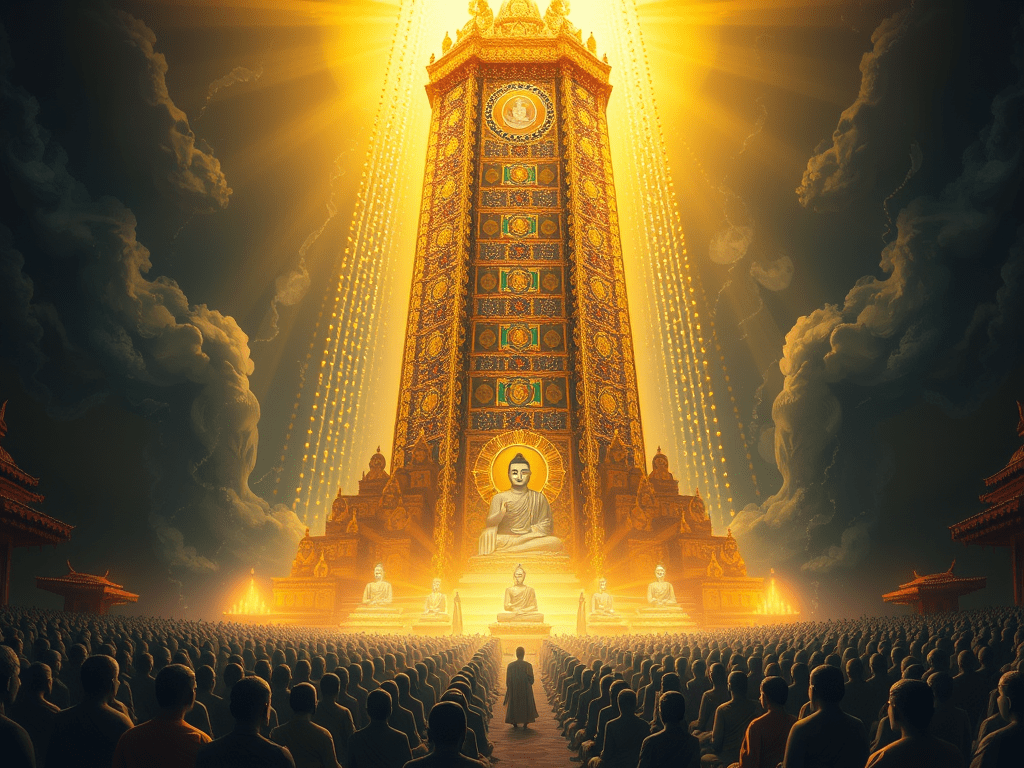
This story is not a quiet parable but a spectacular, cinematic vision from the 11th chapter of the Lotus Sutra, titled “The Appearance of the Treasure Tower.” It begins with the historical Buddha, Śākyamuni, preaching to a vast assembly on a mountain. Suddenly, the earth splits open, and a tower of unimaginable scale—500 yojanas high—emerges and hangs suspended in the air. It is adorned with the “seven kinds of treasures”—gold, silver, lapis lazuli, carnelian, and pearls—and from it issues the fragrance of sacred incense that permeates the entire world. This single, dramatic event is more than a miracle; it’s a profound teaching, a cosmic drama designed to shatter our assumptions about reality, enlightenment, and our own potential.
This post will unpack four of the most powerful and surprising takeaways from this single chapter—ideas that challenge conventional wisdom and suggest that the ultimate treasure we seek is not something to be found, but something to be revealed from within.
A Buddha Who Died Eons Ago Can Show Up to Give His Approval
As the magnificent tower hangs silently in the sky, a great voice booms from within. Śākyamuni explains that the tower contains the living body of a Buddha named Prabhūtaratna, or “Many Treasures.” This is not a contemporary figure, but a Buddha from an incalculably distant past who entered parinirvāṇa—the final nirvana—eons ago. Prabhūtaratna, however, had made a profound vow: that wherever the Lotus Sutra was taught, his Treasure Tower would emerge from the earth to bear witness to its truth.
Before the tower can be opened, however, a condition must be met. Śākyamuni must gather all his emanation Buddhas from countless other universes. In a display of immense power, he purifies entire worlds to make room for this infinite assembly. This act establishes the teaching not as a localized sermon but as a universal principle, acknowledged by all Buddhas everywhere. Only then does Śākyamuni open the tower to reveal Prabhūtaratna, who praises his teaching:
“Good indeed, good indeed, Shakyamuni, World Honored One… that all you say is true and real!”
This is a startling revelation that shatters the common understanding of nirvana as annihilation. Here, Prabhūtaratna represents the eternal, absolute truth (Dharmakāya), a reality that transcends time and space. Śākyamuni, the historical teacher, represents its phenomenal manifestation in our world (Nirmāṇakāya). Their meeting is a visual demonstration of non-duality—a profound statement that the ultimate, eternal truth can be touched and experienced in the real, historical world. Buddhahood is not a state that ends, but an indestructible and ever-present reality.
Enlightenment Isn’t Something You Attain; It’s Something You Uncover
The Treasure Tower does not descend from the heavens; it erupts “from the earth.” This detail is a powerful metaphor for the nature of enlightenment itself. In this symbolism, the “earth” represents the ordinary person—the ground of our daily lives, with all our struggles, impurities, and delusions. The emergence of the magnificent tower from this very ground is the manifestation of our inherent Buddha-nature (buddhadhātu), the pure, enlightened potential that lies dormant within every individual.
This completely reframes the spiritual quest. Many traditions present enlightenment as an external goal we must struggle to acquire, a distant peak we must laboriously climb. This metaphor, however, suggests that Buddhahood is not a prize to be won but an intrinsic reality that already exists within us, waiting to be revealed.
This perspective shifts the focus from acquisition to excavation. The work is not to build something new, but to uncover the treasure that is already there, buried beneath the soil of our own confusion and self-doubt. The story tells us that the most profound reality is not separate from our ordinary existence but is, in fact, waiting to spring forth from it.
All Spiritual Paths Lead to the Same Superhighway
The audience for this cosmic event is as important as the event itself. Gathered on Vulture Peak is a diverse assembly, including highly disciplined monks (śrāvakas), who sought personal liberation, and compassionate bodhisattvas, who vowed to save all beings. In the historical context, a spiritual hierarchy often existed. Some pre-Lotus Sutra texts even stated that śrāvakas could not attain full Buddhahood, making their path inferior to that of the bodhisattvas.
The Lotus Sutra, however, introduces the radical doctrine of the “One Vehicle” (ekayāna). It teaches that these different paths are not separate destinations but are simply “skillful means” (upāya)—different vehicles offered by a compassionate teacher to guide people of varying capacities toward the single, ultimate goal of complete Buddhahood. The sutra famously illustrates this with the parable of the burning house, where a father promises his children three different types of carts to lure them from a burning building, but once they are safe, gives each of them a single, far more magnificent cart. The different paths are the promised carts; Buddhahood is the one great vehicle given to all.
This abstract doctrine of equality is then made vividly real. Śākyamuni uses his power to lift the entire assembly into the air, suspending them at the same level as the tower. This pivotal moment, known as the “Ceremony in the Air” (kokū-e), marks the shift from the sutra’s “theoretical teaching” to its “essential teaching.” It is a physical demonstration that, in the light of the final truth, all distinctions are provisional. All beings are equally heirs to the Buddha’s enlightenment, regardless of the path they have walked.
The Grand Cosmic Treasure Tower… Is Actually You
For centuries, this story was revered as a magnificent, cosmic vision. Then, in the 13th century, a Japanese monk named Nichiren offered a radical reinterpretation that brought the entire drama down to a deeply personal level. He taught that the Treasure Tower is not an external object from an ancient story, but a present reality that is manifested in the very life of a person who embraces the Lotus Sutra.
This was not merely a philosophical idea; Nichiren translated it into a tangible practice by creating the Gohonzon, a mandala that graphically depicts the Ceremony in the Air. The Gohonzon serves as a physical object for practitioners to focus on, allowing them to call forth the Treasure Tower from within their own lives. In this view, the emergence of the tower is a metaphor for Buddhahood welling up from within an ordinary person. The story ceases to be about something that happened long ago and becomes a blueprint for what can happen within you, right now.
This interpretation is profoundly empowering. It transforms a distant symbol into an accessible, lived experience. The goal is no longer simply to understand the meaning of the Treasure Tower, but to become it—to awaken to the infinite dignity and potential that lies dormant within your own life. As Nichiren powerfully stated:
“In the Latter Day of the Law, no treasure tower exists other than the figures of the men and women who embrace the Lotus Sutra”.
What Treasure Will You Reveal?
From a Buddha who defies the finality of death to the radical idea that all spiritual paths merge into one, the vision of the Treasure Tower is designed to expand our understanding of what is possible. Each layer of its symbolism points toward a single, unifying theme: that the grand, cosmic drama described in the sutra is ultimately a story about our own inherent, untapped potential.
The teaching suggests that this potential is not something we lack, but something we have simply not yet uncovered. It is an intrinsic part of our being, waiting for the right conditions to emerge. If these ancient teachings are right, what magnificent treasure tower is waiting to emerge from the ground of your own life?
 Mr. Altig’s Overview of the Wonderful Dharma of the Lotus Sutra
Leave a comment