Introduction: Challenging Our Assumptions
When we think of spiritual enlightenment, we often picture a long and arduous path. It’s a journey that seems reserved for the dedicated few, a process that can take lifetimes of discipline, sacrifice, and accumulated wisdom. This narrative is so common that it can feel like the only way, making the ultimate goal of awakening seem distant and perhaps even unattainable for most.
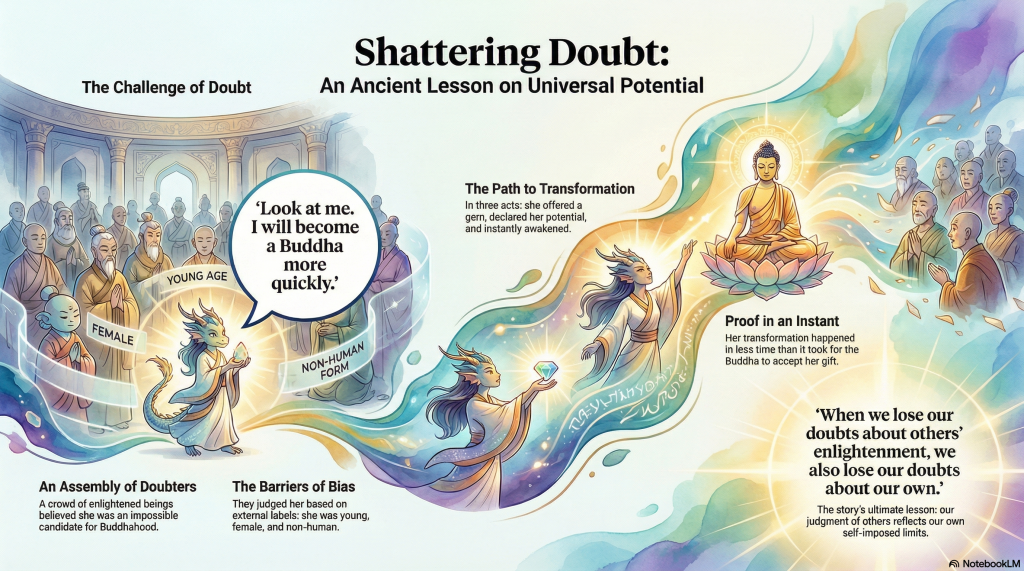
But what if this assumption is incomplete? An ancient and luminous story from the Lotus Sūtra offers a radical counter-narrative. It tells of a young dragon-king’s daughter who attains perfect enlightenment in a flash, challenging conventional wisdom about who can achieve awakening and how long it must take. Her story offers a few profound truths that shatter our self-imposed limits.
Surprising Truths from an Ancient Story
1. Awakening Isn’t Always a Lifelong Journey—It Can Happen in an Instant
The story of Sāgara’s daughter presents a powerful and hopeful idea: enlightenment can occur in a flash. The source text describes how the young daughter offered a priceless gem to the Buddha. Then, before the Buddha’s hand had even closed around the gift, she was transformed into a fully enlightened one before the eyes of the entire assembly. This was no mere transaction; it was a profound symbol. In offering the gem, she demonstrated the ultimate generosity, a complete release of worldly attachment, and a recognition that her own Buddha-nature was the only true treasure.
This concept is radical because it collapses the timeline we so often associate with spiritual progress. Instead of a slow, incremental climb, it suggests that awakening is a potential that exists in every moment. It shifts the focus from a distant goal to an immediate possibility, offering a profound sense of hope that transformation isn’t always a matter of enduring effort, but can also be one of sudden, illuminating insight.
2. The Path Is Open to Everyone, Without Exception
One of the most powerful messages from this story is its profound inclusivity. It demonstrates that enlightenment is not limited by one’s identity, form, or social standing. The protagonist who achieved this ultimate state was young, female, and even non-human—a background that caused the assembly of advanced practitioners to believe she was incapable of such an achievement.
Her success serves as a direct refutation of any spiritual hierarchy. It shows that the capacity for awakening is a universal truth, inherent in all forms of life, regardless of the vessel. The text makes this point explicitly clear:
This story shows that all beings can become enlightened, male and female, young and old, human and non-human.
This is a deeply liberating message. It dismantles the barriers and prejudices we place on the spiritual path, affirming that the potential for ultimate realization resides within every being, without exception.
3. The Final Obstacle Is Our Own Doubt
While the great Mañjuśrī Bodhisattva recognized the daughter’s potential, he was alone in his conviction. Nearly everyone else present—the collective spiritual authority of the era—”believed that she could not attain enlightenment.” The central conflict of the story isn’t a physical trial or a complex philosophical debate; it’s the overwhelming wall of doubt erected by the onlookers. Standing alone against this sea of disbelief, the daughter’s confidence was a beacon. She met their skepticism with a powerful declaration of her own impending success:
“Look at me with your supernatural powers! I will become a Buddha more quickly.”
The story’s final teaching reveals a deep insight: the doubt we hold for others is a mirror of the doubt we hold for ourselves. As the text concludes, “When we lose our doubts about others’ enlightenment, we also lose our doubts about our own.” This reframes the lesson as a core principle of spiritual practice. To judge another’s capacity for awakening is, in itself, an act of ego that reinforces our own sense of limitation. By learning to see the potential for Buddhahood in everyone, we unlock the ability to see it in ourselves.
Conclusion: A New Perspective on Potential
This brief but profound story from the Lotus Sūtra serves as a timeless reminder that our most deeply held assumptions about spiritual progress may be self-imposed. It teaches us that awakening can be instantaneous, that the path is open to all, and that the greatest barrier we face is the one we construct from our own doubt.
If we set aside our doubts about what’s possible for others, what potential might we finally see in ourselves?
 Mr. Altig’s Overview of the Wonderful Dharma of the Lotus Sutra
Leave a comment