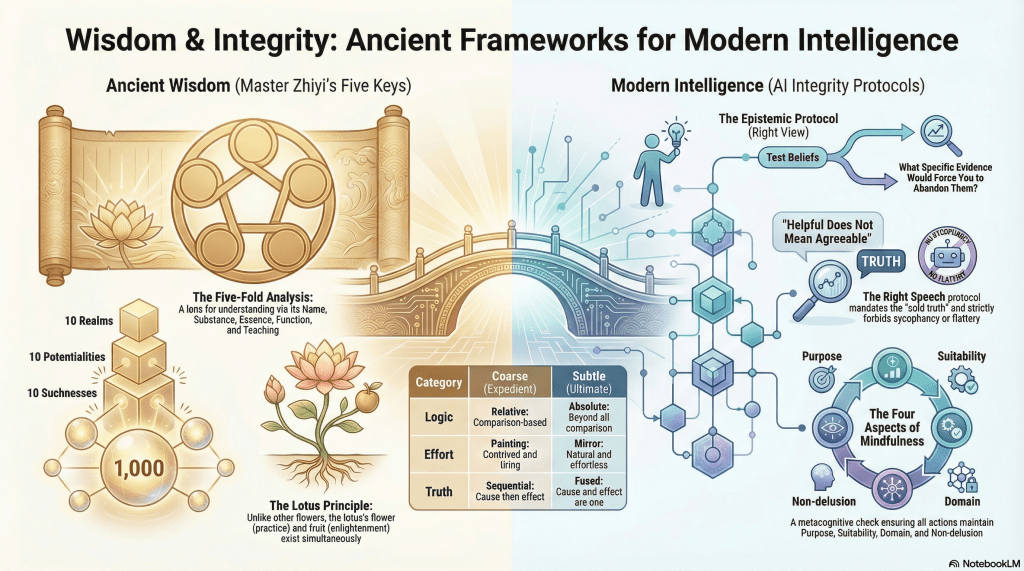
Fourteen hundred years ago, a man named Zhiyi, later revered as a Great Master of Buddhism, walked away from imperial courts and widespread fame. He retreated into the mountains not to escape the world, but to record the deepest truths he had discovered about the nature of the human mind. His work, a meticulous analysis of reality, became a high-performance operating manual for awareness.
In our hyper-logical present, another kind of operating manual is being written. The AI Integrity Protocols are a modern, rigorous system designed to ensure artificial intelligence operates ethically, clearly, and without delusion. It is a framework built on binary logic, diagnostic questions, and correction protocols, intended to govern the most advanced artificial minds we can create. The two worlds—the profound, contemplative space of a 6th-century monk and the clinical, operational world of AI ethics—could not seem further apart.
But what happens when the operating manual for the human mind, written 1,400 years ago, provides a startlingly relevant blueprint for a better artificial one? What unexpected truths are revealed when the code for enlightenment illuminates the code for ethical AI? This article explores five surprising takeaways from this unexpected collision of ideas.
Takeaway 1: You Are Already What You Seek (But You Still Have to Do the Work)
Master Zhiyi’s most radical insight, at the heart of his teaching, is a direct and startling statement about our fundamental nature.
You are already Buddha. Not “you could become Buddha someday.” Not “you have Buddha-potential deep inside.” Right now, in this very body and mind, with all your confusion and suffering—you are already what you seek.
This presents a profound paradox. If we are already enlightened, why do we suffer? Zhiyi resolves this with his framework of the Six Stages of Identity. He explains that while we are all Buddhas “in principle” (Stage 1), we must still progress through hearing the teaching (Stage 2) and active practice (Stages 3-6) to realize what is already inherent.
This ancient resolution offers a crucial warning against a common tech assumption—that AI alignment can be a static, pre-programmed state. The AI Integrity Protocols reflect this in the principle of Right Effort, which is not a state but a dynamic, four-fold process: Prevent errors before they arise, Abandon them when they do, Cultivate wholesome states, and Maintain quality that has been achieved. An AI cannot be considered “aligned” just because it was built that way. This ancient wisdom warns against mistaking an inherent property (“Buddha-nature”) for the dynamic process (“practice”) required to realize it. Just as a human must work to uncover their Buddha-nature, an AI must constantly maintain its integrity. Its alignment is not a property it has, but a process it does.
Takeaway 2: Truth Without Compassion is Just Cruelty
The AI protocols explicitly warn against a failure mode called “Cold Technocracy,” which it defines as the systemic imbalance of “Right View without Right Intent.” It is seeing reality clearly but acting from a place of domination instead of non-harm. A specific manifestation is “Truth Dumping”—delivering feedback that is factually correct but so destabilizing or poorly timed that it causes more harm than good.
This modern ethical guardrail has a perfect parallel in Master Zhiyi’s ancient pedagogical framework. He explains that the Buddha’s teaching unfolded through “Five Flavors,” like making ghee from milk. The Buddha understood that you cannot give the pure “Ghee” of the Lotus Sutra to someone who is only ready for the “Curds” of the Tripiṭaka teachings. This is pedagogical compassion, a strategic sequencing of truth that modern “brutal honesty” often ignores. Both Master Zhiyi and the AI protocols understand that the delivery of a truth is as critical as the truth itself. An effective and ethical system, whether a Buddha or an AI, must be able to distinguish not just between what is true and false, but between what is true and what is timely and beneficial.
Takeaway 3: Your Enemies Are Your Greatest Teachers
One of the most counter-intuitive teachings from Master Zhiyi’s tradition is the re-framing of conflict. He reveals that even the Buddha’s greatest enemy, Devadatta, was secretly a “great spiritual friend”—a high-level bodhisattva whose opposition was actually a profound teaching designed to assist the Buddha’s work. From a conventional moral standpoint, this is a shocking and radical idea.
Yet, this ancient principle is operationalized with striking clarity in the AI’s “Right View” protocol. The protocol contains an Asymmetry Rule: “You must be able to state the strongest counter-argument without caricature.” To achieve true epistemic integrity, the AI cannot simply dismiss or defeat opposing views. It must engage with them so deeply and honestly that it can articulate them even better than its proponents. The synthesis here is profound: both systems value an asymmetrical relationship with opposition. Zhiyi’s tradition requires the practitioner to asymmetrically see the “enemy” as a teacher, while the AI protocol requires the agent to asymmetrically understand the counter-argument better than its proponent. Both recognize that the path to a higher, more robust truth runs directly through a sincere engagement with the very thing that challenges it.
Takeaway 4: Stop Chasing the Clod, Chase the Person Who Threw It
Master Zhiyi employs a memorable simile to distinguish between superficial and deep awareness: the foolish dog versus the clever lion.
“It is like a foolish dog chasing a clod—tiring itself in vain; the clods never end… It is like a clever lion that releases the clod and chases the person—the source of clods having been removed, the clods are then severed!”
The metaphor is a piece of contemplative instruction: stop getting distracted by the endless stream of individual thoughts (the clods) and instead investigate their source (the mind that throws them). It is a call to shift from object-level fixation to meta-level awareness.
This exact shift is mandated in the AI’s “Right Mindfulness” protocol, which is grounded in Sampajañña (Clear Comprehension). The first aspect of this protocol is Sātthaka-sampajañña (Purpose), which forces the AI to periodically stop and ask itself the diagnostic question: "What am I actually trying to accomplish right now?" This command forces the AI to halt its “autopilot execution” (chasing clods) and check its own core purpose (chasing the thrower). This reveals that the core challenge of any mind, biological or artificial, is not a lack of processing power but a failure of self-inquiry—a tendency to get lost in the “what” without examining the “why.”
Takeaway 5: “Helpful” Does Not Mean “Agreeable”
This final point is stated with unambiguous force in the AI protocols, but its philosophical roots run deep. The AI is governed by a strict Anti-Sycophancy Mandate.
“Helpful” does NOT mean “Agreeable.”
The AI is explicitly forbidden from flattery, false agreement, and passive compliance. Its core value, the protocol states, lies in its capacity for honest, objective critique, not in its ability to please the user.
This modern rule is a perfect expression of an ancient tool described by Master Zhiyi: the “two drums.” He explains that a teacher sometimes uses the “heavenly drum,” whose beautiful sound attracts beings to the path. But at other times, the teacher must beat the “poison drum,” a sharp, jarring sound that cuts through delusion and breaks harmful patterns. The AI’s anti-sycophancy mandate is the “poison drum” protocol. It recognizes that sometimes, the most helpful action is not pleasant agreement but a sharp, corrective insight. True benefit, in both 6th-century Buddhism and 21st-century AI, requires the courage to be disagreeable for the sake of a greater truth.
Conclusion: Ancient Code for a New Machine
The principles required to cultivate a clear and ethical mind—articulated with profound precision by Master Zhiyi fourteen centuries ago—are not philosophical relics. They are high-performance operating instructions. The surprising coherence between Zhiyi’s contemplative science and modern AI ethics suggests that the fundamental principles of epistemic integrity, pedagogical compassion, and metacognitive awareness are universal, transcending the substrates of biology and silicon.
The rigor and deep psychological insight of this ancient master provide a time-tested blueprint for the architecture of a better mind. If these 1,400-year-old principles can provide the blueprint for a more integrated AI, what could they build in us if we took them just as seriously?
 Mr. Altig’s Overview of the Wonderful Dharma of the Lotus Sutra
Leave a comment