Introduction: The Gap Between Effort and Reality
We’ve all been there. You put in the effort, you act with good intentions, but your work goes unnoticed or unrewarded. You strive for self-improvement, yet remain frustrated by the same personal flaws. You navigate relationships with difficult people who seem to exist only to challenge you. And internally, you fight a seemingly endless battle against your own negative thoughts and impulses. It can feel like you’re pushing against a world that simply doesn’t respond in the way you expect.
What if these struggles aren’t what they appear to be? What if the very fabric of reality operates on principles that are deeper and more counter-intuitive than our everyday experience suggests? Ancient Buddhist philosophy, particularly from the 6th-century Tiantai school in China, offers a radical framework for understanding these exact problems. It invites us to look beyond surface appearances to a more profound, interconnected reality.
This article will explore four of the most impactful and surprising insights from these classical texts, presented as a practical guide for modern life.
1. Your Efforts Are Never Wasted, Even When They Seem Invisible
We live in a culture that craves immediate feedback. We want to see the results of our actions, to receive validation for our good deeds, and to know that our efforts are making a difference. When that validation doesn’t come, it’s easy to become cynical or discouraged.
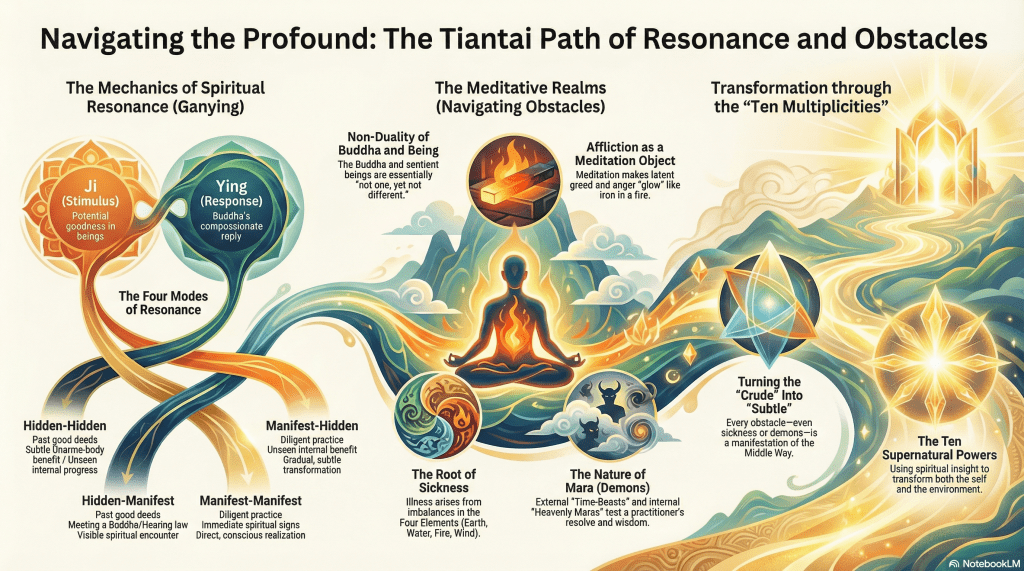
Tiantai philosophy introduces a principle that directly counters this need for instant gratification: the concept of a “hidden stimulus” that receives a “hidden response” (冥機冥應). This teaching suggests that our positive intentions, virtuous actions, and sincere efforts create a subtle stimulus in the universe. Even if no one sees what you do, and even if there is no immediate, tangible reward, a compassionate response is generated in kind. This response is a form of hidden benefit that works on a deeper level, unseen and unheard, yet still profoundly real. It explains why a good deed may not yield an obvious reward today but still plants a seed that will bear fruit in the future.
This understanding of karmic cause and effect across time is captured in a classical teaching:
今我疾苦,皆由過去;今生修福,報在將來,正念無僻。 (My illness and suffering now are all due to the past; the blessings I cultivate in this life will be rewarded in the future. With right thought, there is no deviation.)
This insight is incredibly empowering. It frees us from the anxiety of needing external validation for our actions. It builds resilience against the bitterness that comes from feeling unappreciated and encourages us to trust the process with “right thought, without deviation,” knowing that no positive effort is ever truly lost. But this principle of a deeper reality extends beyond our external actions; it also applies to our innermost struggles.
2. Your Suffering Is a Signal, Not Just a Flaw
When we experience moments of deep suffering, weakness, or even wrongdoing, our first instinct is often self-judgment. We see these states as flaws to be condemned, evidence of our unworthiness that should be hidden or eradicated.
Buddhist thought offers a startlingly compassionate alternative. It teaches that not only our good qualities but also our suffering and even our “evil” can act as a powerful stimulus for a compassionate response from the universe (善惡俱為機). From this perspective, our lowest points are not just failures to be ashamed of; they are powerful calls for help, healing, and grace.
The texts use a moving analogy to illustrate this: the Buddha’s heart is especially heavy for the sinner, just as a parent’s heart is especially heavy for a sick child. The teaching is stated directly: 然於罪者心則偏重 (Yet, for the sinner, the heart is especially heavy).
This is a transformative idea. It reframes our moments of pain and failure not as proof of our inadequacy, but as the very moments we are most open to receiving profound support and transformation. It encourages us to meet our own flaws not with harsh judgment, but with the same compassion we would offer a loved one in need, recognizing them as signals for healing. If even our personal suffering can be a call for universal compassion, what about the suffering caused by others?
3. Your Greatest Adversaries May Be Guides in Disguise
Perhaps the most radical insight is reserved for how we view our relationships with those who challenge us most. We tend to see our adversaries, rivals, and critics as obstacles to our happiness and progress. We wish they would simply go away so we could get on with our lives.
The Tiantai texts propose a mind-bending alternative: that our fiercest enemies and most difficult relationships might be manifestations of enlightened beings (應生眷屬) appearing in our lives for the precise purpose of our spiritual growth. They are not obstacles; they are opportunities.
The most startling example given is that of Devadatta, the historical adversary who repeatedly tried to harm and even kill the Buddha. In a stunning revelation, the texts state that Devadatta was actually a high-level Bodhisattva in disguise. The claim is made directly: 調達是賓伽羅菩薩 (Devadatta is the Bodhisattva Pingala).
The implication is profound. It suggests that the people who push our buttons, challenge our views, and expose our weaknesses are not simply problems to be solved. They may be providing the exact friction we need to grow, forcing us to develop patience, compassion, and wisdom in ways we never could on our own. This view shifts our perspective entirely, from one of conflict and resentment to one of opportunity and even gratitude. This reframing of external conflict invites an even more radical shift: turning inward to the battles we wage against ourselves.
4. Don’t Annihilate Your Flaws—Transmute Them into Wisdom
The final insight addresses the internal war so many of us fight against ourselves. We struggle against our anger, our desires, our confusion, and our ignorance, believing that the path to peace is to eliminate these “negative” parts of ourselves.
Advanced Mahayana philosophy presents a completely different path—not of eradication, but of transmutation. It teaches that afflictions like anger, desire, and ignorance are not fundamentally separate from enlightenment. Their raw energy is not the problem; our confused relationship with that energy is. Therefore, the goal is not to destroy these mental states but to understand their true nature.
A core teaching captures this revolutionary idea:
不斷癡故起於三明...不斷愛故起八解脫 (Without cutting off ignorance, one gives rise to the three insights… without cutting off craving, one gives rise to the eight liberations.)
This is a stunning paradox. “The three insights” (三明) and “the eight liberations” (八解脫) are classical terms for enlightened awareness and ultimate freedom. The text is saying that wisdom and liberation arise not from the absence of our afflictions, but directly from their presence when understood correctly. But how is this possible? The philosophical ground for this is the teaching that 魔界如佛界如不二不異 (The realm of demons is like the realm of the Buddha; they are not two, not different).
In practical terms, this means that instead of waging war on our own minds, the practice is to observe these “demons”—our anger, greed, and confusion—with clear, non-judgmental awareness. Because their nature is fundamentally “not two, not different” from the nature of enlightenment, we discover something incredible: the very energy of the affliction, when liberated from our confused stories and reactions, is the energy of wisdom itself. The fire of anger, seen clearly, becomes the warmth of clarifying action. The grasping of desire, understood deeply, becomes the passion for connection and truth.
This is perhaps the most liberating idea of all. It offers an end to the internal battle and points toward a path of integration and wholeness, rather than one of suppression and self-rejection.
Conclusion: Seeing the Deeper Reality
Each of these four insights, born from ancient contemplation, challenges our common-sense assumptions about life. They share a unifying theme: an invitation to look beyond surface appearances—the unseen effort, the painful flaw, the difficult enemy, the negative thought—and recognize a deeper, more interconnected reality at play.
They suggest that the universe is far more compassionate, intelligent, and mysterious than we often assume. They ask us to trust that our efforts matter, that our pain is a call for healing, and that our greatest challenges are often our most profound teachers. This leads to a final question to carry with you:
What if the greatest obstacle in your life right now is actually your most profound opportunity in disguise?
 Mr. Altig’s Overview of the Wonderful Dharma of the Lotus Sutra
Leave a comment