Post 5 of the Awakened State series. The first in a new set of single-book bridge posts—this one into The Ongoing Assembly (Vol I of The Lotus Sutra for the Modern Reader*). About a six-minute read.
Most people, when they hear the phrase “student of the Lotus Sutra,” picture a monk. A scholar. Someone with the right lineage, the right robes, the right ordination papers, the right training under the right teacher in the right tradition.
The Lotus Sutra itself has a different answer, and it has had it for nearly twenty-five hundred years.
It is technical. It is precise. And it is, by the standards of every religious tradition I know of, surprisingly low.
The sutra defines its students by what they do, not who they are
The defining passage comes from Chapter 10, “The Dharma Master.” The Buddha is addressing Bodhisattva Bhaiṣajyarāja, the Medicine King, and the eighty thousand great ones gathered at Vulture Peak. He says:
“If anyone receives-and-keeps, reads, recites, expounds, or copies the Wonderful Dharma Lotus Sutra—even a single verse—know that such persons have already made offerings to a hundred thousand million Buddhas, fulfilled great vows in the presence of those Buddhas, and have been born among humans out of compassion for sentient beings.”
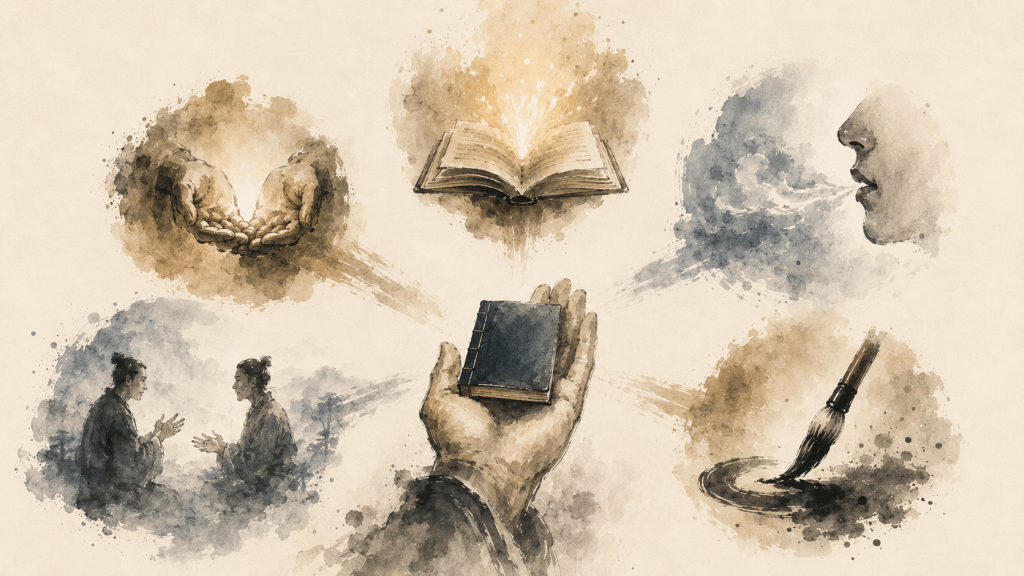
Five practices. The category is called, in Chinese, the 五種法師 (wǔzhǒng fǎshī)—the Five Kinds of Dharma Master. They are:
- Receiving-and-keeping—the foundational practice. Not just hearing the sutra, but taking it in, holding it, letting it become something you carry.
- Reading—engaging the written text, often aloud in the medieval East Asian context, where reading and reciting blended into a single gradient of practice.
- Reciting—from memory, often entire chapters or the whole sutra, the body of the teaching becoming part of the body of the practitioner.
- Expounding—explaining the sutra to others. This is the practice that turns a practitioner into a teacher.
- Copying—the physical transcription of the sutra. In an age before printing, this was a major devotional act: a way of making a dharma-body with your own hand. Medieval Japanese and Chinese records describe one-day-copying rituals in which entire communities would transcribe the twenty-eight chapters in a single sitting, every character seen as a future buddha.
That is the entire list. There is no sixth item, no prior credential, no prior accomplishment. The sutra does not say “those who are ordained dharma masters” or “those who have studied with the proper teachers.” It says: anyone who does these five things, even with a single verse.
The verb-list defines the noun. There is no threshold before the practice.
The threshold is set at “even a single verse”
The phrase is doing enormous work. In Chinese: nǎizhì yī jì—literally, “down to even one verse.” The sutra is not interested in establishing a category that excludes the beginner. It is interested in establishing a category that captures everyone who has ever practiced even minimally.
Chapter 18 extends the principle. The fifty-fold transmission. Even the fiftieth person to hear about the sutra and feel a moment of joy is included. Zhiyi, the great Tiantai commentator, says explicitly that the student-network propagates indefinitely. There is no point in the chain at which the sutra’s efficacy degrades. Every reader of the sutra now is at Vulture Peak now, because Vulture Peak is the dharma-realm in which Lotus reading occurs, and the propagation chain has not lapsed.
This low threshold matters for reasons that have nothing to do with theology and everything to do with how religious communities actually behave. They are very good at producing thresholds that look like devotion but function like gatekeeping. Who has studied long enough. Who knows the proper pronunciation. Who belongs to the correct lineage. Who has the right teacher. Who has suffered enough. Who has earned the right to speak.
The Lotus Sutra refuses to let the student-category be captured by that logic. It does not abolish teachers, lineages, training, or discipline—the Tiantai tradition will build an immense architecture of study and practice around the sutra. But the sutra places the point of entry before all of that. The person who receives even one verse with joy is already inside the field the tradition must then serve.
The student’s voice is the Buddha’s voice
Chapter 10 goes further. The sutra not only defines the student; it defines the authority of the student. The Buddha says:
“If any of these good sons or good daughters, after my extinction, can secretly expound even a single phrase of the Dharma Lotus Sutra to even one person, you should know that these persons are the messengers of the Tathāgata, sent by the Tathāgata, performing the Tathāgata’s work.”
The doctrine is the messenger of the Tathāgata (rúlái shǐ). It means the student’s voice, when speaking the sutra, is the Buddha’s voice. Not a symbolic honor. A functional identity. Because the sutra is the Buddha’s intent, anyone who transmits it is performing the Buddha’s own function.
This is the doctrinal warrant for the “lay-centrism” that characterizes much of modern Lotus practice. The solitary student expounding the sutra to a single friend is “sent by the Tathāgata.” Authority here does not depend on institutional approval.
But the messenger does not own the message. The messenger is accountable to it. The sutra’s authorization is paired with a demand for humility. To be sent by the Tathāgata is not to become a small private Buddha with license to dominate others. It is to become answerable to the Buddha’s work, which the sutra repeatedly identifies with compassion, patience, and the refusal to abandon beings. The same passage that dignifies the practitioner also disciplines them. If the student speaks the Lotus Sutra in a way that humiliates, excludes, or hardens the heart, the function has been betrayed even if the words are technically correct.
A practice-pattern, not a status
The Tiantai commentator Zhiyi, in his Fahua Wenju, makes a critical doctrinal move. He identifies the “disciple” and the “dharma master” as the same identity viewed from two angles: “If one takes the five practices as self-discipline, one is a dharma master of self-cultivation; if one teaches the five practices to others, one is a dharma master of transformation-of-others. As self-disciplined, all are called disciples; as transforming-others, all are called dharma masters.”
The point is that disciple and dharma master are not two separate categories or adjacent stages. They are the same five practices viewed from two angles. The same person, at the same moment, is both. The protection apparatus of the sutra therefore applies to both at once.
This is also why the question “Do I count?” must be replaced by “What pattern am I enacting?” The answer can change from day to day. One day the student receives the sutra with joy; another day they recite it through grief; another day they copy a line because the hand needs to learn what the mind cannot yet hold; another day they explain one phrase to someone who is afraid. The identity is stable because the dharma-realm is stable. But its expression is alive.
The student is the sutra’s way of staying alive
There is a final point, easy to miss, that the contemporary scholar Natalie Gummer makes precise: the dharma master is at once a character within the sutra-text and the mode of its continued existence in the world. When a person reads the sutra today, they are stepping into a structural role that is essential for the dharma’s presence in reality.
The Lotus Sutra is not a museum piece. It is a living practice. And the practice does not live in a stupa, or in a library, or in the mind of a long-dead commentator. It lives in whoever is performing the five practices now, in whatever corner of the present moment they are performing them in.
That is who counts as a student of the Lotus Sutra.
Not who you are. What you are doing. Right now.
The single chapter this post is drawn from is the foundation of an entire book. The Ongoing Assembly (Vol I of The Lotus Sutra for the Modern Reader*) spends eleven chapters tracing what happens when that performative definition is taken seriously—what the Five Practices look like in a contemporary life, what the messenger doctrine asks of a lay practitioner, what the protection apparatus of Chapters 10, 13, 14, 19, 26, and 28 unfolds for the student who has been named. It’s the book that turns the question “do I count?” into the only one that matters: “what am I doing?”
Written by William Altig, also the translator of the Fahua Xuanyi and Mohe Zhiguan English editions.
Next in the series: The Sutra Promises “Protection.” Here’s What It Actually Means.—not a force field, but a reorganization of how a life meets difficulty.
 Buddhist Wisdom for the Long Night
Leave a comment