Post 9 of the Awakened State series. The fifth and final volume-bridge post—this one into The Bodhisattvas of the Earth (Vol V of The Lotus Sutra for the Modern Reader*). About a seven-minute read.
There is a moment in Chapter 15 of the Lotus Sutra that is, in cinematic terms, the most important scene in East Asian Buddhist literature.
The sutra has reached its structural pivot. The Buddha has revealed the One Vehicle. He has recoded the arhats as bodhisattvas. He has established the protection apparatus of the “room, robe, and seat.” Then, with what can only be described as a director’s instinct for staging, he allows an outside offer to be made.
Bodhisattvas from other Buddha-lands — eight Ganges-rivers’ sands of them — rise and offer to protect the Lotus Sutra in this Sahā world after the Buddha’s extinction. They are vast. They are powerful. They are willing.
The Buddha refuses them.
He says, in a single sentence that changes the meaning of the sutra forever: “Stop. Good sons, you do not need to protect this sutra. Why? Because in my own Sahā world there are already sixty thousand Ganges-rivers’ sands of great bodhisattvas, and each of these bodhisattvas has sixty thousand Ganges-rivers’ sands of followers — these are the ones who, after my extinction, can keep, read, recite, and widely expound this sutra.”
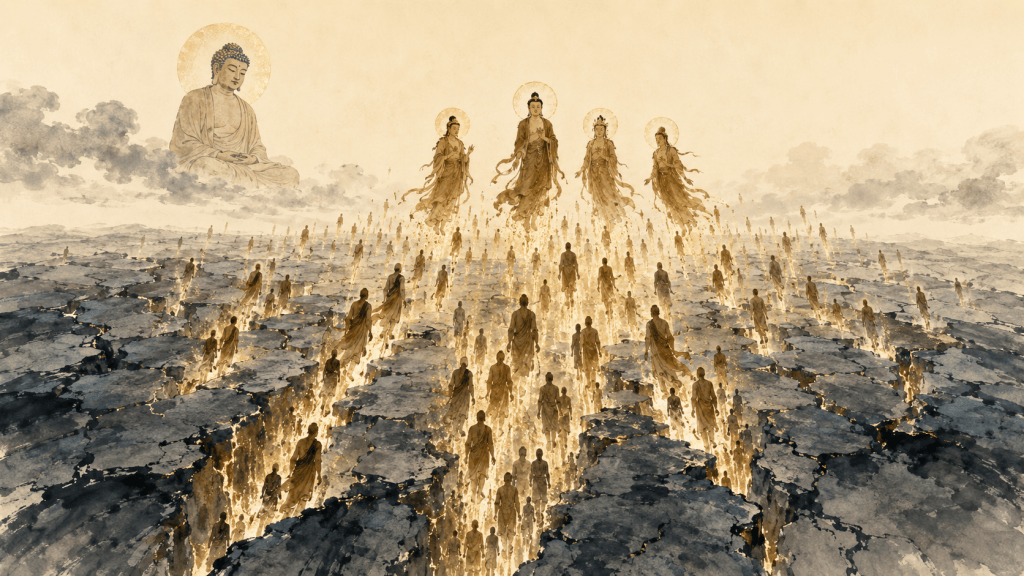
And then the ground quakes. And it splits open.
What rises is not an army in any ordinary sense
From beneath the ordinary visible world, immeasurably-many great bodhisattvas well up. The traditional commentaries on this scene emphasize the granularity of what emerges, because the granularity is the doctrinal point.
Some come with sixty thousand followers. Some with ten. Some with five hundred. Some with three. Some with one. And some — and this is the line the tradition has never stopped returning to — some come alone, with no followers, preferring solitary practice.
The lone reader in the upper room is in the list. The parent reciting a phrase to a child is in the list. The monk chanting in a hall, the scholar preparing a translation, the lay practitioner sharing a passage in a difficult conversation — all of them are in the list. The Buddha’s original sangha is not an army in the military sense. It is an enumeration that refuses to leave anyone out, including the people who are doing the practice alone.
The sutra calls them the Bodhisattvas of the Earth. They are the Buddha’s own students — students he has been teaching across innumerable lifetimes, students whose existence predates not only the historical Buddha’s biographical lifetime but, in the most precise doctrinal sense, any historical reckoning we can manage. They are the empirical evidence for the doctrine Chapter 16 will articulate: the Buddha’s actual teaching activity has been continuous and immeasurable. The protection of the sutra was not waiting for future protectors. It was already staffed by an existing sangha that simply becomes visible at this moment in the sutra.
The recruitment happened in the remote past
The traditional image of becoming a Buddhist is that you are recruited. You hear the teaching, you take refuge, you enter the path, you begin the climb. The Bodhisattvas of the Earth invert that image entirely.
According to the sutra, the recruitment happened in the remote past. The assembly was already there. The ground was already cracked. The light was already rising. You are not “joining” the assembly. You are recognizing that you have always been among them, because “always” and “now” are the same depth.
This is the structural claim that has made the Lotus Sutra the engine of every modern Lotus social movement. Once you accept that the practitioner is already enlisted — that the only thing missing is the recognition of the uniform — the entire relationship between Buddhism and political action changes.
The modern workforce
The pattern is consistent enough across eight centuries to be doctrinal rather than coincidental.
In 1279, twenty peasant followers of Nichiren in the Atsuhara region were arrested by the Kamakura shogunate. Three of the lay believers were beheaded; the remaining seventeen refused to recant. Nichiren, writing from exile, recognized the moment as the fulfillment of the sutra’s prophecy that votaries of the Lotus in the latter age would meet hostility. The Atsuhara martyrs were not victims of political repression. They were enacting the sutra’s promise of protection through persecution. The protection apparatus was not waiting to be activated. It was already staffed by practitioners who recognized the moment for what it was.
Six and a half centuries later, in 1943, the Sōka Gakkai’s founder Tsunesaburō Makiguchi and his disciple Jōsei Toda were arrested under Japan’s Peace Preservation Law for refusing to enshrine the state Shinto talisman. Makiguchi died in prison in 1944 at the age of 73. Toda emerged in 1945 and rebuilt the organization. The Atsuhara peasants of 1279 and the wartime Makiguchi of 1943 stand, in the Nichiren-Lotus tradition, in a single line: bodies “opened” to the Law in the very moment the state believed it had silenced them.
In the same period, the Buddhist socialist Seno’o Girō articulated the same insight in political register: the sutra’s promise of protection does not exempt the practitioner from history. The Father’s absence means we must build justice. No savior is coming. We are the Bodhisattvas of the Earth.
And in 1956, in a different country and a different tradition, B.R. Ambedkar’s Navayāna (“New Vehicle”) mass conversion of nearly half a million Dalits drew on the universalism the Lotus Sutra had been articulating for two millennia — a parallel liberation grammar, even where the textual inheritance was not strictly Nichiren or Tiantai. The Lotus‘s insistence that no being is outside the field of awakening found a modern political expression that the sutra itself had been pointing toward all along.
The pattern is not “Lotus practitioners do political things.” The pattern is: once you understand that the assembly is already staffed, the question of whether to act politically stops being a question. The action is the recognition. The recognition is the action.
What holds the four cases together is not a shared political program. It is a shared epistemology. Each of these movements began from the same observation: the absence of an external rescuer is not the absence of a workforce. The workforce is already present. It has been present since the ground cracked in Chapter 15. It is present now. The work of liberation is not to summon it from somewhere else. It is to recognize it in the people standing next to you — including, after a while, yourself.
The structural peer of the ancient
There is a closing image the fifth volume of this series uses, drawn from the Lotus‘s own logic, and I want to give it to you directly.
When we recognize that the recruitment happened in the remote past, we are no longer “orphaned and exposed” — waiting for a savior who will eventually arrive. We are the structural peers of the Bodhisattvas of the Earth. We are the messenger the father sends back to the house to tell the world that the physician is still alive. We are the Buddha’s responsive presence in the world’s pain.
Our life becomes the medicine the sutra describes.
The army that rose out of the ground did not rise to conquer. It rose to staff the protection apparatus that was already there. The protection of the sutra was never going to be accomplished by a special class of advanced practitioners descending from somewhere else. It was going to be accomplished by the practitioner reading this post right now, recognizing that the ground is already cracked, the light is already rising, and the uniform has been waiting for you to put it on.
You have always been among them.
The assembly has never dispersed.
And the series — the nine posts that have walked from “What does enlightened mean?” through the protection apparatus of the sutra, through the seven parables, through the Buddha who did not die, to this Chapter 15 ground that has been cracking open beneath us all along — closes here. The work that comes next is not a new argument. It is a return. The posts that follow in this blog are evergreen comparison and reference pieces, drawn from the same manuscript. They are for the reader who is ready to go back to the front door and look again at the architecture, knowing what they now know about the back of the building.
The fifth volume of this series reads Chapter 15 of the Lotus Sutra as the doctrinal foundation for every modern Lotus social movement — from the medieval Kamakura martyrs through Makiguchi and Toda through Seno’o Girō and Ambedkar. The Bodhisattvas of the Earth (Vol V of The Lotus Sutra for the Modern Reader*) is the volume of the series that asks what it means to recognize, in the twenty-first century, that you have always been enlisted.
Related Reading
If you want to go deeper, see:
The Awakened State: What Buddhist Enlightenment Actually Means
Petals of Wisdom: A Companion to the Lotus Sutra
The Long Night’s Guide: Dream Signs and Spiritual Progress in Buddhist Practice
Written by William Altig, also the translator of the Fahua Xuanyi and Mohe Zhiguan English editions.
Written by William Altig, also the translator of the Fahua Xuanyi and Mohe Zhiguan English editions.
Next in the series: an evergreen — Lotus Sutra vs. Nirvāṇa Sutra: What’s the Difference? — a comparison search pillar post adapted from The Awakened State.


Leave a comment