
You do not need to read Classical Chinese to use the bilingual Scholarly Edition. The English can carry you forward. The Chinese gives you a place to check the source, notice structure, and slow down when a term matters.
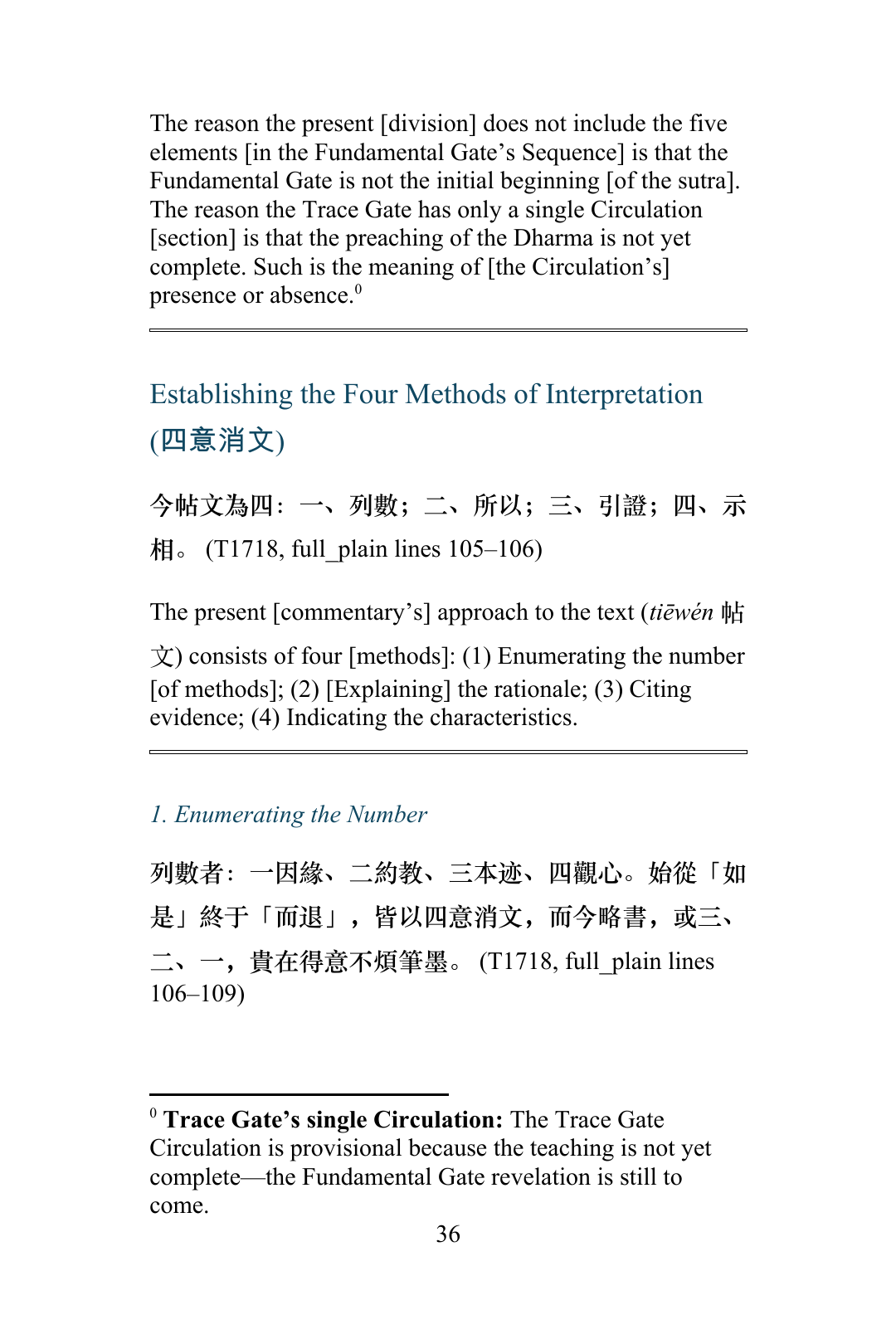
Look at this actual page from Fahua Wenju: The Words and Phrases of the Lotus Sūtra, Scholarly Edition, Volume One.
Start with the English
Read the heading first: “Establishing the Four Methods of Interpretation.” Then read the English explanation. It tells you what the passage is doing before you examine any Chinese characters.
The four methods are different ways to approach a passage:
- Causes and conditions. Ask why this teaching arose for these listeners. What capacities and circumstances called for it?
- According to the teachings. Ask how the passage is classified within the Buddha’s teaching. What kind of instruction is being given?
- Fundamental and trace. Ask what belongs to eternal reality and what belongs to historical manifestation.
- Contemplating the mind. Ask where the teaching becomes your own practice. What does it show about your mind now?
You can follow that entire sequence in English. Nothing requires you to decode the page character by character.
Then let the Chinese show the structure
Now look at the Chinese list: 一因緣、二約教、三本迹、四觀心.
Even if you cannot translate it, you can see the pattern. The numbers mark four approaches, just as the English list does. The passage is not a wall of text. It is an ordered map.
This is one practical use of the bilingual layout. English gives you the meaning. Chinese lets you see the form of the argument and identify the terms being discussed.
Use the Chinese as an anchor, not a test
When a familiar term appears, pause and compare it with the English. You might notice 因緣 beside “Causes and Conditions” or 觀心 beside “Contemplating the Mind.” You are building recognition gradually, not taking an examination.
If you do read Classical Chinese, the facing text gives you a direct way to examine the source. If you do not, you can still see where the English comes from and where a translator’s choices need attention.
The layout itself does not prove that a translation is accurate. It simply makes comparison possible.
A useful way to read the next page
Try this sequence:
- Read the English once for meaning.
- Look at the Chinese for numbering, repeated terms, and structure.
- Compare one term, not fifty.
- Return to the English and continue.
The goal is not to make reading slower everywhere. It is to give you a choice about when to look more closely.
That is how the Chinese and English work together in this volume. The English opens a path through a difficult commentary. The Chinese keeps the source within reach.
Get the bilingual book: Fahua Wenju: Scholarly Edition, Volume One, Fascicles 1–3, paperback.
#FahuaWenju #Tiantai #LotusSutra #BuddhistBooks #BilingualReading


Leave a Reply