The Dhammapada is one of Buddhism’s most beloved, accessible, and widely-translated texts. For over two millennia, its 423 verses, neatly organized into twenty-six chapters, have offered profound wisdom in a simple and memorable format. Practitioners and scholars alike have revered this structure as a definitive presentation of the Buddha’s core teachings.
But what if the structure we’ve known for centuries is incomplete? What if a textual detective story suggests two entire chapters have been hiding in plain sight? This article explores four surprising clues from recent scholarly research that suggest the Dhammapada originally had twenty-eight chapters, challenging our understanding of this foundational scripture.
1. A Glaring Anomaly: The Curious Case of the Overstuffed Final Chapter
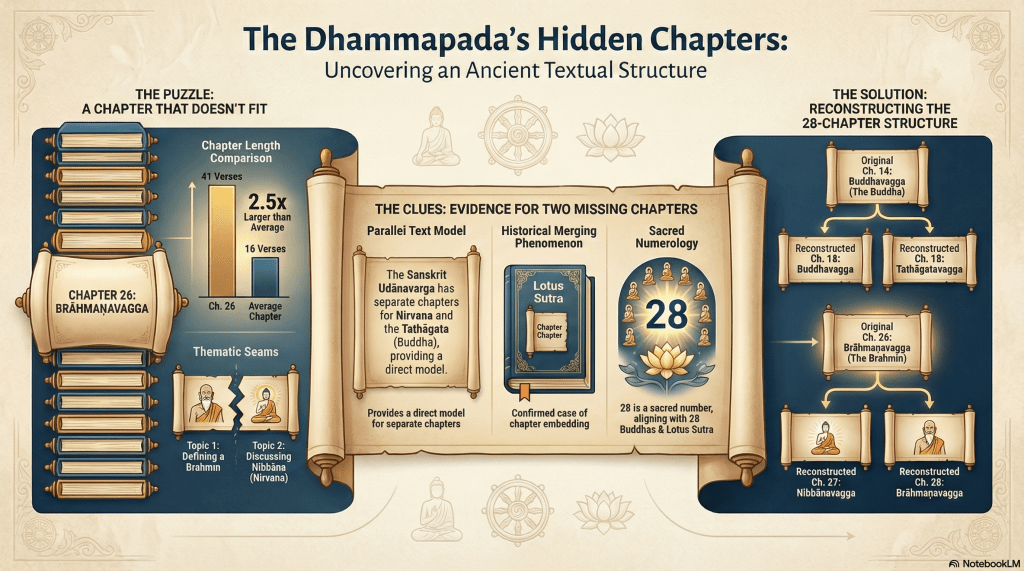
The first clue that something is amiss is a statistical “red flag.” The average chapter length in the Dhammapada is about sixteen verses, a number likely chosen to be manageable for memorization during centuries of oral transmission.
However, Chapter 26, the Brāhmaṇavagga (‘Chapter on the Brahmin’), contains a staggering forty-one verses. This makes it 2.5 times longer than the average chapter. Statistically, this is a massive outlier. The deviation is a staggering 3.63 standard deviations from the mean—an event that would happen by chance less than 0.03% of the time. This isn’t just a slightly longer chapter; it’s a structural anomaly so significant that it demands explanation. For a textual detective, this is the first thread to pull. A similar, though less extreme, structural question hangs over Chapter 14, the Buddhavagga (‘Chapter on the Buddha’), which thematic analysis shows contains two distinct sections: one describing who the Buddha is, and another describing what he taught.
2. A Missing Centerpiece: Where is the Chapter on Nibbāna?
The second clue presents a profound paradox. Nibbāna (Sanskrit: Nirvana) is the ultimate goal of the Buddhist path—the complete cessation of suffering and the final liberation. It is the central aim of the entire teaching. Yet, the Pali Dhammapada has no dedicated chapter on this most crucial of concepts.
This absence becomes conspicuous when we look at a parallel Sanskrit version of the text called the Udānavarga. This version, from a different early Buddhist school, contains dedicated chapters on both Nirvana (Nirvāṇavarga) and on the teachings of the Buddha (Tathāgatavarga)—precisely the two topics that seem to be either missing or merged within the Pali text. Verses about Nirvana that appear in this dedicated chapter have clear parallels in the Pali Dhammapada, but in the Pali version, they are scattered across other chapters, such as those on “Happiness” (Sukhavagga) and “The Monk” (Bhikkhuvagga).
The Udānavarga includes verses like the following, which explicitly link the Buddha’s teaching to Nirvana:
kṣāntiḥ paramaṁ tapas titīkṣā nirvāṇaṁ paramaṁ vadanti buddhāḥ ‘Patience and endurance are the highest austerity; the Buddhas call Nirvana the highest.’
The existence of these dedicated chapters in a parallel textual tradition is powerful evidence. It strongly suggests that the material for such chapters existed within the shared pool of early Buddhist teachings but was merged or dispersed during the transmission of the Pali text we know today.
3. A Historical Precedent: It’s Happened Before in Other Scriptures
The idea that entire chapters could be merged or hidden within others is not just a modern theory; it is a documented phenomenon in Buddhist textual history. Skepticism about such a major revision to the Dhammapada’s structure is tempered by a key precedent from another famous scripture: the Lotus Sutra.
Scholars have firmly established that Chapter 12 of the Lotus Sutra, known as the Devadatta Chapter, was originally embedded within Chapter 11 in early Sanskrit versions of the text. It was only separated into its own distinct chapter during the 4th-century translation into Chinese by the great master Kumārajīva.
An even more direct precedent exists within the Dhammapada family of texts itself. The Patna Dharmapada, another ancient version of the scripture, contains only twenty-two chapters. This proves that chapter merging was not just a theoretical possibility but a documented reality in at least one line of the text’s transmission. These historical examples demonstrate that chapter divisions in major Buddhist texts were fluid, making the hypothesis that the Dhammapada’s chapters were similarly rearranged not only possible, but entirely plausible.
4. The Sacred Math: Why the Number 28 Matters
The final clue lies in the world of sacred numerology. Ancient Buddhist compilers did not structure texts randomly. This was not arbitrary. Early Buddhist teaching is built around sacred numbers that serve as mnemonic and symbolic frameworks, such as the Three Jewels, the Four Noble Truths, and the Noble Eightfold Path. They often used numbers with deep symbolic meaning to organize and imbue their scriptures with greater significance. The number twenty-eight, it turns out, was particularly important.
Evidence for the significance of twenty-eight is found across Buddhist traditions:
- The Lotus Sutra: This major Mahāyāna text has a twenty-eight-chapter structure, showing that the number held pan-Buddhist importance.
- The Lunar Cycle: The Buddhist observance calendar (uposatha) was governed by the lunar month, which consists of approximately twenty-eight days.
- The 28 Buddhas: The Theravāda tradition itself, which preserves the Pali Dhammapada, recognizes a lineage of twenty-eight Buddhas from the past.
- A “Perfect Number”: Ancient mathematicians considered twenty-eight a “perfect number” (a number equal to the sum of its divisors), which gave it cosmological and symbolic weight.
Most remarkably, this reconstruction creates its own numerological harmony. The new Nibbāna chapter becomes Chapter 27 (2+7=9), a number signifying completion in Buddhist thought. The final chapter on the Brahmin becomes Chapter 28 (2+8=10; 1+0=1), signifying unity and a return to the source. This alignment suggests the proposed structure is not just possible, but profoundly intentional.
A Deeper Appreciation
These four converging lines of evidence—a glaring statistical anomaly, missing chapters found in a parallel text, a historical precedent for merged chapters, and the power of sacred numerology—paint a compelling picture. They strongly suggest that the twenty-six-chapter Dhammapada we know today is likely a compression of an earlier, twenty-eight-chapter version. These converging lines of evidence suggest that two chapters—a Nibbānavagga (Chapter on Nibbāna) and a Tathāgatavarga (Chapter on the Buddha’s Teachings)—were merged into the chapters on the Brahmin and the Buddha that we know today.
This textual detective work reminds us that even the most ancient and revered texts have complex human histories. What other secrets might be waiting to be discovered, hiding in plain sight?
William Altig is an independent scholar and translator working on the Lotus Sutra, Dhammapada, and Vimalakirti Sutra. His translations combine scholarly rigor with Blues vernacular interpretation.


Leave a Reply