You have probably heard, more than once, that you already have Buddha-nature. That you are “already a Buddha, you just don’t know it yet.” It is one of the most repeated lines in all of Mahāyāna Buddhism, and one of the foggiest. Almost no one says what it actually means. It drifts past in a haze of incense and good feeling, you nod, and you have no real idea what you just agreed to.
Let me try to say it plainly, with the jargon stripped off.
First, what it is not
A lot of the fog comes from things Buddha-nature gets confused with. So:
- It is not a soul. (That was my last post: the Nirvāṇa Sūtra’s “True Self” is not a little permanent you riding around inside. Buddha-nature is not a spirit-substance tucked behind your ribs.)
- It is not a divine spark you were issued at birth, a pilot light glowing in a corner of you, separate from the rest.
- It is not positive thinking, or the reassurance that you are “perfect just as you are” and never need to change.
- And it is not a guarantee. It does not mean you are finished and may now put your feet up.
What it actually is
Strip all of that away and what remains is almost embarrassingly simple. Buddha-nature is the capacity for awakening, built into what you are. Not bolted on from outside. Not handed over at the end as a prize. It is structural, part of the basic equipment of being a mind at all.
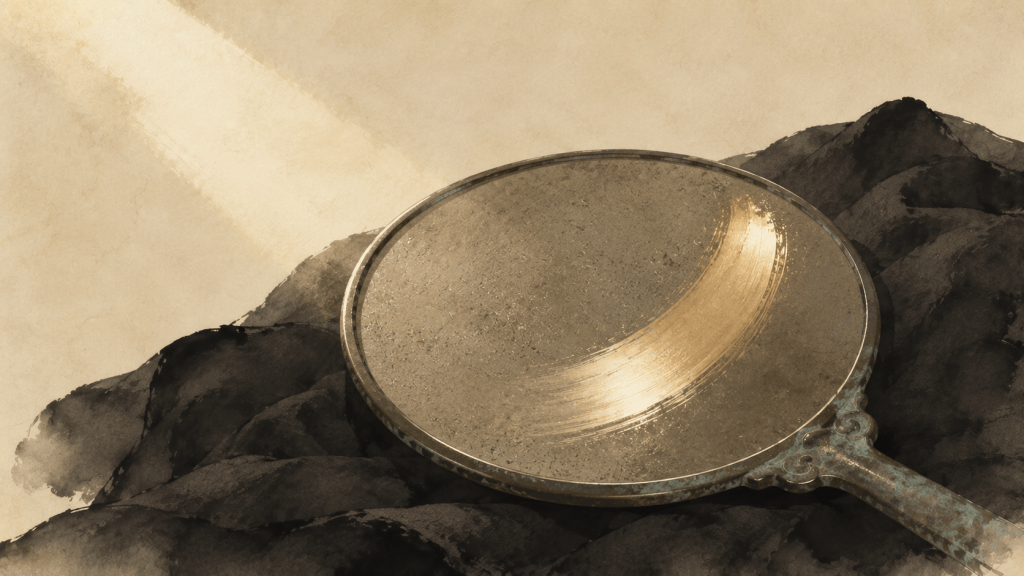
The oldest image for it is a mirror under dust. The mirror is already clean; the dust is not the mirror. Wipe the dust and it reflects, because it was never actually stained. Or take the sun behind clouds: the sun does not have to be built, the clouds only have to thin. In this picture, enlightenment is not a construction project. It is an uncovering. You are not manufacturing something you lack. You are removing what stands in front of something already there.
It is older than you think
You might assume this is a late, mystical Mahāyāna flourish bolted onto a more austere original Buddhism. It is not, or not entirely. Go back to the earliest discourses, the Pāli suttas, and the Buddha already describes the mind as pabhassara, “luminous,” and says it is clouded by “adventitious defilements.” That word adventitious is doing quiet, enormous work. It means the defilements arrive from outside. They are not the mind itself. They are weather, not sky.
So when the Nirvāṇa Sūtra announces “Buddha-nature” centuries later, it is not conjuring something from nothing. It is taking that luminous mind, the one the earliest texts already pointed at, and saying: yes, and that luminosity is the Buddha, present and waiting to be seen.
The line that should stop you
Here is where it turns from interesting to genuinely radical. The Nirvāṇa Sūtra says every being has this, without exception, and then it presses on the single hardest case to prove it means exactly that.
Buddhist cosmology has a figure called the icchantika: the being who has, supposedly, severed all his own good roots. Hostile to the teaching. Spiritually a burned seed, the one case everyone assumed was hopeless. And the Nirvāṇa Sūtra, in its most startling move, insists that even the icchantika has Buddha-nature. Even the burned seed. Even he will, in the end, awaken.
Sit with that, because it is easy to read straight past. The most degraded, most hostile, most apparently lost being you can picture is not written off. And not because the sūtra is feeling generous. The book I wrote is careful on this point, and so am I: this is not optimism, it is ontology, a claim about how reality is put together. No being lacks the capacity for awakening, the way no number lacks the capacity to be doubled. It is not a reward for good behavior. It is the floor under everything.
The catch
Now the honest part, because this is exactly where the teaching gets abused.
Buddha-nature being universal does not make awakening automatic. The capacity is guaranteed; the outcome is not. The mirror is already clean under there, but the dust does not wipe itself, and the clouds do not part on their own. That clearing is the entire reason there is a path at all. “You are already a Buddha” is not a permission slip to do nothing. It is a description of what makes the doing possible in the first place.
This is the line between Buddha-nature and spiritual bypass. Bypass says: you are already perfect, so nothing needs to change, relax. The real teaching says something harder and better: what you most truly are is unobscured and free, and there is dust on the glass, and the work of a lifetime is the patient wiping.
So what does it mean for a Tuesday?
It means the goal is not to become someone other than who you are. You are not under construction, racing to install a better self before some deadline. At the root, you already are the thing you keep reaching toward. The practice is not addition, it is subtraction: clearing the greed, the reactivity, the old grievances, the dust, until what was always there can finally show.
That is Buddha-nature, without the incense. The least dramatic and most hopeful claim in all of Buddhism: that the awakening you are looking for is not a place you have to reach. It is what you already are, under the weather of a hard and ordinary life.
Buddha-nature, and what the Nirvāṇa Sūtra and the Lotus Sutra make of it, is one of the spines of my book The Awakened State: What Buddhist Enlightenment Actually Means, which traces this single claim through the early luminous-mind teachings, the Zen warnings, and the Tiantai Middle Way. If “subtraction, not addition” is a sentence you want unpacked slowly, that is the book.
Related Reading
If you want to go deeper, see:
The Awakened State: What Buddhist Enlightenment Actually Means
Petals of Wisdom: A Companion to the Lotus Sutra
The Long Night’s Guide: Dream Signs and Spiritual Progress in Buddhist Practice
Written by William Altig, also the translator of the Fahua Xuanyi and Mohe Zhiguan English editions.
Next in the series: what “practice” actually means once you stop trying to become someone you are not.


Leave a comment