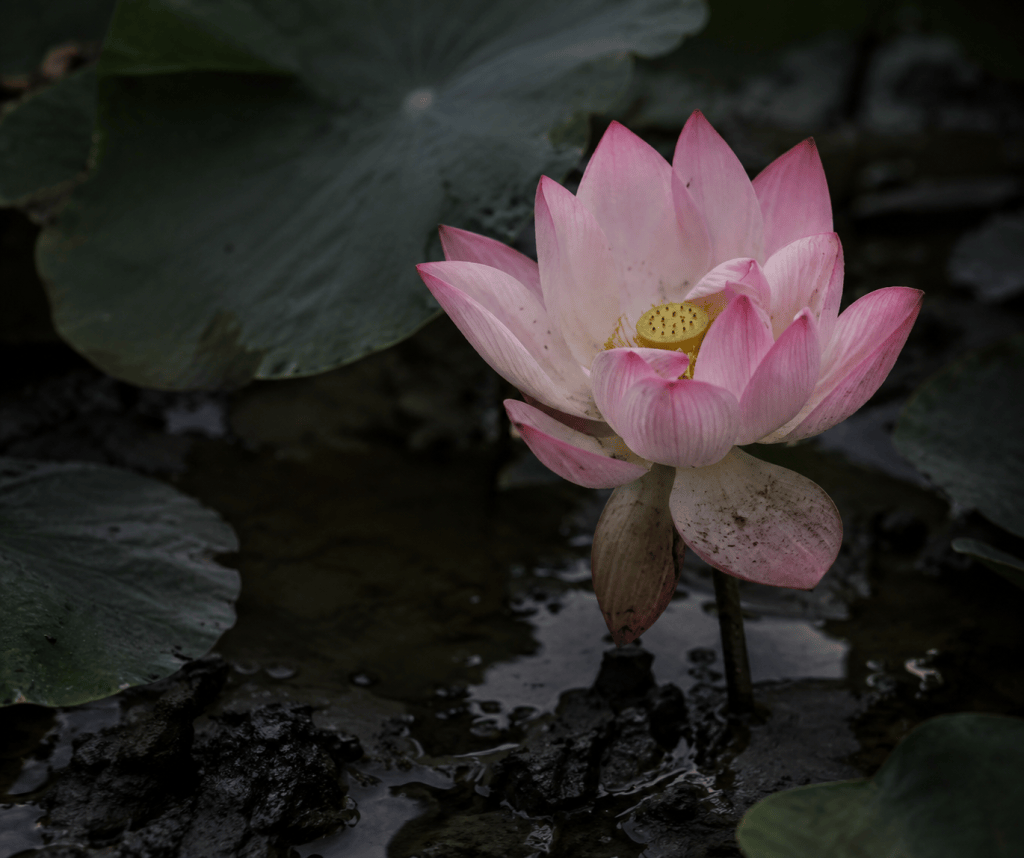
The Lotus Sutra promises protection to those who receive and keep it. Protection by bodhisattvas. The guard of the four heavenly kings. Rescue from fire, from flood, from demons and drawn swords, catalogued in the twenty-fifth chapter with a confidence that will either thrill you or embarrass you, depending on your relationship with the supernatural.
To a modern ear, it sounds like superstition. I want to argue it is closer to botany.
What the words actually say
Start with the promise language itself. The Sanskrit terms are rakṣaṇa and anurakṣaṇa; Kumārajīva’s Chinese renders the family with 護 (hu, Sino-Japanese go). None of these words means a force field. They carry the active sense of guarding, sustaining, and holding a practitioner within the field of the Dharma. Not a wall around a person. A reorganization of the ground they stand on.
That is a small grammatical shift, and it changes the entire book you think you are reading.
Owning the coinage
Here I have to be honest with you, because the book is honest.
When the classical commentators spoke of the lotus blooming in muddy water, they were not offering a psychology of resilience. In Zhiyi’s tradition, the image is primarily about the Buddha’s purity in the midst of defilement, and about the One Vehicle rising above the three earlier vehicles. It is doctrine, not self-help.
“Protection-as-Bloom,” the framework at the center of this volume, is my own coinage. It extends the classical metaphor into the psychological and political registers where modern readers actually live. I offer it as a reading consistent with the tradition’s deepest currents, not as a paraphrase of any one commentator. If you open the book expecting the masters to have said it for me, you will find I tell you, chapter by chapter, exactly where they stop and where I begin.
The mud is the point
The lotus is the sutra’s central metaphor because of where it grows: stagnant, muddy water. Its beauty is not achieved despite the mud. It is achieved because of it. The mud provides the nutrients, the pressure, and the context for the bloom.
Now translate that into a modern life. You know your own mud; I do not need to name it for you. The commute that eats the morning. The conflict with a colleague that replays at 2 a.m. The bill, the diagnosis, the relationship that will not resolve. Most spiritual paths quietly ask you to clean all that up before you can begin. The Lotus Sutra says the opposite: this mess is not the obstacle to your awakening. It is the raw material of it. Desire, pressure, and friction are not fires to be extinguished. They are fuel.
Protection, in this sense, is not immunity. The practitioner does not stop getting sick, does not stop losing people, does not stop being afraid. What changes is the ground: a durable inner resilience, the capacity to remain centered and to act, regardless of the weather. The bloom is the protection. The protection is the bloom.
The cast
The book makes this argument through lives, not abstractions.
First, the scriptural students: the perfect Arhats of the opening chapters, whom the sutra performs a kind of literary surgery on, turning finished saints back into seekers. Then the two impossible cases: Devadatta, the villain of the tradition, and the eight-year-old Nāga Princess, who achieves awakening in a single scene while the assembly’s old guard objects. No history too dark, no body too “impure.” That is the sutra talking, not me.
Then the exegetes: Zhiyi, who built the Threefold Truth and the three thousand realms in a single thought-moment; Saichō and Nichiren, who carried the teaching into new countries and new centuries. Then the moderns: Senoʼo Girō, who in 1931 founded the Youth League for Revitalizing Buddhism in the teeth of Imperial-Way Japan, and who wrote, “There is no use in preaching the Dharma to a hungry man. We must first change the system that keeps him hungry.” And B.R. Ambedkar, whose Navayāna conversion of 1956 the book treats with care: a parallel stream, not a Lotus one, and the book says so plainly. The point is not that all roads run through the Lotus. It is that the sutra’s mandate to relieve suffering keeps converging with everyone else’s.
Why this is Volume Two
Volume One, The Ongoing Assembly, answered the first question every new reader brings to this sutra: who is it for, and am I allowed in? This volume asks the second question: what does holding the sutra actually do to a life?
The answer, in one sentence: it does not get you out of the mud. It teaches you to bloom in it, and it has been teaching that, in an unbroken assembly, for two thousand years.
All three editions — hardcover, paperback, and Kindle — are available now. And starting this week I am running a thirty-day daily serial, Bite-Sized Modern Benefits of the Lotus Sutra*: one short post a day, thirty days, each one a single idea from the book you can use the same morning. Follow along here or on X and Threads, hashtag #ProtectionAsBloom.*
Hardcover: https://www.amazon.com/dp/B0HDZZC7V1 ·
Paperback: https://www.amazon.com/dp/B0HDKFYDBQ ·
Kindle: https://www.amazon.com/dp/B0HCX2KC8L
 Buddhist Wisdom for the Long Night
Leave a comment