I want to tell you about something I saw. I’m still not entirely sure what to do with it, which is part of why I’m telling you.
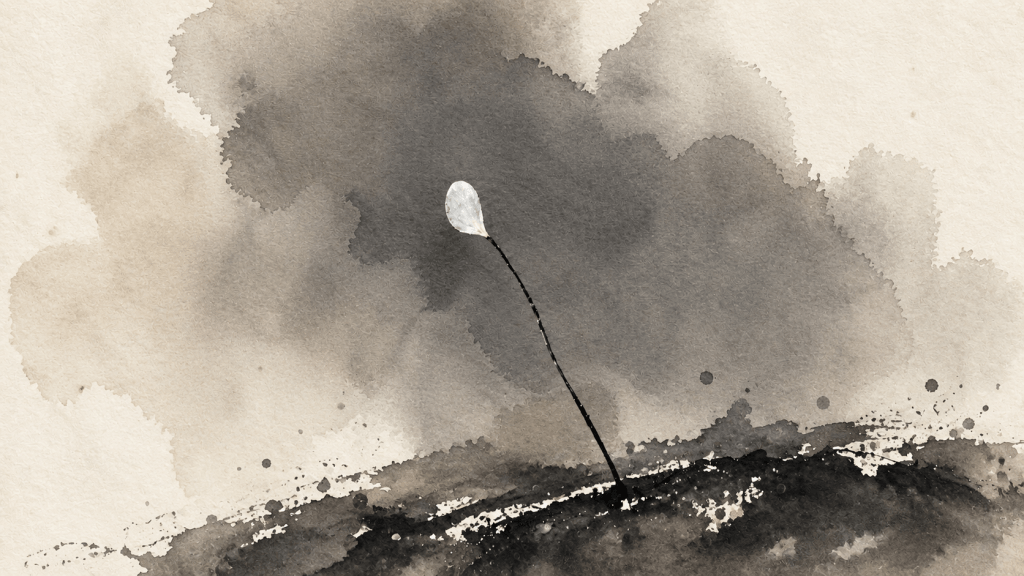
It was a flower. A single white petal, smaller than a fire ant, on a stem like a black thread—a little thicker than the silk a spider lets down, but only a little. So small I almost didn’t trust my own eyes. I saw it once. Then, maybe a year later, I saw another. Two of them. Each time, quiet as a breath, something in me said: those are sacred. They bloom once every few thousand years.
I didn’t go looking for a meaning. The meaning arrived first, in a whisper, and the questions came after.
The flower has a name
I’ve spent decades inside the Lotus Sūtra, and it turns out the thing I saw sits near its very heart. It’s the udumbara (優曇華, Sanskrit uḍumbara). The tradition says it blooms once in three thousand years—and only when a Buddha, or a great wheel-turning king, appears in the world. Its blooming is the rarity of awakening showing up on earth.
It isn’t a stray bit of folklore off to the side. In the second chapter of the Lotus Sūtra—the Expedient Means chapter—the Buddha tells the assembly that the Buddhas appear in the world only rarely, and are hard to meet; that even when they appear, to preach this teaching is rarer still—”like the udumbara flower, which all delight in, rare among gods and humans, appearing only once in a great while.”
Read that again with my little white flower in mind. The rarity of the bloom is doing real work in the text. It is the measure of how unlikely, how precious, how nearly-impossible it is to be standing in the right place at the right moment to meet the truth. The flower is the odds.
The sūtra opens in a fall of flowers
And the Lotus doesn’t mention flowers only once. It opens in them.
In Chapter 1, before a single word of the main teaching is spoken, the Buddha settles into deep meditation, and “the heavens rained down” (天雨) four kinds of celestial blossoms—mandārava and great mandārava, mañjūṣaka and great mañjūṣaka—”and scattered them upon the Buddha and all the great assembly.” The whole sūtra begins inside a quiet storm of falling flowers.
It happens again in Chapter 3, when the disciple Śāriputra is told he will one day become a Buddha, and the assembly rains down a multitude of heavenly flowers in joy. And again far later, in the Medicine King chapter (Chapter 23), where the flowers and a fine dark fragrant powder come down together, “filling the whole sky, descending like clouds.”
Like clouds—that’s the sūtra’s own image. I’ll be honest with you: in my memory the petals fell like snow. That picture is mine, not the scripture’s. But I don’t think the text would begrudge me it. Snow is simply how falling whiteness lives in my eye—maybe the same eye that bent down, twice, to something the size of a thought.
Now the harder truth
I owe you the part that’s less comfortable, because this is a tradition that prizes seeing things as they are over feeling good about them.
If you search for “udumbara flower” today, you’ll find photographs of exactly what I saw: tiny white blooms on hair-fine stalks, appearing on glass, on metal, on the leaves of houseplants, hailed as the three-thousand-year flower. And the botanists and entomologists have a quieter answer. Most of those, they say, are the eggs of the green lacewing—each one laid at the tip of a thread of hardened silk, white, finer than a hair, smaller than an ant.
My flower fits that description almost exactly.
So I could end the story there, a little embarrassed, and call the whisper a trick of a hopeful mind. Plenty of people would. But I think that ending is as shallow as the gullible one. It just fails in the opposite direction.
What the Lotus actually teaches about this
Here is the thing no debunking can touch, and it’s the reason I gave my life to this particular sūtra.
The entire teaching of the Lotus is that the sacred does not live somewhere rarer and finer than here. It is not waiting in another realm for the once-in-an-age conditions to line up. It is the lotus blooming out of the mud—not despite the mud, but rising straight through it. It is, as the Tiantai masters insisted, Buddha-nature in grass and tree and stone (草木成仏): even the things we call insentient are not outside the awakening. It is the eternal hidden inside the most ordinary morning.
Which means the question “was it a miracle bloom or a lacewing’s egg?” is the wrong question. It assumes those are two different orders of thing—the holy and the merely natural—and the Lotus spent twenty-eight chapters dismantling exactly that wall.
A lacewing is a small green creature that, before she dies, lifts each of her eggs up on a thread so the first hatchling can’t eat the others. She builds a tiny white scaffold of care for children she will never meet. If you want to tell me that’s not sacred—that it’s “just” biology—then I think you and I are reading a different universe.
I bent toward something almost too small to exist, twice, and I met it as holy. A whisper named it sacred and I trusted the whisper. In the view of the Lotus Sūtra, that trusting is not the mistake.
That seeing is the practice.
The udumbara doesn’t bloom once every three thousand years because the flower is rare. It blooms that rarely because the seeing is—the willingness to stop, and lower yourself to the level of a thread, and call a small white thing by its true name. That happens about as often as a Buddha walks the earth. Which is to say: it could happen to you this afternoon, if you’re paying the right kind of attention.
I’ve seen it twice now. I’m trying to learn how to see it always.
If this way of reading the world—where the rarest and the most ordinary turn out to be the same thing—speaks to you, it’s the spine of my book The Awakened State: What Buddhist Enlightenment Actually Means, which traces the Lotus and Nirvāṇa Sūtras through what awakening actually is and where it actually lives. [Read it here →]
Related Reading
If you want to go deeper, see:
The Awakened State: What Buddhist Enlightenment Actually Means
Petals of Wisdom: A Companion to the Lotus Sutra
The Long Night’s Guide: Dream Signs and Spiritual Progress in Buddhist Practice
Written by William Altig, also the translator of the Fahua Xuanyi and Mohe Zhiguan English editions.
Next in the series: the Buddha tells his followers he lied about his own death—and why that lie is the most consoling thing in the whole sūtra.


Leave a Reply